
Are Cuffless Blood Pressure Monitors Actually Accurate?
Short answer: Cuffless blood pressure devices, the smartwatches, rings, and optical wristbands that estimate blood pressure without an inflating cuff, have outpaced the science needed to validate them, according to a December 2026 American Heart Association scientific statement. Up to 80% of blood pressure devices sold globally have never undergone standardized accuracy testing. Most use photoplethysmography (PPG), an optical pulse sensor, calibrated against a reference cuff, and accuracy tends to drift over time between calibrations. One device, the Hilo Band, became the first cuffless monitor to earn FDA clearance for over-the-counter use in July 2026, while Samsung’s Galaxy Watch BP feature reached the US in 2026 with no FDA clearance at all. The AHA still advises against using any cuffless device alone for diagnosing or managing hypertension.
At a Glance
- The AHA’s December 2026 scientific statement found most cuffless BP devices lack standardized validation testing
- Cuffless devices use PPG optical sensors at the wrist or finger, not an inflating cuff, and require periodic calibration against a reference cuff
- The Hilo Band (Aktiia) became the first FDA-cleared OTC cuffless BP monitor in July 2026, with US availability expected in 2026
- Samsung’s Galaxy Watch BP feature launched in the US in 2026 as a “wellness feature” specifically exempt from FDA clearance, not a cleared medical device
- Accuracy can vary with arm or wrist position, skin tone, and time since last calibration
- The AHA recommends against using cuffless readings alone to diagnose hypertension or adjust medication
Who This Guide Is For
This article is for anyone using or considering a wearable blood pressure device, including people tracking blood pressure trends around sauna sessions with a smartwatch, ring, or band, and who wants to understand what “accurate” actually means for this category before trusting the numbers. It applies equally to traditional and infrared sauna users monitoring their own cardiovascular response to heat exposure. This is not medical advice, consult your healthcare provider for hypertension diagnosis or treatment decisions.
What Are Cuffless Blood Pressure Monitors, and How Do They Work?
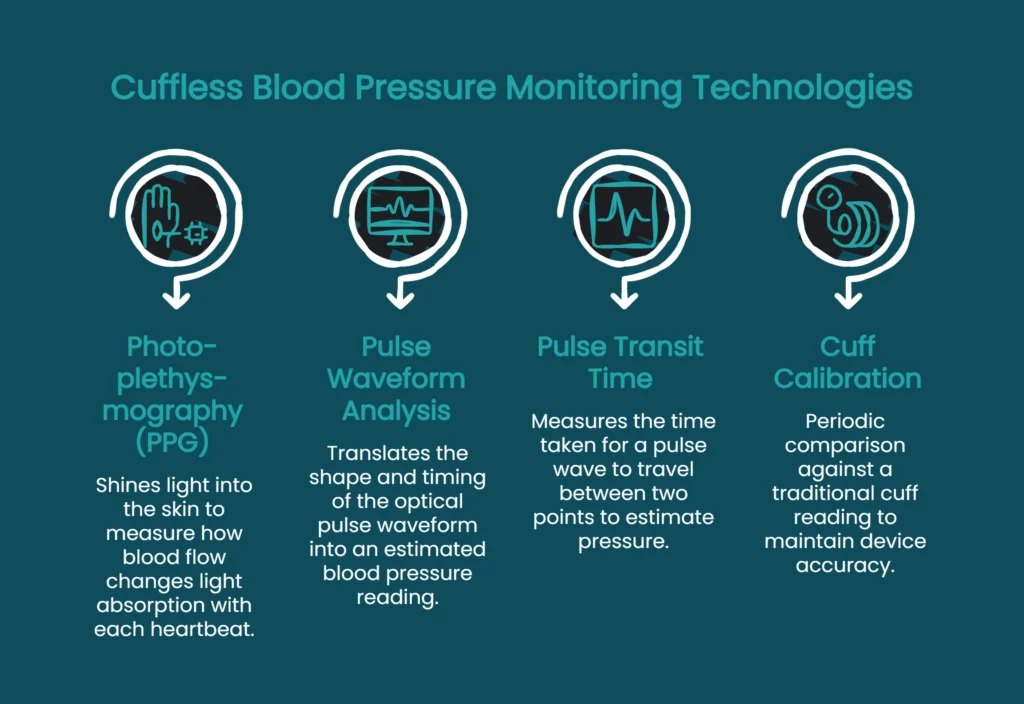
Cuffless blood pressure devices estimate blood pressure without inflating a cuff around the arm. Most use photoplethysmography (PPG), the same optical pulse-sensing technology found in fitness trackers, shining light into the skin and measuring how blood flow changes the light absorbed with each heartbeat. An algorithm translates the shape of that pulse waveform into an estimated blood pressure reading.
Because PPG measures a waveform rather than pressure directly, these devices need periodic calibration against a traditional cuff reading to stay accurate. The Hilo Band, for example, requires calibration using a cuff and is explicitly marketed as not intended to make diagnoses on its own. [1]
How Does a PPG Sensor Actually Estimate Blood Pressure?
The underlying idea is that the shape and timing of the optical pulse waveform correlate with arterial pressure and vascular tone, the same physiology that drives the pulse wave analysis techniques discussed in our central blood pressure explainer linked below. Some devices also use pulse transit time, measuring how long it takes the pulse wave to travel between two points, since faster transit is generally associated with higher pressure and stiffer arteries.
Neither approach measures pressure directly the way a cuff does, by physically compressing the artery until blood flow stops and resumes. Both are estimates built on correlations that can shift with skin tone, arterial stiffness itself, ambient temperature, arm or wrist position relative to the heart, and how long it’s been since the last cuff calibration. This is precisely the gap the AHA’s statement is pointing at: the correlation is real, but the devices measuring it haven’t been tested widely enough, across enough different people and conditions, to know how reliable it stays in daily use. [2]
What Did the AHA’s 2026 Statement Actually Say?
In December 2026, the American Heart Association published “Cuffless Devices for the Measurement of Blood Pressure,” a scientific statement led by Jordana Cohen, MD, chair of the writing group. [2] The statement’s central finding: commercialization of cuffless devices has outpaced the science needed to validate them. Up to 80% of blood pressure devices sold worldwide, cuffed and cuffless combined, have never undergone standardized accuracy testing.
For cuffless devices specifically, the statement flagged several validation gaps: most haven’t been tested during exercise, sleep, or medication changes; arm or wrist position and skin tone can meaningfully affect readings; and frequent automated readings don’t yet have an established link to real health outcomes the way validated cuff readings do.
The AHA’s recommendation is direct: don’t use cuffless devices to diagnose hypertension or make treatment decisions, tell your physician if you’re sharing cuffless readings with them, and check validatebp.org, the AMA-run validated device registry, before trusting a specific device.
Which Cuffless Devices Have FDA Clearance, and Which Don’t?
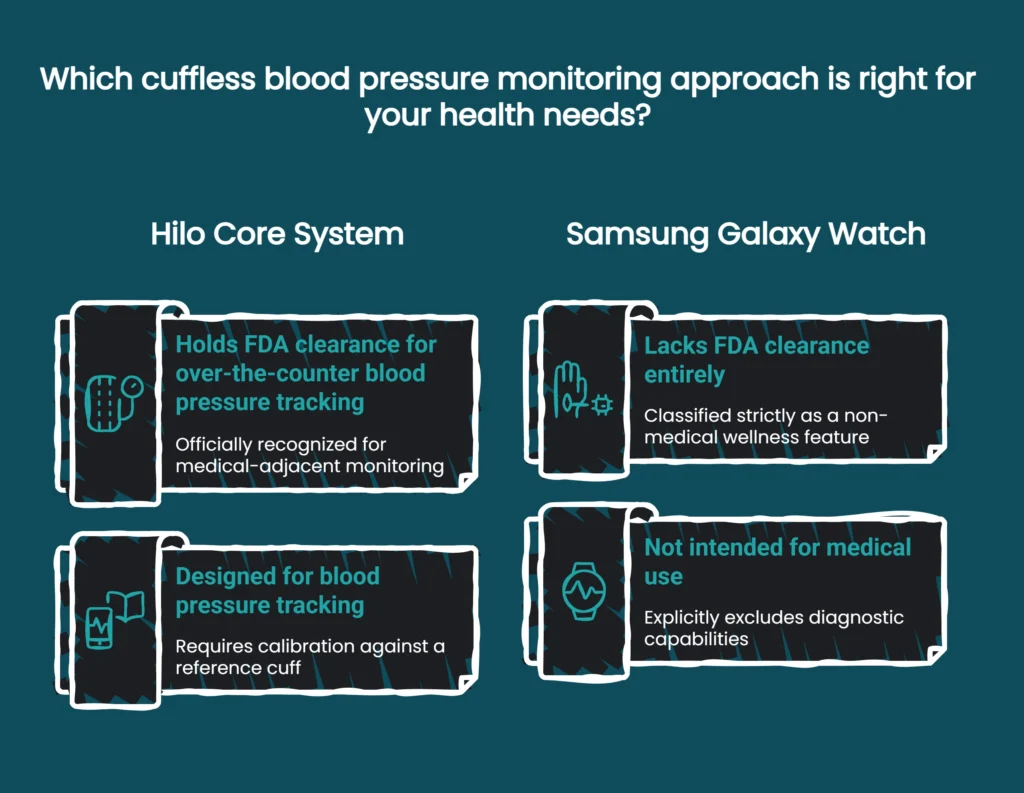
The regulatory landscape here is genuinely mixed, and the differences matter. In July 2026, the FDA cleared the Hilo Band, made by the Swiss company Aktiia, as the first over-the-counter cuffless blood pressure monitor. [1] The clearance covers the device for OTC blood pressure tracking; it still requires calibration against a reference cuff and is not intended for standalone diagnosis.
By contrast, when Samsung’s Galaxy Watch blood pressure monitoring feature arrived in the US in 2026, it did so without FDA clearance at all. Samsung classifies it as a “wellness feature,” explicitly stating it “isn’t intended for medical use, which is why it doesn’t require FDA clearance.” [3] That’s a materially different regulatory position than the Hilo Band’s, even though both are cuffless, wrist-based, and PPG-driven from the user’s perspective.
Apple has taken yet another approach: rather than clearing a device that outputs a blood pressure number, the Apple Watch received FDA clearance for a hypertension alert feature, a tool that flags signs consistent with chronic high blood pressure over time rather than reporting a systolic and diastolic reading. It’s a narrower, differently-validated claim than “this is your blood pressure right now.”
The practical takeaway: two cuffless devices sitting side by side on a wrist can have completely different regulatory standing, and “it’s a wellness feature, not a medical device” is a real, meaningful disclaimer, not fine print to skip past.
How Should Sauna Users Think About Cuffless Monitors?
If you’re using a cuffless device to watch how your blood pressure trends around sauna sessions, our full breakdown of sauna’s acute blood pressure response already covers what to expect physiologically. The relevant addition here: a single cuffless reading immediately post-sauna reflecting a drop is expected physiology, not a device malfunction, but it’s also exactly the kind of reading the AHA flags as less reliable, since heat exposure changes skin blood flow and temperature in ways that can affect PPG signal quality independent of any real blood pressure change.
Where the AHA’s caution matters most is if you’re using cuffless numbers to decide whether it’s safe to sauna on a given day, especially with diagnosed hypertension or blood pressure medication, that’s a decision to make with a validated cuff reading and your physician, not an unvalidated optical estimate taken minutes after heat exposure.
Is a Cuffless Monitor Worth Using at All?
For general trend-watching in healthy adults, a cuffless device can be a reasonable complement to periodic validated cuff readings, particularly for its ability to capture overnight or continuous data that a cuff can’t. For anyone managing diagnosed hypertension or cardiovascular risk, the AHA’s guidance is to treat cuffless readings as directional information only, confirmed against a validated cuff device before any clinical decision is made.
Frequently Asked Questions
Are cuffless blood pressure monitors FDA approved?
It depends on the device. The Hilo Band received FDA clearance in July 2026 for over-the-counter use, the first cuffless monitor to do so. Samsung’s Galaxy Watch BP feature, by contrast, launched in the US without FDA clearance, classified instead as a wellness feature.
Can I use a smartwatch blood pressure reading to manage my hypertension?
No. The AHA specifically advises against using cuffless devices, including smartwatches, to diagnose hypertension or make treatment decisions. Use a validated cuff device and share readings with your physician.
Why does my cuffless BP reading change so much throughout the day?
Some of that variation is real physiology, blood pressure naturally fluctuates, but cuffless devices are also more sensitive to wrist position, skin tone, temperature, and time since last calibration than cuff devices, which can add measurement noise on top of the real variation.
How do I know if my blood pressure monitor is validated?
Check validatebp.org, run by the American Medical Association, which lists devices that passed independent accuracy review against established protocols.
Does a “wellness feature” disclaimer mean a device is inaccurate?
Not necessarily, but it means the manufacturer hasn’t sought the level of regulatory review that a cleared medical device requires. It’s worth treating those readings with more skepticism than a cleared device’s readings, particularly for any decision that matters medically.
Medical disclaimer: This article is for informational purposes only and is not a substitute for professional medical advice, diagnosis, or treatment…
References
[1] Aktiia. Aktiia’s Hilo Band Becomes First Cuffless Blood Pressure Monitor Cleared by FDA for Over-the-Counter Use. PR Newswire. July 9, 2026. View source
[2] Cohen J, et al. Cuffless Devices for the Measurement of Blood Pressure: A Scientific Statement From the American Heart Association. Hypertension. 2026. View on PubMed
[3] SamMobile. Galaxy Watch blood pressure monitoring isn’t approved by the US FDA. 2026. View source