
Pulse Wave Velocity vs. Augmentation Index: How Sauna Use Measures Up
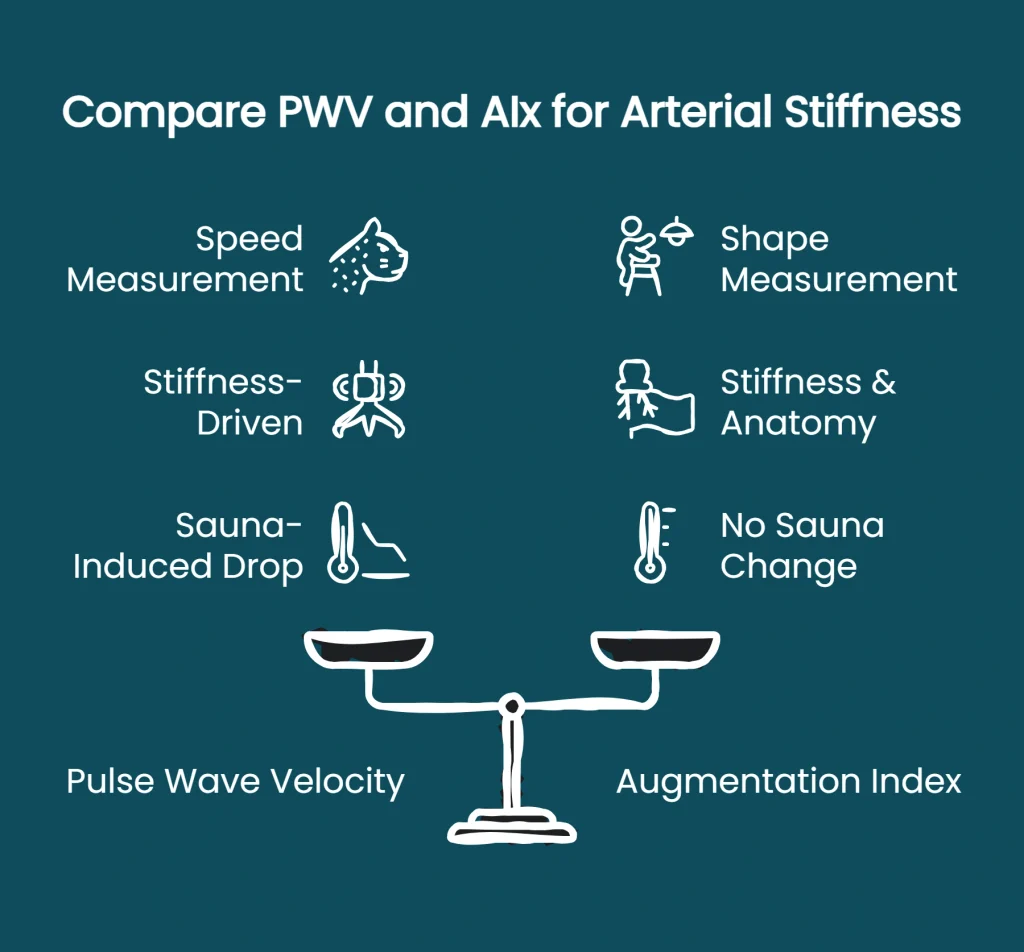
Short answer: Pulse wave velocity (PWV) and augmentation index (AIx) are two different measurements that come out of the same pulse wave analysis process, but they measure arterial stiffness in different ways. PWV is a speed measurement, how fast the arterial pressure wave travels between two points, with faster travel indicating stiffer arteries. AIx is a shape measurement, how much a reflected pressure wave adds to the original wave, influenced by both stiffness and by where in the arterial tree that wave reflects back. A controlled study of 102 adults found PWV dropped significantly during and immediately after a single sauna session, while AIx showed no significant change in the same people, a distinction worth understanding if you’re tracking either number.
At a Glance
- PWV and AIx are both derived from pulse wave analysis, but they measure arterial stiffness differently and aren’t interchangeable
- PWV measures how fast the pressure wave travels between two arterial sites, faster travel means stiffer arteries
- AIx measures how much a reflected wave augments the original pressure wave shape, a metric influenced by stiffness and by reflection-site anatomy, not stiffness alone
- A 2026 European reference-values study established what counts as a “normal” PWV by age decade in healthy adults
- A 102-person study found PWV dropped from 9.8 to 8.6 m/s immediately after a single 30-minute sauna session, while AIx showed no significant change in the same session
- A 2026 randomized controlled trial extended this line of research into adults with diagnosed coronary artery disease
Who This Guide Is For
This article is for sauna users who’ve seen “pulse wave velocity” or “augmentation index” on a device readout or in a study and want the plain-English distinction between them, along with what sauna-specific research on these two particular metrics actually shows. It applies to traditional and infrared sauna users alike, though the controlled study covered here used a traditional Finnish sauna protocol specifically. For the broader definitions of arterial stiffness as a concept, see our arterial stiffness overview linked below, this piece goes deeper into these two specific measurements and their reference ranges. This is not medical advice, consult your healthcare provider for cardiovascular risk assessment.
What’s the Difference Between Pulse Wave Velocity and Augmentation Index?
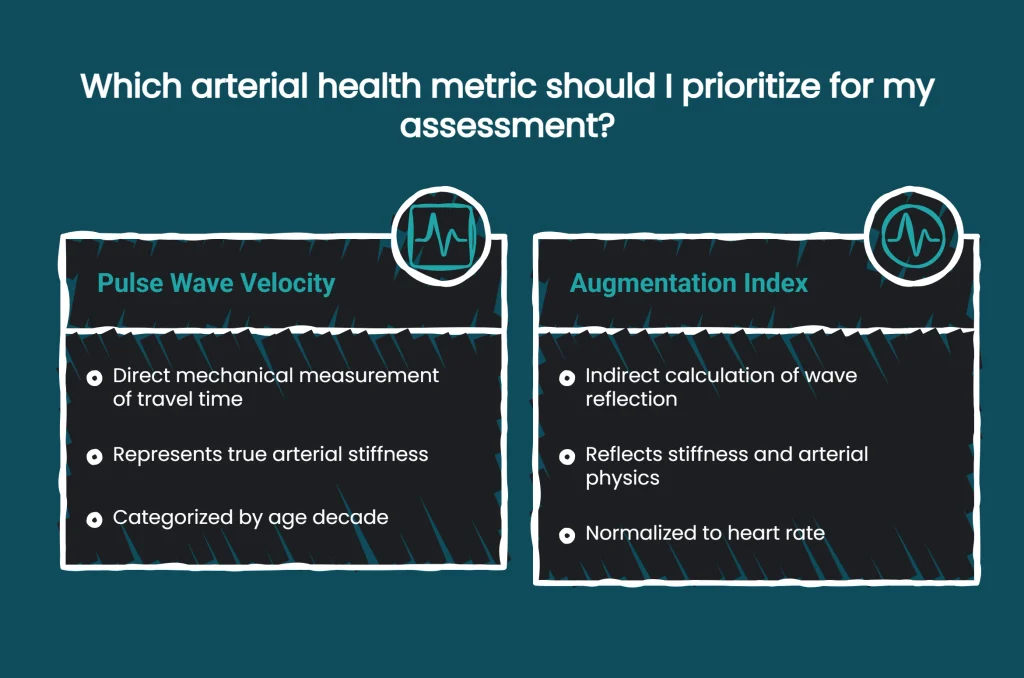
Both metrics come from the same underlying pulse wave analysis process covered in our central blood pressure explainer, but they capture different information. Carotid-femoral PWV, the clinical gold standard, is a fairly direct mechanical measurement: it times how long the pressure wave takes to travel between the carotid artery in the neck and the femoral artery in the groin, and divides that by the distance. Stiffer artery walls transmit the wave faster, so a shorter travel time means a higher, less favorable PWV number.
AIx works differently. As the pressure wave travels outward from the heart, it reflects back off branch points and areas of higher resistance in the smaller arteries, and that reflected wave adds to, or “augments,” the original outgoing wave. AIx expresses how much of that augmentation occurred, usually as a percentage, and it’s often normalized to a standard heart rate of 75 beats per minute (written as AIx@75) because heart rate itself changes the timing of that reflection. This means AIx is a genuinely useful number, but it’s an indirect one: it reflects both true arterial stiffness and the physics of where and how the wave reflects, which is why two people with identical AIx readings can have different actual stiffness, and why AIx and PWV don’t always move together, a point that matters directly for the sauna research below.
What Counts as a “Normal” Pulse Wave Velocity for Your Age?
The reference values most PWV interpretation is built on come from a 2026 European collaboration that pooled data from over a dozen studies to establish mean carotid-femoral PWV in healthy people with no cardiovascular risk factors, broken out by age decade. [1] Their published normal-population values: under 30, 6.2 m/s; 30 to 39, 6.5 m/s; 40 to 49, 7.2 m/s; 50 to 59, 8.3 m/s; 60 to 69, 10.3 m/s; and 70 and older, 10.9 m/s. Each of these is a mean with a wide normal range around it, individual variation is substantial, so a single reading above your age-decade mean isn’t itself a diagnosis, it’s a data point to track over time or discuss with a physician.
PWV rising with age is expected physiology, arteries naturally stiffen somewhat over a lifetime, which is part of why these values are presented by age decade rather than as one universal “normal” number.
What Does Sauna Research Actually Show About Pulse Wave Velocity?
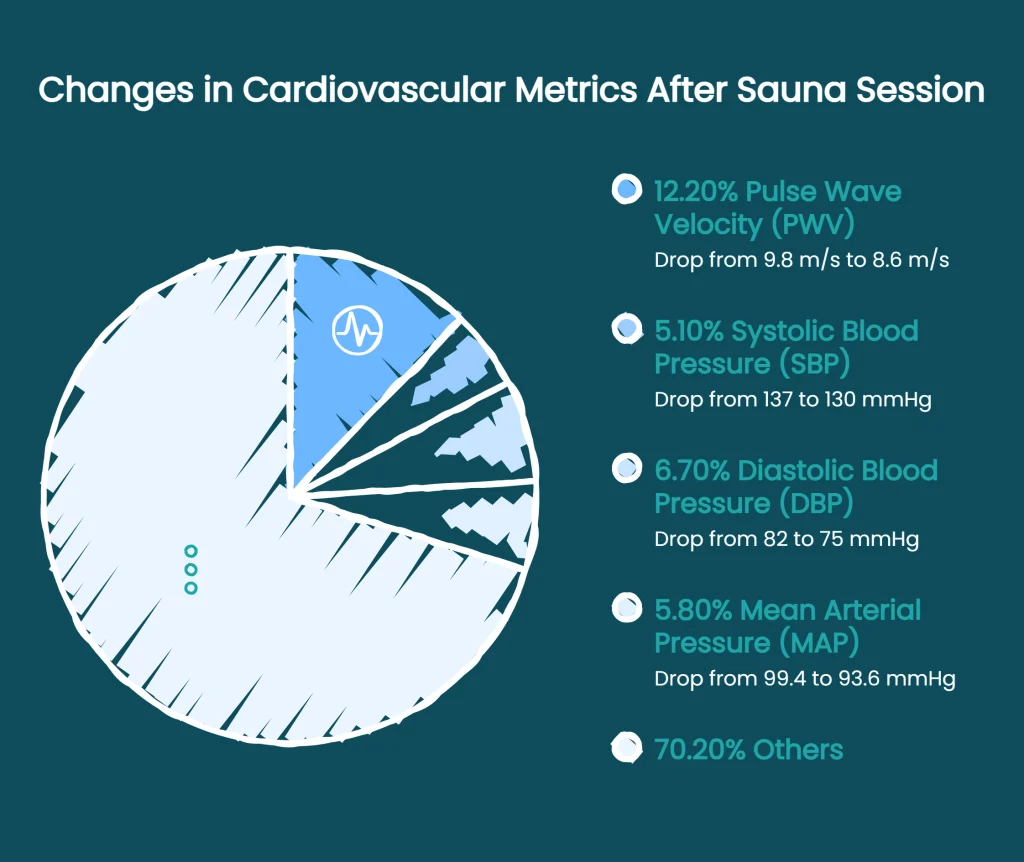
A study of 102 asymptomatic adults with at least one cardiovascular risk factor, average age 51.9, measured PWV before, immediately after, and 30 minutes following a single 30-minute sauna session at 73°C. [2] PWV dropped from 9.8 m/s at baseline to 8.6 m/s immediately post-sauna (p<0.001), and remained improved at 9.0 m/s after the 30-minute recovery period. The same session also produced significant drops in systolic blood pressure (137 to 130 mmHg), diastolic blood pressure (82 to 75 mmHg), and mean arterial pressure (99.4 to 93.6 mmHg), alongside an expected heart rate increase from 65 to 81 beats per minute.
Worth being precise about what this does and doesn’t show: this is a single-session, acute-response study, not a trial of months of regular sauna use producing a lasting reduction in resting PWV. What it demonstrates clearly is that a real sauna protocol produces a measurable, statistically significant, direct reduction in this specific stiffness metric during and shortly after the session itself, heat-driven vasodilation working in real time on a validated clinical measurement.
What About Augmentation Index? Why Didn’t Sauna Change It in the Same Study?
In that same 102-person study, AIx showed no significant change, despite PWV moving in a clearly favorable direction. [2] This isn’t a contradiction, it’s a demonstration of exactly the distinction covered above. Heart rate rose sharply during the sauna session, from 65 to 81 beats per minute, and because AIx is sensitive to heart rate (which is why it’s often reported as AIx@75, adjusted to a standard rate), a rapid heart rate change during a heat exposure can shift the timing of wave reflection independently of whatever is happening to the arterial wall itself. That can mask or offset a change in AIx even while PWV, the more direct stiffness measurement, is moving favorably.
This is a known limitation of AIx interpretation broadly, not something specific to sauna research, and it’s part of why PWV is generally treated as the more robust of the two metrics in clinical and research settings. If you’re comparing your own AIx readings around sauna sessions, expect more noise from heart-rate-driven variation than you’d see in a PWV reading taken under similarly controlled conditions.
Has This Been Studied Beyond a Single Healthy-Adult Session?
A 2026 randomized controlled trial extended this research into adults with diagnosed coronary artery disease, examining vascular health measures following a structured Finnish sauna bathing protocol in a clinical population rather than the healthy-and-at-risk-factor group the 2026 study covered. [3] That’s a meaningful extension, cardiovascular disease patients are exactly the population where both the benefit and the safety profile of heat exposure matter most, and it’s worth reading directly if you want the full trial detail, we’re not restating specific outcome figures here beyond what’s summarized in this piece, given the added complexity of interpreting RCT results in a clinical population correctly.
What Should You Take Away From This If You Track Your Own Vascular Numbers?
If you’re using a home device that reports PWV, expect a temporary drop immediately around a sauna session, that’s consistent with what controlled research shows and reflects real acute vasodilation, not a device malfunction, similar to the caution we give around post-sauna blood pressure readings elsewhere on this site. If you want a stable baseline number to compare against the age-decade reference values above, take that reading before your session rather than immediately after. And if your device also reports AIx, treat session-to-session swings in that number with more skepticism than PWV swings, given how directly heart rate can move it independent of any real change in your arteries.
CONNEQT Pulse is worth knowing about here specifically because it reports both numbers from a single reading, PWV and AIx side by side, along with central blood pressure and SEVR, using the same SphygmoCor-based technology covered in our central blood pressure article. That makes it one of the few home options where you could actually watch the exact pattern this article describes play out on your own readings. We put it through a full session-by-session breakdown in our hands-on CONNEQT Pulse testing, linked below.
Frequently Asked Questions
What is a “good” pulse wave velocity number for my age?
There’s no single universal target, but the 2026 reference-values study provides age-decade means for healthy adults: roughly 6.2 m/s under 30, rising to around 10.3 to 10.9 m/s at 60 and older. A reading meaningfully above your age-decade mean is worth discussing with a healthcare provider rather than self-diagnosing from it.
Why did my augmentation index not change even though my pulse wave velocity did?
This is a documented pattern, not a device error. AIx is sensitive to heart rate, and sauna use typically raises heart rate substantially, which can offset or mask an AIx change even while PWV, a more direct stiffness measurement, moves favorably.
Is pulse wave velocity the same thing as vascular age?
No, though they’re related. Vascular age is a derived comparison, your PWV measured against age-based population norms, while PWV itself is the underlying raw measurement. See our vascular age article linked below for that distinction in full.
Can I measure pulse wave velocity myself at home?
A small number of consumer and prosumer devices now offer PWV estimation, typically built on the same pulse wave analysis technology used clinically. Accuracy depends on the specific device and its validation, not something to assume without checking.
Medical Disclaimer
This article is for informational purposes only and is not a substitute for professional medical advice, diagnosis, or treatment. Pulse wave velocity and augmentation index readings and their clinical interpretation should be discussed with a qualified healthcare provider, particularly for anyone with hypertension, diagnosed cardiovascular disease, or other cardiovascular risk factors.
References
[1] The Reference Values for Arterial Stiffness’ Collaboration. Determinants of pulse wave velocity in healthy people and in the presence of cardiovascular risk factors: ‘establishing normal and reference values’. European Heart Journal. 2026. View on PubMed
[2] Lee E, Laukkanen T, Kunutsor SK, Khan H, Willeit P, Zaccardi F, Laukkanen JA. Sauna exposure leads to improved arterial compliance: Findings from a non-randomised experimental study. European Journal of Preventive Cardiology. 2026. View on PubMed
[3] Debray A, et al. Finnish sauna bathing and vascular health of adults with coronary artery disease: a randomized controlled trial. Journal of Applied Physiology. 2026. View on PubMed