Does Sauna Use Actually Improve Heart Rate Variability?
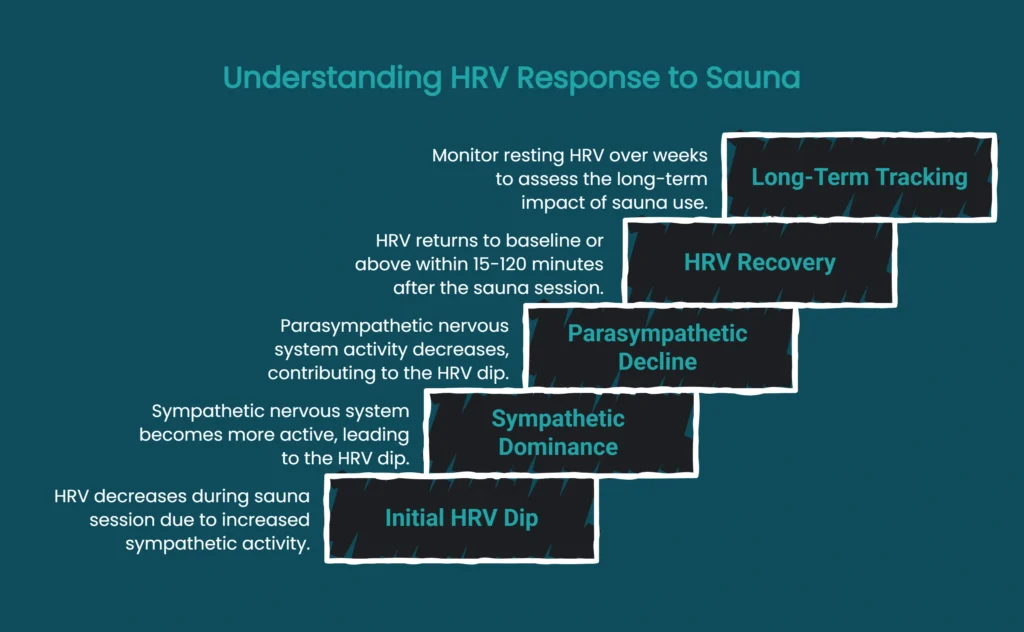
A single sauna session temporarily lowers heart rate variability (HRV) as heat stress activates the sympathetic nervous system, then HRV rebounds often above pre-sauna levels within 15 to 120 minutes as parasympathetic activity returns during cooling. This acute pattern is well-documented in both traditional and infrared sauna research. However, an 8-week randomized controlled trial found that regular post-exercise sauna bathing produced no measurable long-term HRV improvement beyond exercise alone. Some evidence in trained athletes suggests repeated heat exposure over 10 or more consecutive days may support autonomic adaptation, but lasting HRV gains from sauna use by itself remain preliminary rather than established.
Last updated: August 2026
At a Glance
- Sauna sessions lower HRV during exposure as the sympathetic nervous system activates, this is well-documented and expected, not a warning sign
- HRV typically rebounds to or above baseline within 15–120 minutes of finishing a session
- An 8-week RCT found no significant long-term HRV improvement from regular post-exercise sauna versus exercise alone; the marketing claim that sauna reliably raises resting HRV is unsupported by this trial, while the underlying long-term effect remains preliminary rather than disproven
- People with untreated hypertension show a larger acute sympathetic swing during sauna sessions than the general population
- Athletes using 10+ consecutive days of sauna heat exposure showed autonomic adaptation trends, but this evidence is preliminary and population-specific
- Traditional and infrared sauna studies report a similar acute HRV pattern
Who This Guide Is For
This guide is for people already tracking HRV through a wearable, chest strap, or app who want to understand what changes they’re seeing after sauna sessions, and for anyone deciding whether sauna use is likely to move their HRV trend over time. It covers both traditional and infrared sauna research, since the acute autonomic response has been studied in both. It is not intended for people using HRV to manage a diagnosed cardiac arrhythmia or autonomic disorder; those readers should rely on guidance from their treating physician rather than general population research.
What Happens to HRV During a Sauna Session?
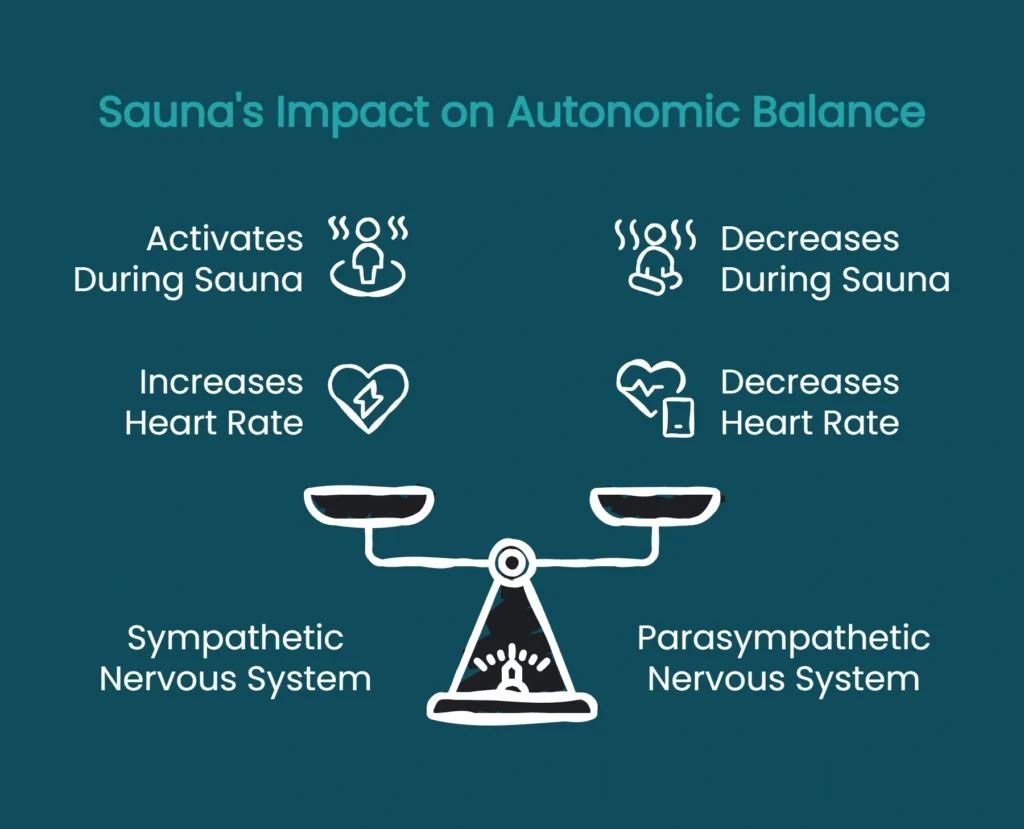
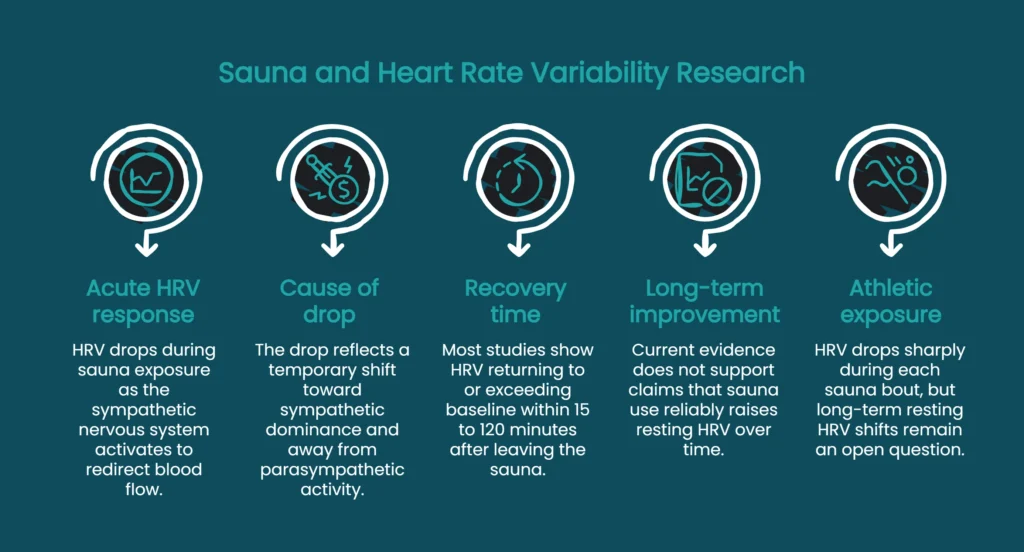
Well-documented. HRV drops during sauna exposure. As core and skin temperature rise, the sympathetic nervous system activates to redirect blood flow to the skin and increase heart rate, which reduces the moment-to-moment variability between heartbeats [1]. In a study of 93 participants with cardiovascular risk factors using a 30-minute traditional sauna session at 73°C, HRV measures were significantly altered during the session, with heart rate rising from a resting baseline before returning toward normal during recovery [1].
Why Does HRV Drop During Sauna Heat Exposure?
Well-documented. The drop reflects a temporary shift toward sympathetic (“fight or flight”) dominance and away from parasympathetic (“rest and digest”) activity, the same autonomic pattern seen during moderate exercise. This is an expected physiological response to thermal stress, not an indicator of harm in healthy adults. Research in patients with untreated hypertension confirmed this same pattern, with a significant increase in sympathetic markers and decrease in parasympathetic markers during sauna exposure [2].
How Long Does It Take for HRV to Recover After Sauna Bathing?
Well-documented. Most studies show HRV returning to or exceeding baseline within 15 to 120 minutes after leaving the sauna. In the 93-participant study, HRV indices trended back toward baseline within about 30 minutes of recovery, with resting heart rate ending lower after recovery (68 beats per minute) than before the session (77 beats per minute) [1]. The hypertension study found autonomic measures normalized within a similar 15- to 120-minute window [2].
Does Regular Sauna Use Improve Long-Term HRV?
Preliminary — and partly unsupported by current evidence. This is the most commonly overstated claim in sauna marketing content, and it deserves a direct correction. A 2026 randomized controlled trial assigned 38 sedentary adults with cardiovascular risk factors to eight weeks of exercise plus post-exercise sauna, exercise alone, or a control group. Regular exercise alone improved several HRV measures compared to control, but adding sauna bathing after exercise produced no additional HRV benefit beyond exercise by itself [3]. In other words, the current best evidence does not support marketing claims that sauna use, on its own or added to a workout routine reliably raises resting HRV over time. The researchers noted that longer or larger trials could still find an effect that this study wasn’t sized to detect, so this remains an open question rather than a settled negative.
Does Repeated Heat Exposure Affect HRV Differently in Athletes?
Preliminary. A small study of well-trained cyclists using daily 30-minute sauna sessions (87°C) for 10 consecutive days after training found that HRV dropped sharply during each individual sauna bout, consistent with the acute pattern described above [4]. Whether repeated exposure over many weeks meaningfully shifts an athlete’s resting HRV trend, independent of their training load, has not been established in this population and should be treated as an open question rather than a confirmed benefit.
Is the Acute HRV Response Different for People With Hypertension?
Preliminary. In a small study of ten patients with untreated hypertension, both a sauna-only session and a post-exercise sauna session produced a significant increase in sympathetic markers and decrease in parasympathetic markers during the session, normalizing within 15 to 120 minutes afterward [2]. This suggests the acute HRV swing may be more pronounced in this population, though the study’s size means this should be treated as a signal for further research rather than a definitive population-wide finding. Anyone with diagnosed hypertension or another cardiovascular condition should discuss sauna use with their physician before adding it to a routine.
Does Sauna Type Change the HRV Response?
Preliminary. Most controlled HRV research uses traditional (dry-heat or steam) sauna protocols at higher temperatures, since that’s where the majority of published trials originate. Infrared sauna operates at lower ambient temperatures, and while it’s commonly described as producing a similar acute autonomic pattern, less controlled trial data exists specifically for infrared exposure compared to traditional sauna. Readers deciding between the two types for cardiovascular purposes should weigh this evidence gap alongside our infrared versus traditional comparison.
How Can You Track Your Own HRV Response to Sauna Use?
If you already use a chest strap or wearable, an Oura Ring, WHOOP band, Garmin watch, or a Polar H10 chest strap, most of which report HRV as RMSSD or SDNN, the two standard time-domain metrics — that measures HRV, the acute pattern described above gives you a reasonable expectation: a dip during or immediately after the session, followed by recovery toward or above your baseline (reflecting higher vagal tone) within roughly half an hour to two hours. A single low reading right after a sauna session is expected physiology, not a cause for concern in healthy adults. Because the long-term trend evidence is still preliminary, tracking your own resting HRV over weeks, rather than judging any single post-sauna reading, is the more useful way to see whether sauna sessions are part of a pattern that works for you.
FAQ
Is a drop in HRV after sauna use dangerous?
No. A temporary HRV drop during and immediately after a sauna session reflects normal sympathetic nervous system activation from heat stress, similar to the response seen during exercise. It is expected to recover within 15 to 120 minutes in healthy adults.
Will sauna use raise my average HRV score over time?
The current evidence doesn’t support that as a reliable outcome. The best available randomized trial found no additional long-term HRV benefit from regular sauna use added to exercise, compared to exercise alone. Sauna’s acute effects on HRV are well established; its long-term effects are not.
Does infrared sauna affect HRV differently than traditional sauna?
Both are reported to produce a similar acute HRV pattern, a drop during exposure and recovery afterward but traditional sauna has a larger body of controlled HRV research behind it. Infrared-specific long-term data is more limited.
Should I check my HRV before deciding whether to use a sauna that day?
Some people use a low morning HRV reading as a signal to keep a sauna session shorter or cooler that day, since it can indicate the body is already under stress from poor sleep, illness, or training load. This is a personal-monitoring practice rather than a clinical recommendation, and there’s no controlled research confirming it changes outcomes.
Is the HRV response different for people with heart conditions?
Limited research in people with untreated hypertension shows a larger acute sympathetic swing during sauna sessions, though it normalized afterward in that small study. Anyone with a diagnosed cardiovascular condition should talk to their physician before starting regular sauna use.
Medical Disclaimer
This article is for informational purposes only and is not a substitute for professional medical advice, diagnosis, or treatment. Heart rate variability responses to heat exposure can vary based on individual cardiovascular health, medications, and other factors. Always consult a qualified healthcare provider before beginning sauna use, especially if you have a diagnosed heart condition, uncontrolled blood pressure, or are taking medications that affect heart rate or blood pressure. Never disregard professional medical advice or delay seeking it because of something you have read here. If you experience chest pain, dizziness, or irregular heartbeat during or after sauna use, stop immediately and seek medical attention.
References
- Laukkanen T, Lipponen J, Kunutsor SK, et al. Recovery from sauna bathing favorably modulates cardiac autonomic nervous system. Complementary Therapies in Medicine. 2026;45:190-197. View on PubMed
- Gayda M, Bosquet L, Paillard F, et al. Effects of sauna alone versus postexercise sauna baths on short-term heart rate variability in patients with untreated hypertension. Journal of Cardiopulmonary Rehabilitation and Prevention. 2026;32(3):147-154. View on PubMed
- Lee E, Ketelhut S, Wiklund P, et al. Regular postexercise sauna bathing does not improve heart rate variability: A multi-arm randomized controlled trial. Physiological Reports. 2026;13(13):e70449. View on PubMed
- Leicht AS, Halliday A, Sinclair WH, et al. Heart rate variability responses to acute and repeated postexercise sauna in trained cyclists. Applied Physiology, Nutrition, and Metabolism. 2026;43(7):704-710. View on PubMed