
Infrared vs traditional saunas: key differences explained

Short answer: The core difference between infrared and traditional saunas lies in their heating method and the maturity of the scientific evidence supporting them. Traditional saunas use convection to heat the air, creating a systemic stress response backed by decades of research. Infrared saunas use radiant heat to warm the body directly, offering targeted benefits supported by more recent, smaller-scale studies.
Key Takeaways
- Traditional saunas have 40+ years of large-scale population research; infrared saunas have emerging, smaller-scale clinical studies
- Heat delivery differs fundamentally: convection (hot air) vs radiant heat (direct tissue warming)
- Traditional operates at 150-195°F; infrared at 110-135°F due to different heating mechanisms
- Both types trigger thermoregulatory responses, but through different pathways and intensities
Comparing Saunas: Why Evidence Matters More Than Temperature
If you’re exploring adding a sauna to your wellness routine, you’ve likely encountered a vibrant debate: the classic, high-heat traditional sauna versus the modern, technologically advanced infrared sauna. The conversation often gets stuck on simple metrics like temperature, heat-up time, or energy consumption.
The fundamental distinction is not merely about how they generate heat. It is about the quality and depth of scientific evidence associated with each modality. Your choice should ultimately be a deliberate alignment of your primary health goals with the corresponding body of research. Are you seeking benefits validated by decades of large-scale population studies, or are you interested in targeted applications backed by promising, but less established, clinical evidence?
Understanding the differences in heat delivery helps clarify why each type produces distinct biological responses. For technical details on infrared wavelength penetration and cellular mechanisms, see our infrared sauna mechanism guide.
Heat Transfer Mechanisms: Convection vs Radiant Heat
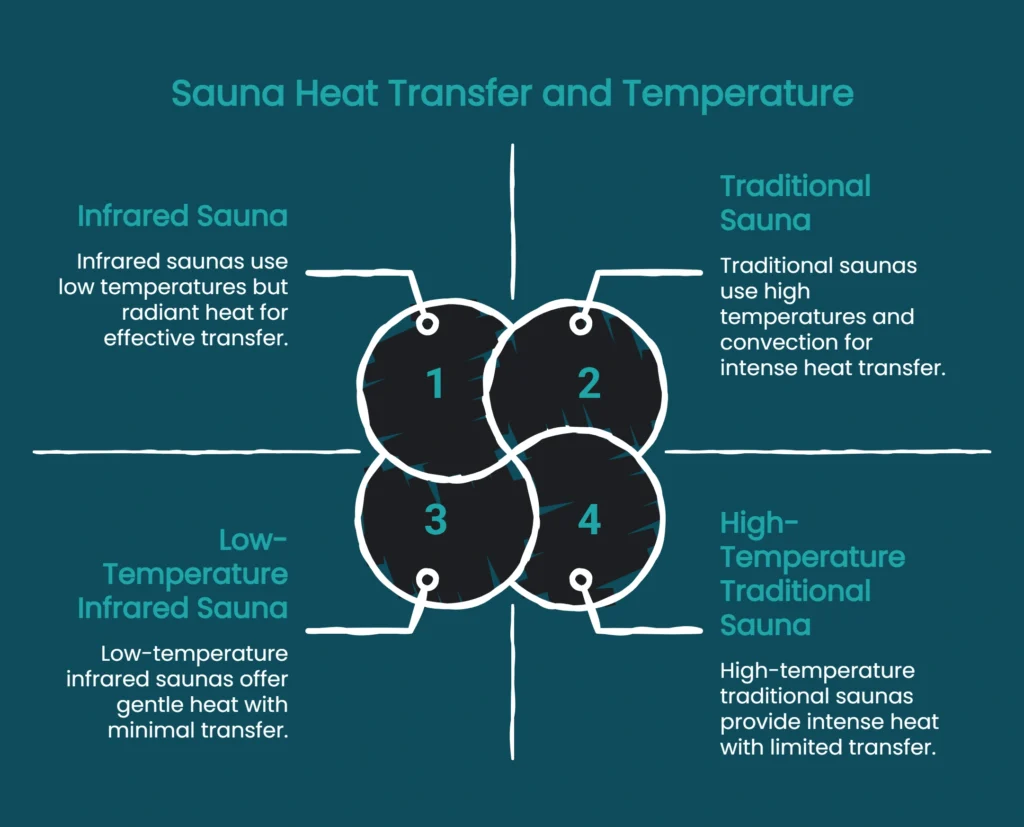
To understand the different physiological effects, we must first grasp how each sauna type heats your body. They operate on two completely different principles of thermal dynamics.
Traditional Saunas: The Power of Convection and Intense Ambient Heat
A traditional Finnish sauna, the archetype of this category, relies on convection heat. A powerful heat source—typically a wood-burning stove or a modern electric sauna heater—heats a large mass of stones. These super-heated stones then radiate heat into the room, raising the ambient air temperature to significant levels. A proper traditional sauna can operate anywhere from 150°F to 195°F (65°C to 90°C).
In this environment, your body is heated from the outside in by the hot air. This experience is often intensified by the practice of creating löyly—the Finnish term for the steam generated by ladling water onto the hot stones. This momentarily spikes humidity levels, creating a wave of intense, penetrating heat. The result is a powerful, systemic thermal stress that challenges the entire body, leading to profuse sweating and a robust physiological response. This can be either a dry heat experience or a wet heat experience, depending on the use of water.
Infrared Saunas: Heating the Body, Not the Air
Infrared saunas work on an entirely different principle: radiant heat. Instead of heating the air around you, they use specialized emitters—often carbon heaters or ceramic heaters—to generate infrared light waves. This light penetrates the skin and gently raises your core body temperature directly. Because the energy is focused on heating you rather than the space, infrared saunas operate at a much lower and more tolerable ambient air temperature, typically between 110°F to 135°F (43°C to 57°C).
This method allows for longer session duration and is often preferred by individuals who find the intense heat of a traditional sauna overwhelming. There are different types of infrared, including near-infrared, far-infrared, and full-spectrum saunas, each claiming slightly different depths of penetration and associated benefits.
The Evidence Gap: Why Decades of Research Matter
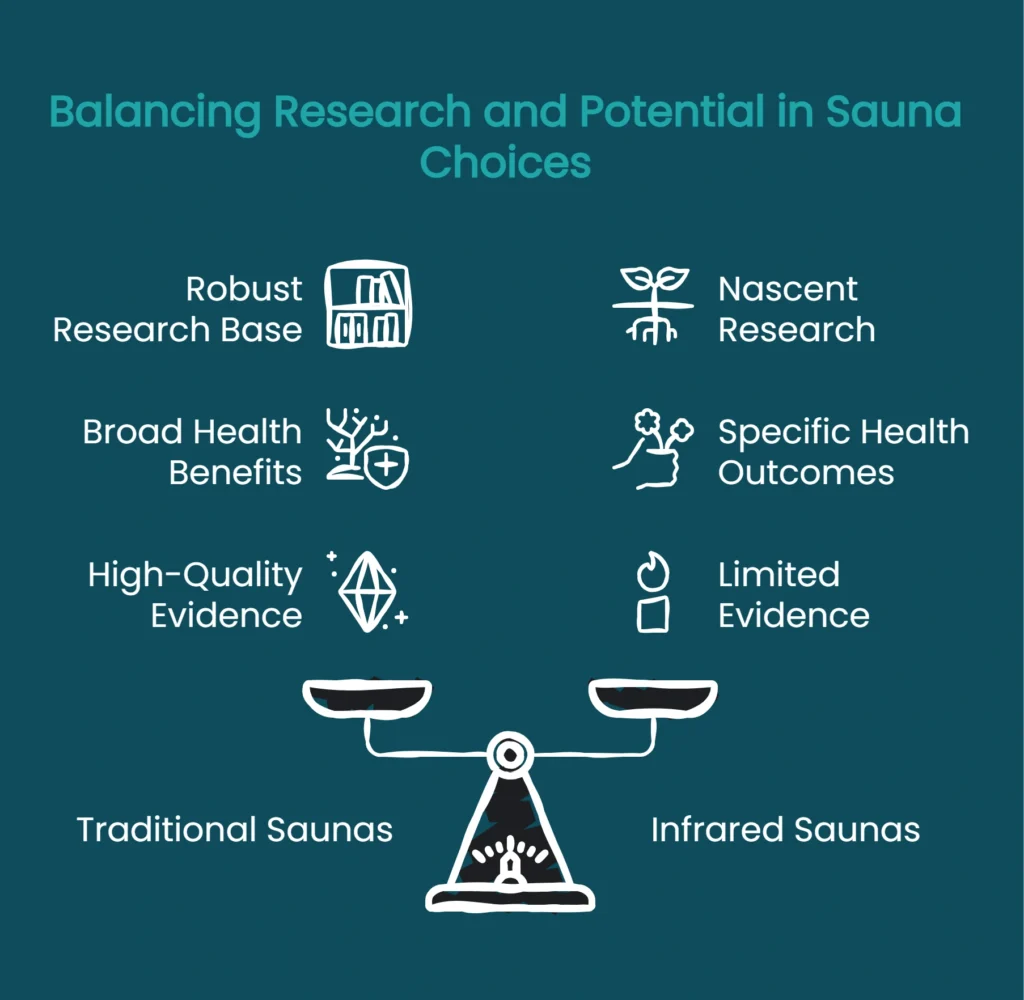
Here we arrive at the core thesis. When people reference the profound health benefits of sauna use—particularly for cardiovascular health and longevity—they are almost exclusively referring to studies conducted on traditional, high-heat Finnish saunas. This creates a significant “evidence gap” that is critical for any prospective buyer to understand.
The Robust Case for Traditional Saunas
The practice of sauna bathing is deeply embedded in Finnish culture, providing researchers with a unique opportunity to conduct long-term, large-scale epidemiological studies. The results are compelling. Population-based studies that have followed thousands of people over many years consistently suggest that regular users of traditional saunas have significantly lower rates of heart disease and all-cause mortality than those who do not use saunas.
The body of evidence is substantial. A 2018 systematic review of traditional dry sauna bathing identified 40 separate clinical studies involving a total of 3,855 participants, exploring benefits from cardiovascular function to respiratory health. This vast library of research gives us high confidence in the ability of traditional sauna use to support long-term health, particularly in areas like blood pressure regulation and heart rate variability (HRV).
The Promising, Yet Nascent, Case for Infrared Saunas
Infrared sauna technology is much newer, and consequently, the research is less mature. The studies that exist are generally smaller, of shorter duration, and focused on more specific outcomes rather than broad, long-term health markers like longevity. For instance, a comprehensive review examining far-infrared saunas (FIRS) for cardiovascular risk factors was only able to identify nine relevant papers with high-quality level I or level II evidence. This is a stark contrast to the volume of research on traditional saunas.
Experts acknowledge the potential but urge caution. According to the Mayo Clinic, while some studies show benefits for chronic health problems, “larger and more-exact studies are needed to prove these results.” The evidence for specific applications is also narrowly defined. The same review that found limited cardiovascular data described the evidence for infrared sauna therapy in chronic pain as ‘fair evidence, from a single study.’
This doesn’t mean infrared saunas are not effective; it simply means the scientific proof is not yet as broad or deep as it is for their traditional counterparts.
Mechanism of Action: Systemic Stress vs Targeted Therapy
The difference in heating methods leads to different primary physiological responses. Understanding this can help you map the technology to your specific wellness goals.
Traditional Sauna: A Hormetic, Systemic Challenge
The intense ambient heat of a traditional sauna induces a powerful systemic stress response. This is a form of “hormesis”—a beneficial stress that stimulates the body to adapt and become more resilient. Your heart rate increases, blood vessels dilate, and circulation improves dramatically, creating cardiovascular responses through heat-induced thermoregulation.
This powerful response has been studied in relation to its well-documented health associations. A key part of this process is the production of heat shock proteins, which help protect cells from stress and have been studied in relation to longevity and cellular repair. This full-body challenge also triggers endorphin release, contributing to the feeling of relaxation and mental clarity after a session.
Infrared Sauna: A Targeted Thermal Application
Infrared’s radiant heat is less about stressing the entire system and more about delivering thermal energy directly into the body’s tissues. The far-infrared wavelengths penetrate up to 1.5 inches into the body. This makes it a studied tool for targeted applications. The direct heating of muscles and joints may be why it shows promise for post-workout recovery, reducing muscle soreness, and offering support for conditions like joint discomfort and arthritis management. The focus is less on a massive systemic shock and more on a deep, localized warming effect that may help relax tissues and improve local circulation.
The direct tissue warming effect distinguishes infrared from ambient heating. For a detailed technical explanation of how infrared wavelengths interact with cellular structures and what happens when light enters tissue, see our guide to infrared heat delivery and tissue interaction.
Deconstructing the Popular “Detox” Claim
One of the most pervasive marketing claims, particularly for infrared saunas, is that of superior “detoxification.” The theory often cited is that because infrared heat penetrates more deeply, it mobilizes toxins stored in fat cells, which are then released through sweat. The claim is often accompanied by the assertion that infrared-induced sweat contains a higher percentage of toxins than sweat from a traditional sauna.
It’s vital to approach this claim with a critical, scientific lens.
Your Body’s Primary Detoxification Pathways
The human body’s detoxification workhorses are the liver and kidneys. These sophisticated organs filter your blood and metabolize and excrete waste products and toxins continuously. Sweating is a secondary, and much less significant, route of elimination.
The Composition of Sweat
Sweat is overwhelmingly composed of water and electrolytes (like sodium and potassium). While it is true that trace amounts of heavy metals and some other compounds like BPA can be excreted through sweat, the quantities are very small compared to what your liver and kidneys handle. There is little robust evidence to suggest that the composition of sweat from an infrared sauna is meaningfully different or superior for detoxification than that from a traditional sauna or vigorous exercise.
A More Accurate View
The real benefit of any sauna use for “detox” is its ability to support your body’s natural processes. By inducing a heavy sweat and increasing blood circulation, you are helping to mobilize fluids and support the function of your primary detox organs. Both sauna types excel at this. The idea that one offers a unique or profoundly “deeper” detox is more marketing hype than physiological fact.
Goal-Based Decision Framework
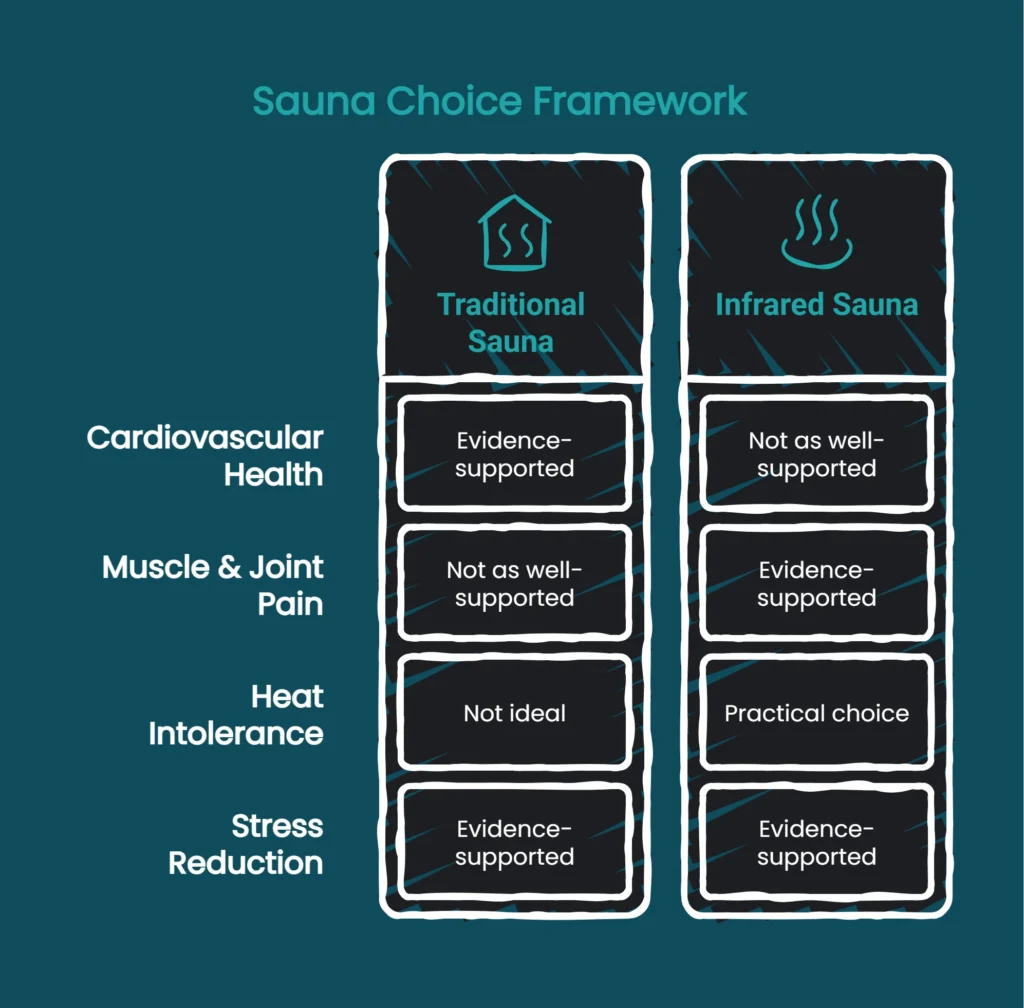
Instead of asking “Which sauna is better?” a more productive question is “Which sauna aligns with my specific goals and the evidence supporting those outcomes?”
Goal: Cardiovascular Health, Longevity, and Systemic Resilience
Evidence-supported choice: Traditional Sauna.
The evidence here is substantial. If your primary motivation is to leverage the benefits seen in the large-scale Finnish studies—such as associations with reduced cardiovascular event risk and improved longevity markers—the traditional high-heat sauna is the modality that has been extensively studied. The powerful hormetic stress, stimulation of heat shock proteins, and intense cardiovascular response are the mechanisms studied in relation to these outcomes.
Goal: Targeted Muscle & Joint Pain Relief, Post-Workout Recovery
Evidence-supported choice: Infrared Sauna.
If you are an athlete or someone dealing with chronic pain conditions like arthritis or fibromyalgia, the case for an infrared sauna is stronger. Its ability to deliver radiant heat directly to tissues and joints without extreme ambient temperatures may provide more targeted support. The research, while not as vast, specifically points toward these applications.
Goal: High Heat Intolerance or Seeking a Gentler Experience
Practical choice: Infrared Sauna.
This is a clear-cut choice based on user comfort. Many people find the 180°F+ temperatures of a traditional sauna to be suffocating or uncomfortable. The lower operating temperature of an infrared sauna allows for a relaxing, therapeutic experience and longer sessions, making the benefits of heat therapy accessible to a wider audience.
Goal: Stress Reduction and Improved Sleep Quality
Evidence-supported choice: Either (Based on Personal Preference).
Both sauna types have been studied in relation to stress reduction and cortisol regulation. The choice comes down to the kind of experience you find more relaxing. Do you prefer the intense, ritualistic cycle of heat followed by a cold plunge? Choose a traditional sauna. Do you prefer a longer, gentler, meditative session? An infrared sauna is likely a better fit for your wellness routine.
Key Distinctions at a Glance
For quick reference, here are the core differences:
| Factor | Traditional Sauna | Infrared Sauna |
| Heat delivery | Convection (hot air heats body) | Radiant heat (light warms tissue directly) |
| Operating temperature | 150-195°F (65-90°C) | 110-135°F (43-57°C) |
| Evidence base | 40+ years, large-scale population studies | Emerging research, smaller clinical studies |
| Primary mechanism | Systemic cardiovascular stress, hormetic response | Targeted tissue warming, localized heat |
| Heat-up time | 30-60 minutes | 15-20 minutes |
| Session duration | 10-20 minutes typical | 20-45 minutes typical |
| Best studied for | Cardiovascular health, longevity associations | Muscle recovery, joint pain support |
| Detoxification | Liver/kidneys primary; sweating supportive | Liver/kidneys primary; sweating supportive |
Practical Considerations: What Fits Your Home and Lifestyle
Beyond the health benefits, practical factors will influence your choice. Infrared saunas, often sold as plug-and-play home sauna kits, typically have faster heat-up time (15-20 minutes) and lower energy consumption. They are often easier to install.
Traditional saunas require more time to heat (30-60 minutes) and may have more complex installation requirements, especially for a wood-burning stove model. Concerns about EMF (electromagnetic fields) are sometimes raised with infrared units; reputable brands have invested heavily in low-EMF technology, so it’s a key feature to look for. As with any significant health investment, medical consultation is always advised, especially if you have pre-existing conditions.
How the Evidence Shapes Expectations
When comparing infrared and traditional saunas, the most important takeaway is not which one is “better,” but how confidently we can link each modality to specific outcomes.
Traditional saunas benefit from decades of population-level research, particularly in cardiovascular health and longevity. These findings are closely tied to the high ambient temperatures and systemic cardiovascular load created by convection-based heat exposure.
Infrared saunas, by contrast, represent a newer modality. The existing research is more limited in scope and duration, but it offers insight into targeted applications such as muscle recovery, joint comfort, and heat tolerance in individuals who cannot tolerate high temperatures. The physiological mechanisms differ, and so does the strength of the evidence supporting each outcome.
Understanding this distinction helps set realistic expectations. Rather than viewing infrared and traditional saunas as interchangeable, it is more accurate to see them as distinct tools that apply heat to the body in different ways, each with its own research profile and appropriate use cases.
This evidence-first perspective allows sauna use to be integrated thoughtfully into a wellness routine—without overstating benefits, dismissing limitations, or relying on marketing narratives.
For detailed safety guidelines, contraindications, and evidence-based usage protocols for both sauna types, visit https://www.saunahealthnut.com/.
Medical Disclaimer: This article provides educational information about infrared sauna safety and is not intended as medical advice. The content should not be used to diagnose, treat, cure, or prevent any medical condition. Individual responses to heat therapy vary based on health status, medications, and underlying conditions. Always consult with a qualified healthcare provider before beginning infrared sauna use, especially if you have cardiovascular disease, are pregnant, take prescription medications, or have any chronic health conditions. The information presented here is for educational purposes only and does not replace professional medical guidance.