
What Is Central Blood Pressure, and Why Does Your Home Cuff Miss It

Short answer: Central blood pressure is the pressure your heart actually generates at the aorta, distinct from brachial blood pressure, the number your arm cuff measures at the upper arm. Because the pulse wave amplifies as it travels from the aorta to the periphery, a standard cuff can overestimate or underestimate the pressure your heart, brain, and kidneys are actually exposed to. Central pressure more strongly predicts subclinical cardiovascular disease and target organ damage than brachial pressure does. It’s measured through pulse wave analysis, historically a clinical-only technology built on decades of pharmaceutical research, now available in a small number of at-home devices.
At a Glance
- Central blood pressure is the pressure at your aorta; brachial pressure is what an arm cuff measures
- The pulse wave amplifies traveling from the aorta to the arm, so brachial pressure isn’t a direct stand-in for central pressure
- Central pressure is a stronger predictor of subclinical cardiovascular disease and organ damage than brachial pressure
- The technology behind central pressure measurement, pulse wave analysis, has been used in pharmaceutical research for over 50 years
- A small number of at-home devices now bring this measurement outside the clinic for the first time
Who This Guide Is For
This article is for anyone who wants to understand what their standard blood pressure cuff isn’t telling them, including sauna users tracking cardiovascular markers beyond a basic reading, and anyone evaluating an at-home central blood pressure device. It applies to traditional and infrared sauna users alike, since neither sauna type is measured by a standard cuff at this level of detail. This is not medical advice, consult your healthcare provider for cardiovascular risk assessment.
What’s the Difference Between Central and Brachial Blood Pressure?
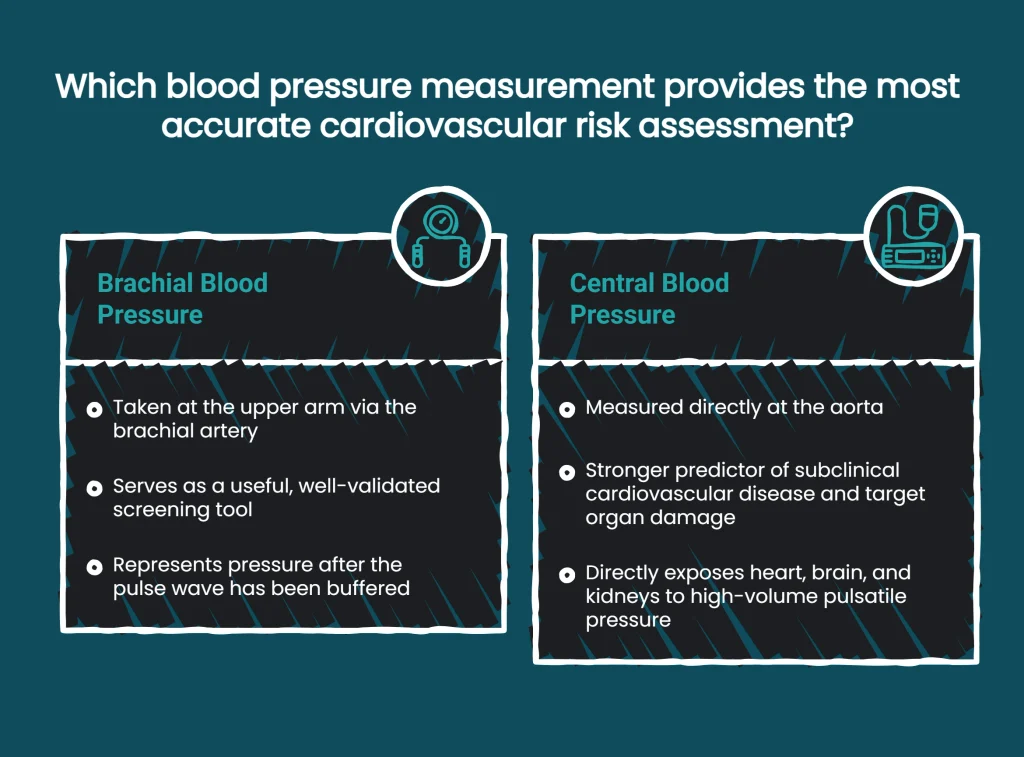
Brachial blood pressure is what a standard cuff measures: the pressure in your brachial artery, at the upper arm. Central blood pressure is the pressure at the aorta, the pressure your heart itself is actually generating and working against.
These aren’t the same number. As the pulse wave travels from the aorta out to the peripheral arteries, it amplifies, meaning brachial pressure readings can diverge from what’s happening centrally. [1] Two people can have identical brachial blood pressure readings and meaningfully different central pressure, and therefore different cardiovascular risk.
Why Does Central Pressure Matter More Than the Cuff Number?
Central blood pressure more strongly relates to vascular disease and cardiovascular outcomes than brachial pressure does. A 2007 study found central pressure a stronger predictor of subclinical cardiovascular disease and target organ damage, the kind of damage to the heart, brain, and kidneys that develops silently over years. [2] Brachial pressure remains a useful, well-validated screening tool, it’s just not the complete picture.
How Does Central Pressure Affect the Heart, Brain, and Kidneys Specifically?
These three organs share a common vulnerability: they all receive continuous, high-volume blood flow directly from large central arteries, which means they’re more exposed to whatever pressure is actually present at the aorta than organs further downstream where the pulse wave has been buffered.
In the heart, elevated central pressure increases the workload the left ventricle has to pump against, a burden captured by the subendocardial viability ratio (SEVR), covered in more depth in our arterial stiffness article linked below. In the brain, small blood vessels are directly exposed to pulsatile pressure with less protective buffering than larger arteries provide, which is part of why central pressure and arterial stiffness are studied in relation to small vessel changes and cognitive health. In the kidneys, the glomeruli, the filtering units of the kidney, operate at a specific pressure range, and chronically elevated central pressure is implicated in the kind of gradual kidney function decline that doesn’t produce symptoms until it’s advanced.
How Does Pulse Wave Analysis Actually Work?
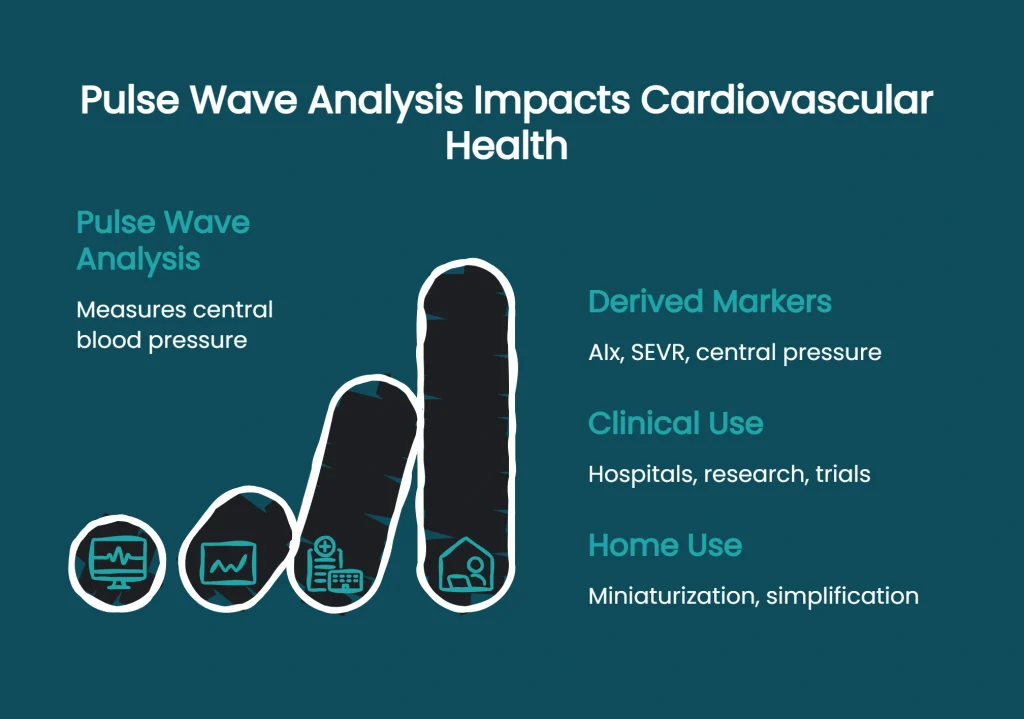
Central pressure can’t be measured directly with a cuff, it has to be derived. The classic clinical method is applanation tonometry: a pen-like sensor is pressed gently against a peripheral artery, usually at the wrist, flattening it just enough to capture an accurate pressure waveform without fully occluding blood flow. That waveform, plus a calibration reading from a standard cuff, is fed into a validated mathematical transfer function that reconstructs what the pressure waveform looks like back at the aorta.
From that reconstructed central waveform, several derived markers become available: augmentation index (AIx) and SEVR, both explained in detail in our arterial stiffness guide, along with central pulse pressure and central systolic pressure themselves. The accuracy of this whole process depends on the quality of the peripheral waveform capture and the validity of the transfer function used, which is why this technology took decades of research to move from lab curiosity to clinically trusted tool.
Why Isn’t Central Blood Pressure Measurement Mainstream Yet?
The technology underlying most central blood pressure devices, including the SphygmoCor platform built into CONNEQT Pulse, one of the first devices to bring this measurement into the home, has more than 50 years of cardiovascular research behind it and has supported over 3,000 peer-reviewed publications. It’s been used in pharmaceutical trials by 8 of the top 10 pharmaceutical companies, with more than 11,000 patients tested using this technology in drug development research alone. We cover how it performs in day-to-day use in our full CONNEQT Pulse review, linked below, if you’re weighing whether a device like this is worth adding to your routine.
Despite that research depth, the hardware and expertise required, precise peripheral waveform capture plus a validated transfer function, kept this measurement confined to hospitals, research centers, and pharmaceutical trials for most of its history. What’s changed recently isn’t the underlying science, which has been settled for years, it’s the miniaturization and simplification of the sensor and calibration process enough to put a version of it in consumer hands. That’s also why the evidence tier split matters: the science connecting central pressure to cardiovascular risk is well-documented, while the specific value of tracking your own central pressure at home, on your own, over time, is preliminary, simply because home use of this technology is new enough that it hasn’t been studied the way home cuff monitoring has.
What Does This Mean for Sauna Users?
If you’re already tracking blood pressure around your sauna routine, central pressure is a reminder that a single brachial number, even an accurate one, doesn’t capture your full vascular picture. The mechanisms behind sauna’s blood pressure effects, heat-driven vasodilation and improved endothelial function, covered in depth in our sauna and blood pressure article, are the same pathways connected to arterial stiffness and, by extension, central pressure. Someone with normal brachial readings but elevated arterial stiffness could still be missing meaningful cardiovascular information from a cuff alone.
Frequently Asked Questions
Is central blood pressure more important than the number on my home cuff?
Central pressure is a more complete predictor of cardiovascular risk, but brachial pressure from a validated cuff remains a well-established, useful screening tool. They answer different questions, not competing ones.
Can my regular blood pressure monitor measure central blood pressure?
No. Standard cuffs measure brachial pressure only. Central pressure requires pulse wave analysis, available in a small number of specialized at-home devices or in a clinical setting.
What is applanation tonometry?
It’s the classic method for capturing the peripheral pressure waveform used to calculate central blood pressure: a sensor is pressed gently against a peripheral artery, usually at the wrist, flattening it just enough to record an accurate waveform without cutting off blood flow.
Why haven’t I heard of central blood pressure before?
The measurement technology has existed in research and pharmaceutical trial settings for over 50 years, but it’s only recently become available outside those environments, which is why it’s not yet part of most people’s home health monitoring vocabulary.
Medical Disclaimer
This article is for informational purposes only and is not a substitute for professional medical advice, diagnosis, or treatment. Central blood pressure assessment and its clinical interpretation should be discussed with a qualified healthcare provider, particularly for anyone with hypertension, cardiovascular risk factors, or a family history of cardiovascular disease.
References
[1] Laurent S, et al. Aortic stiffness is an independent predictor of all-cause and cardiovascular mortality in hypertensive patients. Hypertension. 2001. View on PubMed
[2] Roman MJ, et al. Central pressure more strongly relates to vascular disease and outcome than does brachial pressure. Hypertension. 2007. View on PubMed