
Vascular Age vs. Chronological Age: Can Heat Therapy Turn Back the Clock?

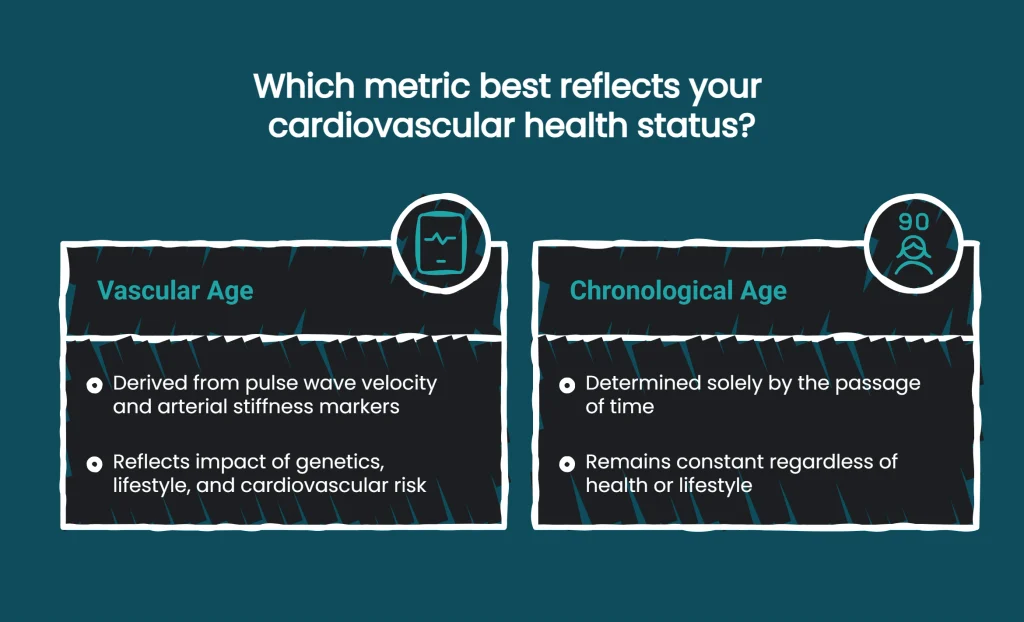
Short answer: Vascular age is a comparative metric: it measures how your arterial stiffness compares to population-average values for your age group, not your birth certificate. It’s calculated by comparing your pulse wave velocity (PWV) against reference values established from large healthy-population studies. If your PWV matches what’s typical for someone 15 years older, your vascular age is older than your chronological age, regardless of how old you actually are. Regular sauna use has been associated with improved arterial compliance and reduced arterial stiffness markers in small studies, which would translate to a younger vascular age on paper, but no study has directly measured “vascular age” as its own outcome in sauna research yet. The evidence is preliminary.
At a Glance
- Vascular age compares your arterial stiffness to population norms for your age group, it’s a relative metric, not a raw number
- It’s calculated from pulse wave velocity (PWV) measured against age-based reference values from large population studies
- A 2026 European collaboration established the reference values most vascular age tools are built on
- Sauna research shows improvements in the underlying arterial stiffness markers that feed into vascular age calculations
- No study has directly measured “vascular age” as a named outcome in sauna research specifically, that’s an inference from the underlying markers, not a direct finding
- Consumer vascular age calculators and at-home devices exist, but accuracy varies by the reference population and method used
Who This Guide Is For
This article is for sauna users who’ve encountered the term “vascular age” through a wearable, an at-home device, or a physician’s report, and want to understand what it actually measures and whether heat therapy affects it. It applies to traditional and infrared sauna users alike, since neither sauna type has been studied against vascular age directly. This is not medical advice, consult your healthcare provider for cardiovascular risk assessment.
What Does “Vascular Age” Actually Mean?
Vascular age isn’t a direct measurement, it’s a comparison. Your arteries are measured for stiffness, typically via pulse wave velocity, and that number is then compared against reference values for what’s typical at different ages in a healthy population. If your arteries perform like a typical 55-year-old’s but you’re 40, your vascular age is 55. If they perform like a typical 35-year-old’s, your vascular age is 35, regardless of your actual age.
This distinction matters because two people with the same brachial blood pressure reading, or even the same chronological age, can have meaningfully different vascular ages depending on how their arteries have aged relative to lifestyle, genetics, and cardiovascular risk factors. For the underlying markers this is built on, see our full breakdown of arterial stiffness, augmentation index, and pulse wave velocity, linked below.
How Is Vascular Age Actually Calculated?
The reference values most vascular age tools rely on trace back to a 2026 European collaboration that pooled data from over a dozen studies to establish normal and reference PWV values across age groups in healthy people. [1] That study, and the population norms it produced, is the scientific backbone behind most consumer and clinical vascular age calculations, whether the specific tool cites it or not.
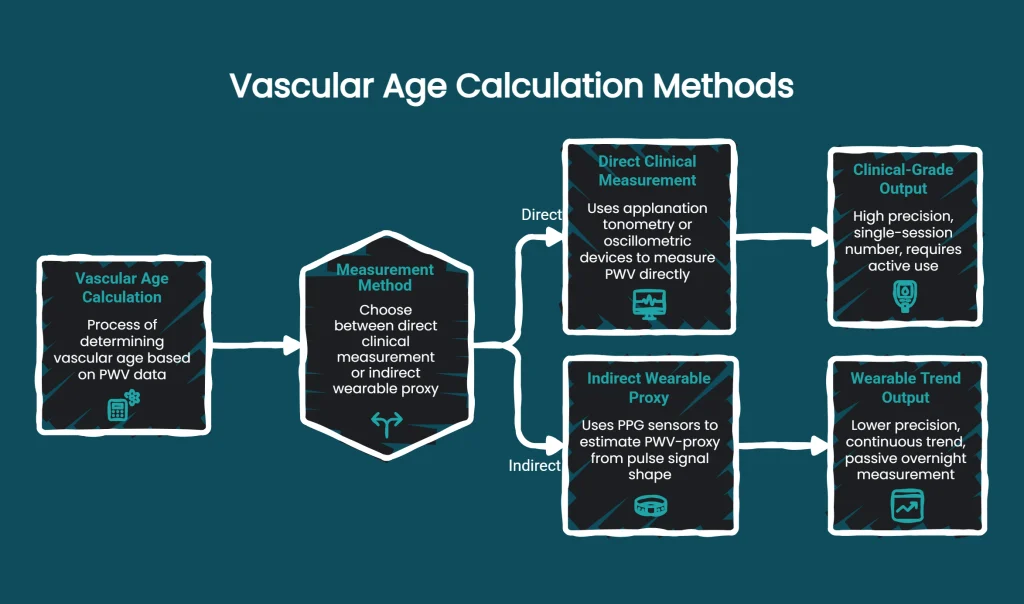
In practice, calculating vascular age requires two things: an accurate PWV measurement (via applanation tonometry, oscillometric devices, or increasingly some at-home vascular health devices) and a reference dataset to compare it against. The quality of a vascular age estimate depends heavily on both, a PWV measurement from an unvalidated device compared against a poorly matched reference population will produce a number that looks precise but isn’t necessarily meaningful.
How Do Consumer Vascular Age Tools Actually Calculate Your Number?
Not every device gets to a vascular age number the same way, and the difference matters for how much weight to put on the result. Clinical-grade home devices, built on the same pulse wave analysis technology covered in our central blood pressure article, measure PWV directly through a peripheral waveform and a validated transfer function, the same approach hospitals and research settings use. CONNEQT Pulse by CONNEQT Health is one example available for home use: it reports eight arterial and cardiovascular markers in a single reading, including central blood pressure, augmentation index, SEVR, pulse pressure amplification, and a reference age estimate calculated from central pressure and arterial stiffness parameters, positioned as a comparison point rather than a diagnosis.
A newer category of consumer wearables takes a different, less direct route. Oura Ring 5’s Cardiovascular Age feature, for instance, doesn’t measure PWV directly, it uses the ring’s overnight photoplethysmography (PPG) sensor to build a “PWV-proxy” from pulse signal shape, then estimates vascular age from that proxy using a model trained on data from hundreds of thousands of members alongside clinical validation work. A 2026 study from the National University of Singapore found this approach predicted vascular age with a mean error of six to seven years compared to participants’ actual ages, useful directional accuracy for a passive, no-effort overnight measurement, but a wider margin than a direct clinical-grade PWV reading would typically produce.
The practical distinction: a direct-measurement device gives you a more precise single-session number and requires you to actively use it, while an overnight wearable gives you a less precise but continuously updating trend with no extra effort. Which one makes more sense depends on whether you want a periodic checkup-style reading or an ongoing trend line.
What Do Sauna Studies Actually Show About the Underlying Markers?
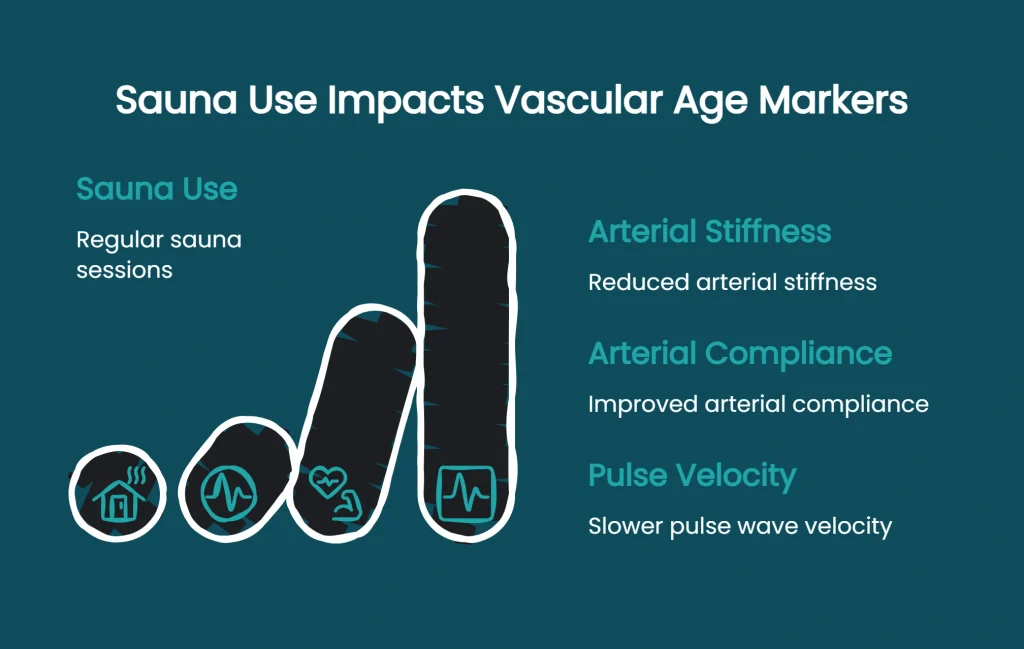
No published study has measured “vascular age” as its own named outcome in sauna research. What does exist is research on the components vascular age is built from: arterial stiffness, arterial compliance, and pulse wave velocity itself, several of which have shown improvement with regular sauna use in small studies, covered in full in our arterial stiffness article linked below.
The inference is straightforward but worth stating plainly: if regular sauna use improves the arterial stiffness markers that vascular age is calculated from, it’s reasonable to expect a corresponding effect on vascular age. But that’s an inference from adjacent research, not a direct finding, which is why this claim sits at the preliminary tier rather than well-documented. Nobody has run a study where sauna users had their vascular age calculated before and after a sauna protocol specifically.
Can You Track Your Own Vascular Age at Home?
A small but growing number of consumer tools now offer vascular age estimates, and it’s worth knowing what you’re actually getting from each category before treating the number as meaningful. Clinical-grade options like CONNEQT Pulse measure the underlying arterial stiffness markers directly, the same pulse wave analysis method used in research and hospital settings, then calculate a reference age from that data as one output among several. Wearable-based options like Oura Ring 5 estimate a Cardiovascular Age passively overnight from pulse signal shape, with no dedicated measurement session required, at the cost of a wider margin of error compared to a direct reading.
If you’re using one of these tools to track trends around your sauna routine, treat the absolute number with some skepticism regardless of which category you’re using, but a consistent downward trend over months of regular use is a reasonable thing to watch, provided you’re using the same device and method each time for a fair comparison. And whichever device you use, the gap covered earlier in this article still applies: none of these tools, direct or passive, have been validated specifically against sauna-driven changes. They measure the general arterial stiffness markers sauna research affects, not “vascular age after a sauna session” as its own studied outcome.
Frequently Asked Questions
Is vascular age a real medical measurement, or just a wellness marketing term?
The underlying concept, comparing arterial stiffness to age-based population norms, is grounded in real published research. How rigorously any specific consumer tool applies that science varies, so the concept is legitimate even when a specific product’s execution should be evaluated on its own merits.
Can sauna use lower my vascular age?
No study has directly tested this. Sauna use has been associated with improvements in the arterial stiffness markers vascular age is built from, which makes a beneficial effect plausible, but it hasn’t been directly measured as an outcome.
How much older can your vascular age be than your chronological age?
This varies widely by individual and is influenced by cardiovascular risk factors, smoking, hypertension, diabetes, and lifestyle. There isn’t a universal “normal gap,” it’s specific to the reference population and measurement method used.
Is a vascular age calculator on a smartwatch or app accurate?
Accuracy depends on how the underlying stiffness measurement is taken and which reference population it’s compared against, neither of which is always disclosed. Treat consumer estimates as directional rather than clinically precise.
Medical Disclaimer
This article is for informational purposes only and is not a substitute for professional medical advice, diagnosis, or treatment. Vascular age estimates from consumer devices are not equivalent to clinical cardiovascular risk assessment. Always consult a qualified healthcare provider for evaluation of cardiovascular risk factors and arterial health.
References
[1] The Reference Values for Arterial Stiffness’ Collaboration. Determinants of pulse wave velocity in healthy people and in the presence of cardiovascular risk factors: ‘establishing normal and reference values’. European Heart Journal. 2026. View on PubMed