
Infrared Saunas for Weight Loss: Myth vs Reality

Short answer: Infrared saunas do not produce meaningful fat loss. Weight loss measured immediately after a session is almost entirely water weight from sweating, which returns upon rehydration. No peer-reviewed evidence supports infrared sauna use as a standalone or meaningful contributor to fat reduction. Where infrared saunas may play a supporting role is as a recovery tool that helps sustain an active lifestyle — but the weight-loss mechanism is indirect at best.
Last updated: 2026
At a glance
- Weight lost during an infrared sauna session is water weight, not fat — it returns when you rehydrate
- Calorie expenditure from a sauna session is modest and not equivalent to cardiovascular exercise
- No peer-reviewed research supports infrared sauna use as a direct fat-loss intervention
- Infrared saunas may play an indirect support role by aiding recovery, reducing barriers to exercise, and supporting stress regulation
- Marketing claims about “passive calorie burn” and “fat mobilization through heat” are not supported by the available evidence
Who this guide is for
This article addresses the common question of whether infrared saunas contribute to weight loss. It separates what is physiologically happening during a session from what marketing claims suggest. Readers interested in weight management should treat this as one reference point within a broader evidence-based approach to body composition.
What Actually Happens to Your Body Weight During an Infrared Sauna Session
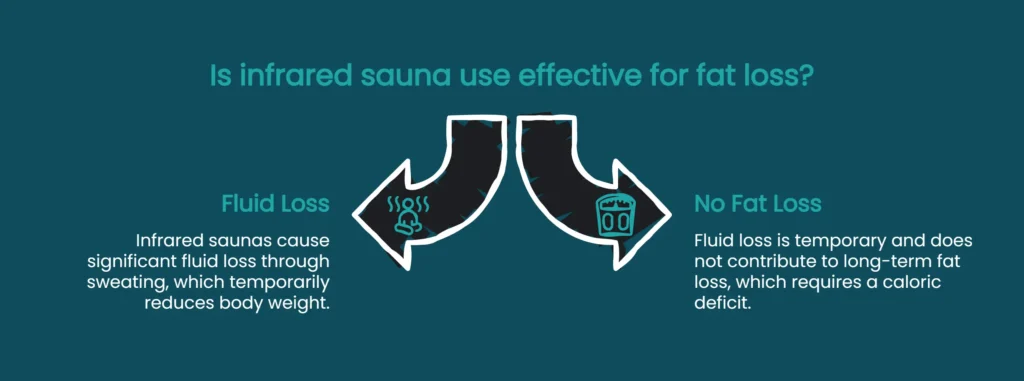
When core temperature begins to rise during a session, the thermoregulatory system responds by increasing heart rate to pump more blood toward the skin surface for heat dissipation, dilating blood vessels (vasodilation) to increase surface circulation, and activating sweat glands to release fluid that evaporates from the skin. You can lose 0.5–1.5 liters of fluid per session through sweat, which translates to approximately 1–3 pounds on a scale — this appears to be weight loss.
It is not fat loss. It is fluid loss. The moment you drink water after your session, that weight returns. Fat loss requires a sustained caloric deficit — consuming fewer calories than your body expends over time. Sweating out fluid does not contribute to this process.
The Calorie Question: How Much Do You Actually Burn?
A commonly repeated marketing claim is that infrared sauna sessions burn 200–600 calories per session. This figure is frequently cited without sources, or by referencing heart rate elevation as a proxy for caloric expenditure.
Some studies measure oxygen consumption (VO2) or heart rate during sauna sessions and use these to estimate caloric expenditure. The problem is that the elevated heart rate in a sauna is driven primarily by thermoregulation — increasing blood flow to the skin to dissipate heat — not by increased metabolic work from muscle activity. Heart rate is a reliable proxy for caloric expenditure during exercise because exercise involves muscular work that requires oxygen. During sauna use, the heart rate elevation occurs without significant muscular work, making heart-rate-based caloric estimates unreliable.
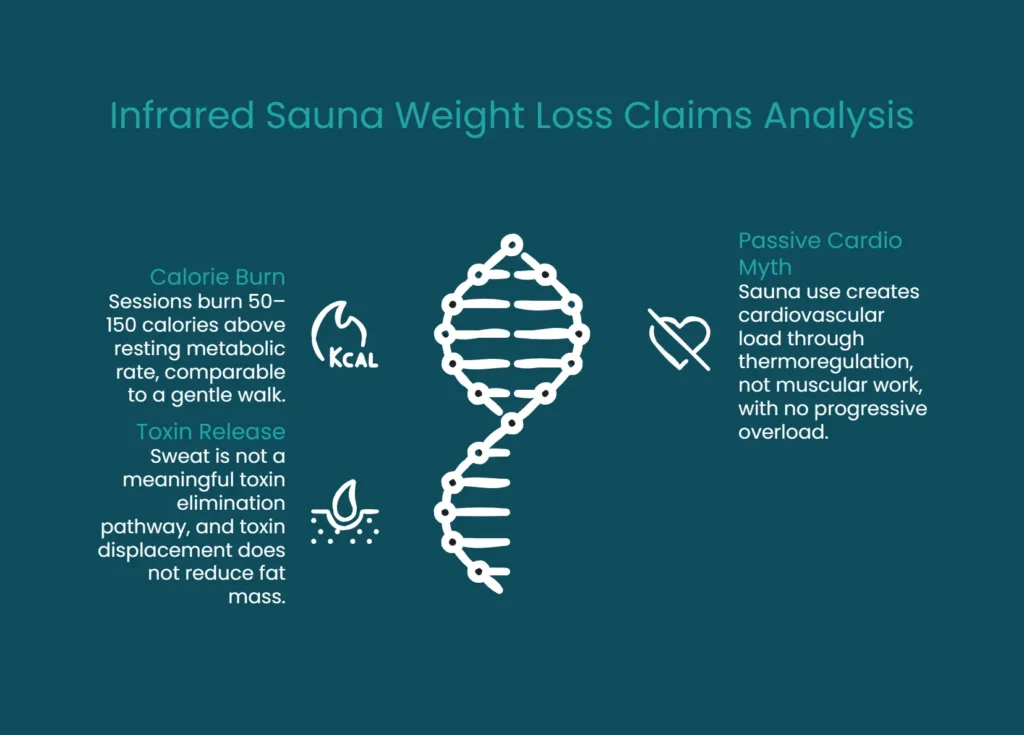
A 30-minute infrared sauna session produces estimated caloric expenditure in the range of 50–150 calories above resting metabolic rate for most adults — comparable to a gentle walk, not a cardiovascular workout. [1] Studies claiming significantly higher calorie burns typically lack rigorous methodology, use small samples, or conflate total energy expenditure (including resting metabolism during the session) with the incremental expenditure specifically attributable to sauna use.
The “Passive Cardio” Myth: Why It Doesn’t Transfer to Fat Loss
Some marketing describes infrared sauna use as “passive cardio” — implying that the cardiovascular response (elevated heart rate, vasodilation) produces similar effects to aerobic exercise. This framing misrepresents how cardiovascular adaptation and fat metabolism work.
Exercise builds cardiovascular fitness and supports fat loss through increased cardiac output demand from working muscles, progressive overload on the heart and vascular system, metabolic adaptation including improved insulin sensitivity, fat oxidation capacity, and mitochondrial density, and sustained caloric deficit contribution through muscular energy expenditure. Sauna use creates cardiovascular load through thermoregulation — not muscular work — with no progressive overload and no meaningful improvement in fat oxidation capacity.
A 2009 review of far-infrared sauna clinical evidence specifically noted only weak evidence from single studies supporting infrared sauna use for obesity — the strongest available evidence at the time could not identify sufficient data to recommend infrared saunas as a weight management intervention. [2]
The “Toxin Release” Weight Loss Claim: Not Supported
A separate but related claim is that infrared saunas promote weight loss by “releasing toxins stored in fat cells” through deep heat penetration. This claim has two separate problems.
First, the detox mechanism is misrepresented. The body’s primary detoxification organs are the liver and kidneys, which filter blood and process waste products continuously. While some compounds can be detected in sweat in trace amounts, sweat is not a meaningful toxin elimination pathway. [1]
Second, even if toxins were released from fat cells, this would not reduce fat mass. Fat loss requires the mobilization and oxidation of fatty acids through a caloric deficit — not heat-induced toxin displacement.
Where Infrared Saunas May Play an Indirect Supporting Role
Dismissing direct fat-loss claims does not mean infrared saunas have no place in a weight management approach. The indirect mechanisms are more plausible, though the evidence connecting them to actual weight outcomes is limited.
One of the most consistent barriers to sustained exercise is delayed onset muscle soreness (DOMS) and inadequate recovery between training sessions. Infrared sauna use has been studied in relation to reduced muscle soreness and improved recovery markers in small trials. If regular sauna use allows an individual to train more consistently or at higher intensity by improving recovery, the downstream effect on caloric expenditure could be meaningful — but this is an indirect pathway, not direct fat loss from the sauna itself.
Elevated cortisol from chronic stress is associated with increased appetite, preference for calorie-dense foods, and abdominal fat accumulation through hormonal mechanisms. Infrared saunas have been studied in relation to cortisol reduction and parasympathetic nervous system activation. If regular sauna use contributes to lower chronic stress and cortisol levels, it may indirectly support better food intake regulation — again, an indirect pathway with gaps in the evidence chain.
Sleep deprivation is consistently associated with disrupted appetite regulation (leptin/ghrelin imbalance), increased caloric intake, and reduced energy for physical activity. [3] Some small studies suggest infrared sauna use in the evening may improve sleep onset and quality through the core temperature elevation-then-drop mechanism. Improved sleep quality may support better appetite regulation and energy for exercise as a further indirect pathway.
What the Evidence Does Support
| Use Case | Evidence Quality |
|---|---|
| Relaxation and stress reduction | Moderate — consistent across user reports and small studies |
| Temporary muscle soreness reduction | Moderate — small controlled studies |
| Cardiovascular stimulus during session | Well-documented — heart rate elevation and vasodilation are consistent findings |
| Heat shock protein production | Well-documented mechanism |
| Temporary pain relief for musculoskeletal conditions | Moderate — studied in fibromyalgia, arthritis |
| Direct fat loss | Not supported |
| Meaningful caloric expenditure above resting | Weak — modest and not clinically significant for weight management |
| Detoxification through sweat | Not supported as a meaningful pathway |
A Realistic Framework for Infrared Sauna Use and Body Composition
Use it as a recovery tool, not a weight loss tool. Post-exercise sessions at 130–140°F for 20–30 minutes may support recovery and allow more consistent training — which is where the body composition benefit actually comes from. Do not reduce caloric intake more aggressively because you “burned calories” in the sauna — the caloric expenditure is too modest to meaningfully offset dietary decisions. Do not substitute sauna sessions for exercise — the cardiovascular and metabolic adaptations from exercise are distinct from the thermoregulatory responses induced by sauna use. Do use it for stress management — if sauna sessions reduce chronic stress and cortisol, this is a legitimate supporting pathway, just not a direct fat-loss mechanism.
Frequently Asked Questions
Will I lose weight using an infrared sauna?
You will temporarily lose water weight during and immediately after a session. This returns when you rehydrate, which is essential for safety. Sustained fat loss requires caloric deficit through diet and exercise — infrared saunas do not contribute meaningfully to this process on their own.
How many calories does an infrared sauna session burn?
Approximately 50–150 calories above resting metabolic rate for a 30-minute session at moderate temperature, based on available metabolic estimates. Claims of 400–600 calories per session are not supported by rigorous evidence.
Can infrared saunas help with belly fat specifically?
No. Spot reduction of fat from specific body areas through any non-surgical method is not supported by evidence. Fat loss distributes across the body according to individual genetics and hormonal patterns — not according to where heat is applied.
Is it safe to use a sauna for weight loss purposes?
Using an infrared sauna as a general wellness tool is safe for most healthy adults with proper hydration. Using it specifically as a weight loss strategy risks false confidence in caloric expenditure and potential dehydration risk if users restrict fluid to “preserve” the weight lost during the session. Always rehydrate fully after a session.
Do any studies show infrared saunas help with weight loss?
The 2009 review of far-infrared sauna clinical evidence found only weak evidence from single studies for obesity as an application. [2] No subsequent high-quality randomized controlled trials have established infrared sauna use as an effective weight loss intervention as of this writing.
Medical Disclaimer: This article provides educational information about the physiological effects of infrared sauna use in relation to body weight and is not intended as medical advice. Weight management involves complex physiological factors. Consult a qualified healthcare provider or registered dietitian for personalized guidance on weight management.
For comprehensive guides on infrared sauna evidence, safety, and practical use, visit Sauna Health Nut.
References
[1] Hannuksela ML, Ellahham S. “Benefits and risks of sauna bathing.” The American Journal of Medicine. 2001. View on PubMed
[2] Beever R. “Far-infrared saunas for treatment of cardiovascular risk factors: summary of published evidence.” Canadian Family Physician. 2009. View on PMC
[3] Spiegel K, et al. “Brief communication: Sleep curtailment in healthy young men is associated with decreased leptin levels, elevated ghrelin levels, and increased hunger and appetite.” Annals of Internal Medicine. 2004. View on PubMed
You might also find these useful: