
Sauna Detoxification: What the Science Actually Shows

Short answer: Saunas do not detoxify the body in the way most marketing claims suggest. The liver and kidneys are the body’s primary detoxification organs, processing and eliminating waste products continuously through urine and bile. Sweat is composed overwhelmingly of water and electrolytes, with only trace amounts of toxins — too small to be physiologically significant. Where saunas genuinely support health is through improved circulation, cardiovascular stimulus, and stress reduction — not through sweating out toxins.
Last updated: 2026
At a glance
- The liver and kidneys handle over 95% of the body’s toxin elimination — sweat is a minor secondary pathway at best
- Sweat is approximately 99% water and electrolytes — trace heavy metals and compounds are present but in quantities too small to be clinically meaningful
- No peer-reviewed evidence supports the claim that sauna-induced sweating produces superior detoxification compared to normal kidney and liver function
- Both infrared and traditional saunas provide genuine health benefits — but through circulation, cardiovascular stimulus, and stress reduction, not detox
- The detox claim is the most pervasive piece of sauna marketing misinformation and has been consistently contradicted by medical experts
Who this guide is for
This article is for sauna users and prospective buyers who have encountered detoxification claims in sauna marketing and want to understand what the evidence actually shows. It covers how the body actually eliminates toxins, what sweat composition research shows, where the detox claim originated, and what genuine benefits saunas provide instead. For evidence-based health applications of sauna use, see our infrared sauna benefits for chronic pain and sauna for cardiovascular health articles.
How the Body Actually Detoxifies
Before evaluating sauna detox claims, it helps to understand how the body actually eliminates waste products and toxic compounds. This is not complicated — but it is consistently misrepresented in wellness marketing.
The Liver
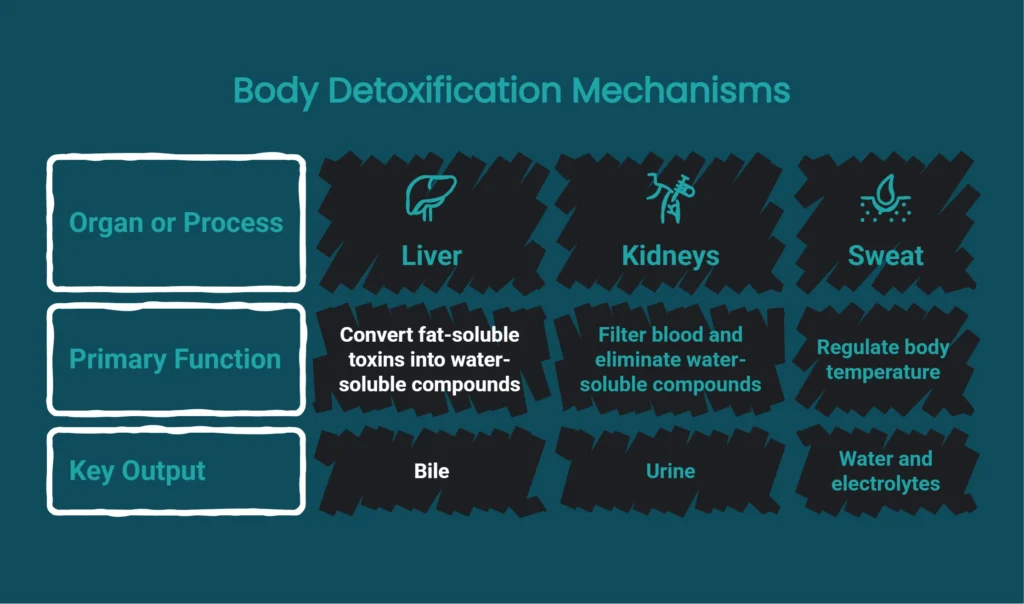
The liver is the body’s primary detoxification organ. It receives blood directly from the digestive system via the portal vein and processes everything absorbed from food and drink before it reaches general circulation. The liver uses two-phase enzymatic processes to convert fat-soluble toxins into water-soluble compounds that can be excreted in bile or filtered by the kidneys. It processes alcohol, medications, environmental chemicals, metabolic waste products, and thousands of other compounds continuously — 24 hours a day, 7 days a week. [1]
The Kidneys
The kidneys filter approximately 200 liters of blood per day, producing 1–2 liters of urine that contains metabolic waste products, excess minerals, water-soluble toxins, and drug metabolites. The kidneys are the primary elimination route for most water-soluble compounds and work in close coordination with the liver’s biotransformation processes. [1]
The Role of Sweat
Sweat exists to regulate body temperature — not to eliminate toxins. The eccrine sweat glands that produce the majority of human sweat output are designed specifically for thermoregulation. Sweat composition reflects this function: approximately 99% water and electrolytes (primarily sodium, chloride, potassium, and magnesium). [2]
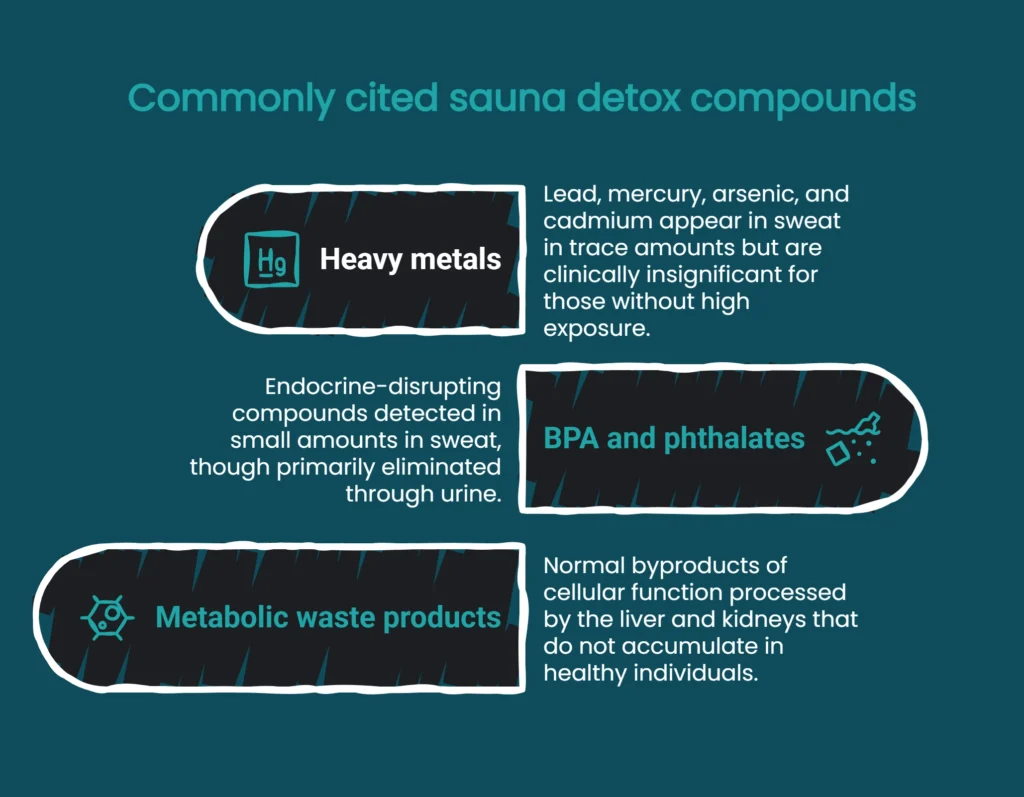
Trace amounts of other compounds can be detected in sweat — including some heavy metals, BPA, and other environmental chemicals — but the quantities are small relative to what the kidneys eliminate through urine. A 2026 review examining sweat composition and toxin elimination concluded that while some compounds appear in sweat, the contribution of sweating to overall toxin elimination is minor compared to urinary and biliary excretion. [2]
Where the Sauna Detox Claim Came From
The detoxification claim in sauna marketing has two origins — one plausible, one not.
The plausible origin: Some early occupational medicine research examined whether induced sweating could help eliminate certain heavy metals in workers with occupational chemical exposures. Small amounts of lead, cadmium, arsenic, and mercury were detected in sweat in these studies, leading to the interpretation that sweating aids in heavy metal elimination. [2] This is technically accurate but contextually misleading — the quantities found were small, the populations studied had abnormally high toxic exposures, and urinary elimination still exceeded sweat elimination for most compounds.
The marketing extrapolation: From this limited occupational medicine research, sauna marketers extrapolated broadly — claiming that far-infrared heat specifically mobilizes toxins from fat cells and produces sweat with uniquely high toxin concentrations. The “toxins stored in fat cells” mechanism specifically has no credible scientific support. Fat-soluble toxins are processed by the liver, not mobilized by heat and excreted through sweat glands.
What Sweat Composition Research Actually Shows
Several studies have directly analyzed sweat composition to evaluate the detox hypothesis. The findings are consistent:
Sweat contains trace amounts of heavy metals and environmental chemicals. However, the quantities are consistently small relative to urinary elimination. A study examining sweat, blood, and urine concentrations of various toxins found that urinary elimination exceeded sweat elimination for all compounds measured. [2]
The claim that infrared-induced sweat has a higher toxin concentration than traditional sauna sweat or exercise-induced sweat has been tested and not confirmed. The composition of sweat from different heat sources does not differ meaningfully in its toxin content. [3]
Importantly, excessive sweating without adequate rehydration can actually impair kidney function by reducing blood volume and urinary output — counterproductively reducing the body’s primary toxin elimination pathway. This makes aggressive sauna use for “detox” potentially counterproductive if hydration is not maintained. [1]
The “Toxins” Problem
A consistent issue with sauna detox marketing is the use of the word “toxins” without specifying what compounds are being referenced. This vagueness is not accidental — it allows the claim to be unfalsifiable. When pressed, proponents typically cite:
Heavy metals (lead, mercury, arsenic, cadmium): These do appear in sweat in trace amounts. However, for people without occupational or environmental heavy metal exposure, baseline blood levels are already low and the amounts eliminated through sweat are clinically insignificant. Diagnosed heavy metal toxicity is treated through chelation therapy under medical supervision — not sauna use. [1]
BPA and phthalates: Some studies have detected these endocrine-disrupting compounds in sweat. The amounts are small, and the primary elimination route for these compounds remains urinary. Reducing exposure at the source (food packaging, plastics) has far greater impact than sweat elimination. [2]
Unspecified “metabolic waste products”: This category is circular — metabolic waste products are normal byproducts of cellular function that the liver and kidneys process continuously. They do not accumulate in the body under normal circumstances in healthy individuals. There is nothing to “detox.”
What Saunas Actually Do Well
Dismissing the detox claim does not mean saunas lack genuine health benefits. The evidence for other mechanisms is substantially stronger:
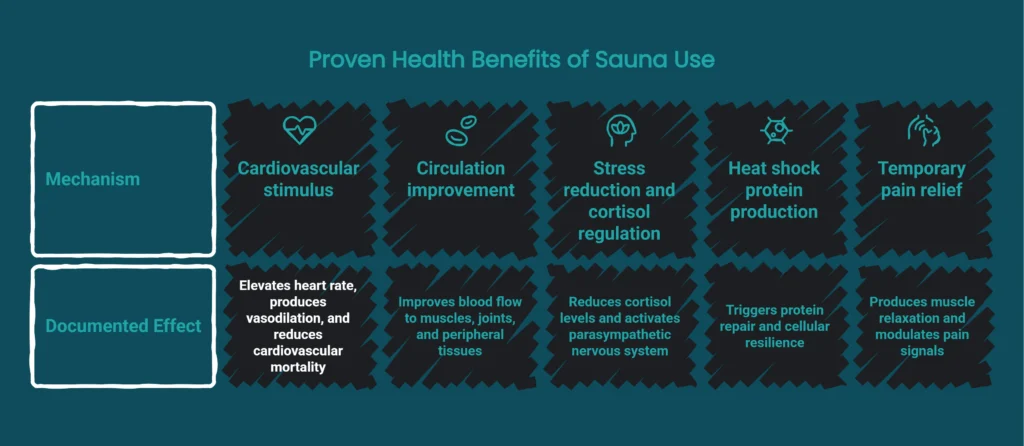
Cardiovascular stimulus: Both infrared and traditional saunas elevate heart rate, produce vasodilation, and create a cardiovascular response comparable to moderate exercise. Finnish population studies have documented associations between regular sauna use and reduced cardiovascular mortality. [4]
Circulation improvement: Heat-induced vasodilation improves blood flow to muscles, joints, and peripheral tissues — a real mechanism with real applications for recovery and pain management.
Stress reduction and cortisol regulation: Regular sauna use has been associated with reduced cortisol levels and parasympathetic nervous system activation — well-documented effects with meaningful implications for stress-related health outcomes.
Heat shock protein production: Both sauna types trigger HSP production — a cellular stress response with documented roles in protein repair and cellular resilience.
Temporary pain relief: Deep tissue warming from far-infrared radiation produces muscle relaxation and temporary pain signal modulation — studied specifically for fibromyalgia, rheumatoid arthritis, and musculoskeletal pain.
These are the mechanisms worth understanding and communicating. They are supported by evidence. The detox claim is not.
Evidence Summary
| Claim | Evidence Status | What the Evidence Actually Shows |
|---|---|---|
| Saunas eliminate toxins through sweat | Not supported | Sweat eliminates trace amounts; liver/kidneys are primary organs |
| Infrared sweat has higher toxin content than other sweat | Not supported | No meaningful difference in sweat composition by heat source |
| Far-infrared mobilizes fat-stored toxins | Not supported | No credible mechanism; fat-soluble toxins processed by liver |
| Sweating supports “detox” | Partially true, misleadingly framed | Sweat contains trace toxins but contribution is minor vs urinary elimination |
| Saunas improve circulation and cardiovascular health | Well-supported | Consistent across multiple study types and populations |
| Saunas reduce cortisol and support stress reduction | Moderate evidence | Consistent direction across available studies |
Frequently Asked Questions
Do saunas help the body detox?
In the strict physiological sense, no — not in the way marketing claims suggest. Sweat contains trace amounts of toxins but the quantities are small relative to what the liver and kidneys eliminate continuously through urine and bile. The body detoxifies through these organs around the clock regardless of sauna use. What saunas do provide — improved circulation, cardiovascular stimulus, stress reduction — are genuine benefits, just not detoxification.
Is there any evidence for sauna detoxification?
Some occupational medicine research found elevated heavy metals in sweat among workers with high toxic exposures. This was extrapolated by sauna marketers into broad detox claims. The evidence does not support sauna use as a meaningful detoxification method for the general population with normal toxic exposures. Medical detoxification for diagnosed toxicity requires clinical intervention, not sauna sessions.
Does infrared sauna produce better detox than traditional sauna?
No evidence supports this claim. The composition of sweat does not differ meaningfully between infrared-induced and traditional sauna-induced sweat in studies that have examined this question.
If saunas don’t detox, why do I feel so good after a session?
The post-sauna feeling of wellbeing is real — it just has nothing to do with toxin elimination. The actual mechanisms are endorphin release triggered by heat stress, parasympathetic nervous system activation producing deep relaxation, improved circulation delivering oxygen and nutrients to tissues, and reduced cortisol levels. These are genuine physiological effects with well-characterized mechanisms.
Can sauna use support liver and kidney function?
Indirectly, through improved circulation and reduced chronic stress — both of which support overall organ function. However, this is a far more modest and indirect claim than “detoxification through sweat.” Maintaining adequate hydration during and after sauna sessions is important because dehydration can impair kidney function.
Medical Disclaimer: This article provides educational information about sauna use and detoxification claims and does not constitute medical advice. If you have concerns about toxic exposures or require medical detoxification, consult a qualified healthcare provider. Do not substitute sauna use for medically supervised detoxification treatment.
For comprehensive guides on evidence-based sauna health applications, visit Sauna Health Nut.
References
[1] Hannuksela ML, Ellahham S. “Benefits and risks of sauna bathing.” The American Journal of Medicine. 2001. View on PubMed
[2] Genuis SJ, et al. “Blood, urine, and sweat (BUS) study: monitoring and elimination of bioaccumulated toxic elements.” Archives of Environmental Contamination and Toxicology. 2026. View on PubMed
[3] Sears ME, et al. “Arsenic, cadmium, lead, and mercury in sweat: a systematic review.” Journal of Environmental and Public Health. 2026. View on PubMed
[4] Laukkanen JA, et al. “Cardiovascular and Other Health Benefits of Sauna Bathing: A Review of the Evidence.” Mayo Clinic Proceedings. 2026. View on PubMed
You might also find these useful: