
What Does Infrared Heat Actually Do to Your Cardiovascular System?

Short answer: The cardiovascular health associations frequently attributed to sauna use, reduced risk of cardiac events, improved blood pressure, lower all-cause mortality, are derived almost exclusively from research on traditional Finnish high-heat saunas, not infrared saunas. Infrared saunas do produce measurable cardiovascular responses during sessions (heart rate elevation, vasodilation, blood pressure changes), and preliminary research suggests potential benefits for specific conditions. However, the long-term cardiovascular evidence base for infrared specifically is thin. Understanding this distinction is essential for evidence-aligned expectations.
Last updated: 2026
At a glance
- The landmark cardiovascular sauna studies (KIHD cohort) studied traditional Finnish saunas at 174°F, not infrared saunas Infrared saunas produce acute cardiovascular responses during sessions: heart rate elevation, vasodilation, temporary blood pressure changes Preliminary studies suggest infrared may benefit congestive heart failure and peripheral arterial disease patients under clinical supervision Cardiovascular contraindications are significant: unstable conditions require medical clearance before any sauna use Evidence supports treating infrared sauna as a cardiovascular stimulus tool, not a cardiovascular treatment
Who this guide is for
This is an evidence review for health-conscious adults, wellness practitioners, and people with cardiovascular health goals evaluating infrared sauna use. It distinguishes between the acute cardiovascular effects of infrared sessions and the long-term associations found in sauna research, and identifies where the evidence is strong versus where it is preliminary or absent. This article is not medical advice. Always consult a cardiologist or healthcare provider before using infrared saunas if you have any cardiovascular condition.
I used a colon on the contraindications bullet since it’s introducing a reason rather than just pausing, and split the medical-advice line into two sentences instead of a comma splice, felt cleaner than forcing a comma there.
The Evidence Gap: What Most Sauna-Heart Research Actually Studied
The most important context for any discussion of infrared saunas and cardiovascular health is understanding what the landmark research actually examined.
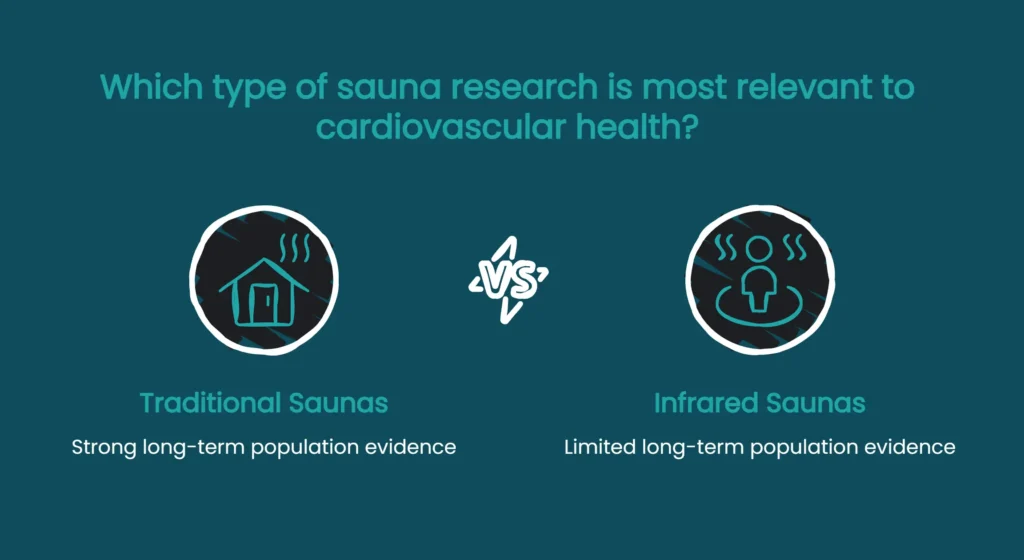
The strongest long-term evidence comes from Finnish population studies, most notably the KUOPIO Ischemic Heart Disease (KIHD) Risk Factor Study, which followed over 2,000 middle-aged Finnish men for up to 20 years. Population-based studies following thousands of people over many years consistently suggest that regular users of traditional saunas have significantly lower rates of heart disease and all-cause mortality than non-users. [1]
A 2026 systematic review of traditional dry sauna bathing identified 40 separate clinical studies involving 3,855 participants, examining outcomes from cardiovascular function to respiratory health. [2]
These studies used traditional Finnish saunas operating at 174–195°F (79–91°C) with high ambient heat and steam exposure, a fundamentally different heat delivery mechanism than infrared sauna radiant heat at 110–150°F.
When someone cites “sauna research” in relation to cardiovascular benefits, they are almost certainly citing traditional sauna data. This does not invalidate interest in infrared sauna cardiovascular effects, it simply means the long-term population evidence does not directly apply to infrared sauna use.
Acute Cardiovascular Responses During Infrared Sauna Sessions
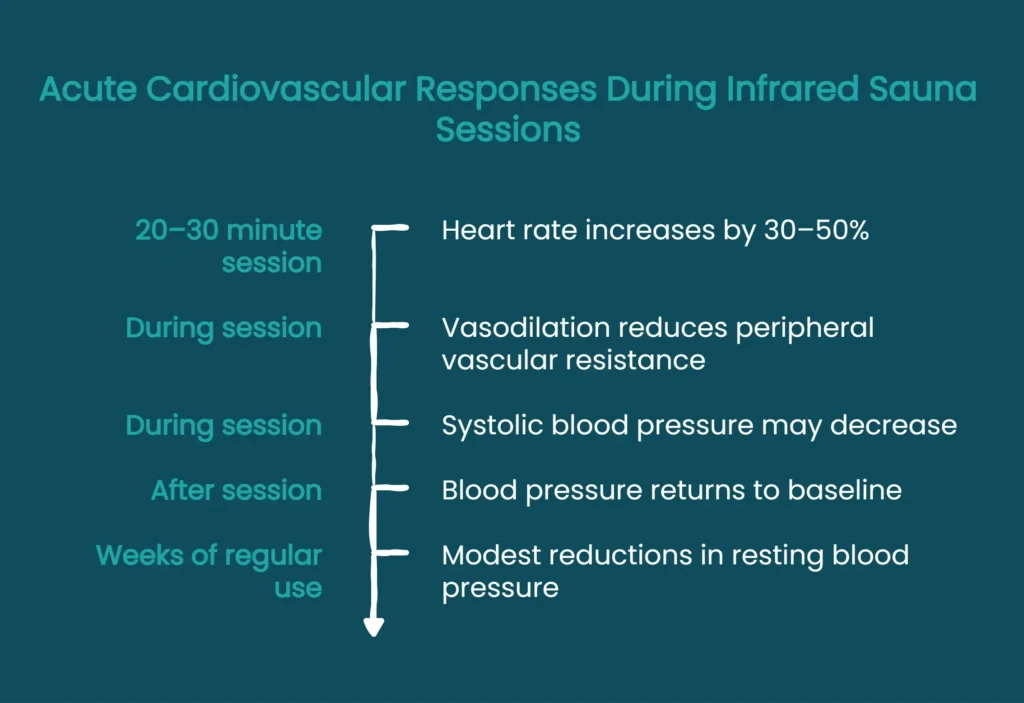
Distinct from long-term associations, the acute cardiovascular effects of infrared sauna sessions, what happens to your cardiovascular system during a 20–30 minute session, are better documented.
Heart Rate Elevation
During a typical infrared sauna session at 130–150°F, heart rate increases by approximately 30–50% above resting baseline. In a person with a resting heart rate of 60–70 bpm, this corresponds to approximately 90–110 bpm during a session. This elevation occurs through thermoregulatory mechanisms: the cardiovascular system increases cardiac output to pump more blood toward the skin surface for heat dissipation, not through mechanical muscular demand as in exercise.
Vasodilation
Infrared heat causes blood vessels to dilate (expand), reducing peripheral vascular resistance. This vasodilatory response is a well-documented physiological effect of heat exposure and is the basis for the blood pressure changes observed during and after sessions.
Blood Pressure Changes
Systolic blood pressure may decrease during a session as vasodilation reduces resistance, and typically returns to baseline afterward. In some individuals and studies, repeated infrared sauna use has been associated with modest reductions in resting blood pressure over weeks of regular use. A far-infrared sauna review found cardiovascular risk factor data in nine relevant studies with high-quality evidence, showing hemodynamic effects including heart rate changes and blood pressure modulation. [3] The authors noted these were preliminary findings warranting larger studies.
Cardiac Output
The combination of increased heart rate and vasodilation increases cardiac output during sessions, a meaningful cardiovascular stimulus that shares surface-level similarity with moderate aerobic exercise in terms of heart rate response. The mechanisms and training adaptations differ substantially from exercise, however.
Infrared Sauna Research for Specific Cardiovascular Conditions
While long-term population evidence is lacking for infrared specifically, several targeted studies have examined infrared sauna use in specific cardiovascular patient populations.
Congestive Heart Failure
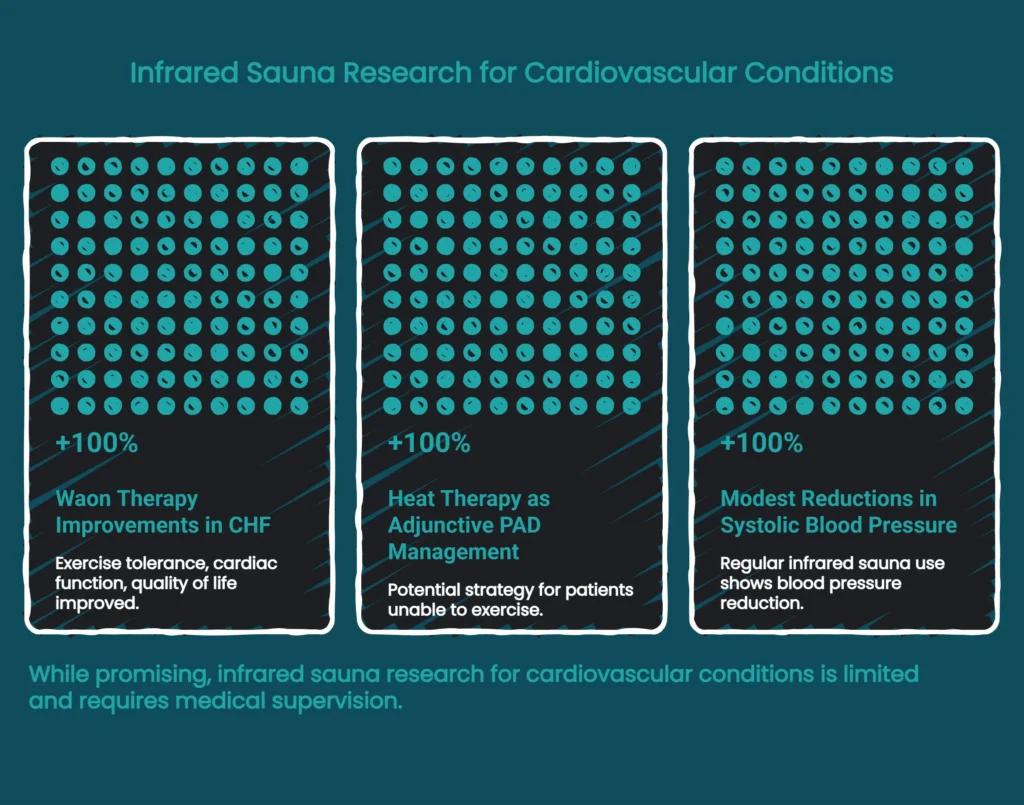
The most specific and promising infrared cardiovascular evidence involves congestive heart failure (CHF). Japanese researchers have conducted multiple studies examining “Waon therapy,” a form of far-infrared dry sauna therapy developed for cardiac patients. Studies of Waon therapy in CHF patients reported improvements in exercise tolerance, cardiac function markers, and quality of life measures compared to control conditions. [4] These studies used medically supervised sessions with specific FIR protocols and careful patient selection; they are not a basis for unsupervised home sauna use by CHF patients.
Congestive heart failure is a serious medical condition. These findings represent supervised clinical research and should not be interpreted as permission for independent sauna use by CHF patients without explicit cardiologist approval.
Peripheral Arterial Disease
Peripheral arterial disease (PAD) involves reduced blood flow to the limbs, often causing exercise-limiting leg pain (claudication). Because PAD patients frequently cannot exercise adequately, heat therapy has been explored as an alternative cardiovascular stimulus. Emerging research is examining heat therapy including saunas as a potential adjunctive management strategy for cardiovascular diseases, particularly for PAD patients who face barriers to traditional exercise. [5] This research is preliminary and ongoing.
Hypertension
Several small studies have examined the effect of repeated infrared sauna sessions on blood pressure in hypertensive individuals. Findings have generally shown modest reductions in systolic blood pressure with regular use, consistent with the vasodilatory mechanism. [3] Individuals with uncontrolled hypertension should not use infrared saunas without medical clearance; the cardiovascular load of a sauna session can be significant.
Heat Shock Proteins: A Mechanistic Link to Cardiovascular Health
One mechanism connecting repeated sauna use to potential long-term cardiovascular health is the production of heat shock proteins (HSPs). When core body temperature rises during a sauna session, cells produce HSPs as a protective stress response. These proteins act as molecular chaperones: helping repair damaged proteins, prevent protein aggregation, and support cellular resilience. HSP70 and HSP90 have been studied in relation to vascular endothelial function, and regular heat-induced HSP production may contribute to improved vascular resilience over time. Whether repeated infrared sauna sessions produce sufficient HSP stimulus for meaningful cardiovascular protection remains to be established in long-term studies.
Cardiovascular Contraindications: When Not to Use
The cardiovascular load of an infrared sauna session makes contraindications critically important for cardiac patients.
Do not use infrared saunas with:
- Unstable angina
- Recent myocardial infarction, generally within 4–6 weeks, or longer depending on cardiac status
- Severe aortic stenosis
- Uncontrolled heart failure without physician clearance
- Significant arrhythmias that are not rate-controlled
- Hypertrophic obstructive cardiomyopathy
Consult a cardiologist before use if you have:
- Controlled hypertension (even well-managed)
- Stable coronary artery disease
- History of cardiac events
- Implanted cardiac devices (pacemakers, ICDs)
- Any condition requiring cardiovascular medications
Medication considerations: Beta blockers blunt the heart rate response and cardiovascular load is still present even if heart rate elevation is reduced. Diuretics increase dehydration risk significantly. Vasodilators and antihypertensives may cause excessive blood pressure drops during sessions.
Evidence Summary Table
| Cardiovascular Outcome | Evidence Type | Evidence Quality | Notes |
|---|---|---|---|
| Acute heart rate elevation | Mechanistic + clinical | Well-documented | Consistent across infrared studies |
| Acute vasodilation | Mechanistic + clinical | Well-documented | Core physiological response |
| Short-term blood pressure reduction | Small RCTs | Moderate preliminary | Multiple small studies |
| Long-term cardiovascular event reduction | Population studies | Strong — traditional saunas only | Does not directly apply to infrared |
| CHF symptom improvement (supervised) | Controlled clinical studies | Moderate | Waon therapy; requires clinical supervision |
| PAD adjunctive therapy | Emerging research | Preliminary | 2026 Frontiers study and others ongoing |
| All-cause mortality reduction | Population studies | Strong — traditional saunas only | No infrared-specific long-term data |
Frequently Asked Questions
Do the Finnish sauna longevity studies apply to infrared saunas?
Not directly. The landmark KIHD studies used traditional high-heat saunas at 174–195°F. Infrared saunas operate at significantly lower ambient temperatures through a different heat delivery mechanism. While both types produce cardiovascular stimulus, the specific protocols, temperatures, and physiological exposures differ which the Finnish data cannot be directly transferred to infrared sauna use.
Can infrared saunas lower blood pressure?
Preliminary evidence from small studies suggests regular infrared sauna use may produce modest reductions in resting blood pressure in hypertensive individuals, consistent with the vasodilatory effects of heat exposure. This is not established as a reliable hypertension treatment and does not substitute for prescribed antihypertensive medications. Anyone with hypertension should consult their physician before sauna use.
Is it safe to use an infrared sauna if I have heart disease?
It depends entirely on the specific condition, its current status, and medical management. Some patients with stable, well-controlled cardiac conditions may be cleared for sauna use by their cardiologist. Patients with unstable conditions, recent cardiac events, or significant arrhythmias should not use saunas. Medical clearance from a cardiologist is non-negotiable.
How does infrared sauna cardiovascular stimulus compare to exercise?
Both increase heart rate and cardiac output and produce vasodilation. The mechanisms differ: exercise creates cardiovascular load through muscular metabolic demand, while sauna creates it through thermoregulation. Exercise produces progressive cardiovascular adaptations (improved cardiac efficiency, VO2 max, capillary density) through repeated training stimulus. Infrared sauna use does not produce equivalent cardiovascular training adaptations. They are distinct tools with different outcomes.
How often would I need to use an infrared sauna for cardiovascular benefit?
The Finnish traditional sauna research found the strongest associations with 4–7 sessions per week. For infrared specifically, most available studies use 3–5 sessions per week over 4–12 weeks. No optimal frequency has been established for infrared cardiovascular outcomes specifically.
Medical Disclaimer: This article is an educational evidence review and does not constitute medical advice. Cardiovascular conditions require individualized medical management by qualified healthcare professionals. Do not modify cardiovascular medications, substitute sauna use for prescribed cardiac rehabilitation, or begin sauna use with any cardiovascular condition without explicit clearance from your cardiologist or physician.
For comprehensive guides on infrared sauna safety, mechanisms, and usage guidelines, visit Sauna Health Nut.
References
[1] Harvard Health Publishing. “Can regular sauna sessions support a healthy heart?” Harvard Medical School. View article
[2] Hussain J, Cohen M. “Clinical Effects of Regular Dry Sauna Bathing: A Systematic Review.” Evidence-Based Complementary and Alternative Medicine. 2026. View on PMC
[3] Beever R. “Far-infrared saunas for treatment of cardiovascular risk factors: summary of published evidence.” Canadian Family Physician. 2009. View on PMC
[4] Kihara T, et al. “Repeated sauna treatment improves vascular endothelial and cardiac function in patients with chronic heart failure.” Journal of the American College of Cardiology. 2002. View on PubMed
[5] Frontiers in Cardiovascular Medicine. “Heat therapy as adjunctive management for cardiovascular disease including peripheral arterial disease.” 2026. View study
You might also find these useful: