
How to Measure and Compare EMF Levels in Infrared Saunas

Short answer: To measure EMF levels in an infrared sauna, use a trifield meter capable of reading both magnetic fields (in milligauss, mG) and electric fields (in volts per meter, V/m). Test at four positions — bench height at center, near the heating panels, floor level, and head height — with the sauna at full operating temperature. Building biology guidelines suggest keeping sustained magnetic field exposure below 1 mG and electric fields below 5 V/m in therapeutic environments, though no regulatory standard specific to saunas currently exists.
Last updated: 2026
At a glance
- EMF from infrared saunas includes both magnetic fields (measured in mG) and electric fields (measured in V/m) — both require testing
- A trifield meter is the standard consumer tool for measuring both field types
- Test at four positions: center bench, near panels, floor level, and head height — readings vary significantly by position
- Building biology guidelines: below 1 mG (magnetic) and below 5 V/m (electric) for sustained therapeutic environments
- Manufacturer EMF claims require third-party verification — measurement conditions dramatically affect results
Who this guide is for
This article is for infrared sauna owners and prospective buyers who want to independently verify EMF levels rather than rely solely on manufacturer claims. It covers testing methodology, meter selection, measurement positions, how to interpret results, and how to compare models. For a foundational explanation of why EMF levels matter for infrared sauna effectiveness, see our guide to low-EMF infrared saunas.
Why Measuring EMF in Infrared Saunas Requires a Specific Approach
Infrared saunas generate electromagnetic fields from two sources: the heating elements themselves (which carry alternating current to produce infrared radiation) and the wiring and power delivery systems within the cabin. Both sources contribute to the total EMF environment inside the sauna during operation.
The challenge with relying on manufacturer claims alone is that EMF readings are highly dependent on measurement conditions. Distance from the emitter dramatically affects readings — doubling the distance from an EMF source reduces field strength by approximately 75% (inverse square law for near-field sources). Measurement position within the cabin produces different readings at bench level, floor level, and near panels. Operating state matters — readings differ between pre-heat, full operating temperature, and maximum settings. Meter type and calibration also vary — different meters produce different readings for the same field.
Because of these variables, a manufacturer’s “low EMF” claim may reflect measurements taken under favorable conditions that don’t represent the field environment a user actually occupies during a session. Independent measurement under standardized conditions is the only way to know what you’re actually being exposed to.
What Equipment Do You Need?
A trifield meter measures both magnetic fields and electric fields in a single device. For sauna EMF testing, you need readings for both field types — magnetic fields pass through most materials and are difficult to shield against without specialized engineering, while electric fields are present when voltage exists even without current flowing and are more easily reduced with proper grounding and shielding.
Recommended specifications: measures magnetic fields in milligauss (mG) or nanotesla (nT); measures electric fields in volts per meter (V/m); frequency range covering 50–60 Hz (generated by AC electrical systems); digital display with peak-hold function for capturing spikes. The Trifield TF2 is frequently used by building biologists and independent testers for sauna EMF assessment — it measures both magnetic and electric fields and covers the relevant frequency range. [1]
Do not use single-axis meters (measure only one field orientation), RF-only meters (measure radio frequency, not power frequency EMF), or phone apps using built-in sensors (insufficient accuracy for meaningful EMF measurement).
Testing Protocol: Four-Position Measurement Method
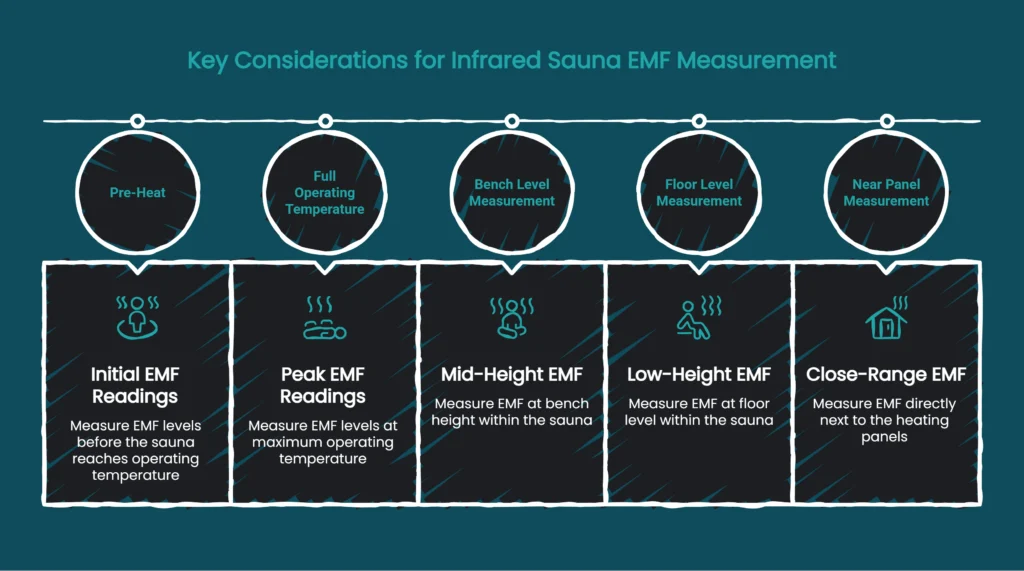
Pre-test preparation: pre-heat the sauna to its typical operating temperature (not maximum setting unless that is your normal use), allow the sauna to reach stable operating temperature before measuring (typically 15–20 minutes), enter the sauna with the meter — do not take readings from outside the cabin, and keep your body away from the meter during readings to avoid influencing results.
Position 1: Center Bench — Body Position
This is where your torso and core organs are located during a typical session and represents your primary exposure zone. Hold the meter at mid-chest height (approximately 3–4 feet from the floor) in the center of the bench, away from the side panels. Record both magnetic field (mG) and electric field (V/m) readings, noting both average and peak readings if your meter has a peak-hold function.
Position 2: Near the Heating Panels
The panels are the primary source of EMF in the cabin. This reading identifies the field strength close to your back, legs, or sides. Hold the meter 2–4 inches from the panel surface (simulating contact with your skin if you lean against or sit near a panel). These will typically be your highest readings.
Position 3: Floor Level
Your feet and lower legs are often near floor-level panels or the base of side panels. Hold the meter approximately 6 inches from the floor in the center of the cabin.
Position 4: Head Height
Head and brain proximity to EMF sources is a specific concern for users spending 20–30 minutes in the cabin. If your sauna has upper panels or ceiling elements, head-height readings may differ significantly from bench-level readings. Hold the meter at approximately 5–6 feet from the floor (standing head height) or at the height your head occupies when seated (approximately 4–4.5 feet).
How to Interpret Your Results
Reference Guidelines for Magnetic Fields (mG)
No regulatory standard specific to sauna EMF exposure currently exists. The guidelines below come from building biology standards used for therapeutic and sleeping environments. [1]
| Magnetic Field Reading | Building Biology Classification |
|---|---|
| Below 0.2 mG | No concern (sleeping/therapeutic environment) |
| 0.2–1.0 mG | Slight concern |
| 1.0–5.0 mG | Severe concern for therapeutic environments |
| Above 5.0 mG | Extreme concern |
Average residential EMF exposure in the US is approximately 0.4–0.8 mG. [2] A sauna generating readings significantly above this range means you are being exposed to substantially elevated fields during your session.
Reference Guidelines for Electric Fields (V/m)
| Electric Field Reading | Building Biology Classification |
|---|---|
| Below 1 V/m | No concern |
| 1–5 V/m | Slight concern |
| 5–50 V/m | Severe concern |
| Above 50 V/m | Extreme concern |
Unlike magnetic fields, electric fields can often be substantially reduced through proper grounding of the sauna unit and its wiring. High electric field readings may indicate inadequate grounding rather than an inherent design flaw in the heating elements.
What “Low-EMF” Should Mean in Practice
For a sauna to legitimately claim low-EMF design, independent testing should show magnetic fields below 1 mG at bench position (center) and electric fields below 5 V/m at bench position. Many marketing claims of “low EMF” or “ultra-low EMF” do not specify what readings were achieved, at what positions, or under what operating conditions.
Comparing EMF Levels Between Sauna Models
Request specifically: third-party test reports (not internal testing), magnetic field readings in mG at bench center position at operating temperature, electric field readings in V/m at bench center position, testing distance from panels clearly specified, and operating temperature at time of testing.
Red flags in EMF claims include: claims of “zero EMF” (physically impossible for any powered electrical device), test results showing only magnetic OR only electric fields, readings taken at distances greater than 18 inches from the user’s body, and no third-party documentation.
A credible EMF test report should include the testing organization name and credentials, date of testing, specific model tested, exact measurement positions and distances, both magnetic and electric field readings, and operating conditions at time of testing.
What Affects EMF Levels in an Infrared Sauna
Heater type is less determinative than heater wiring design and shielding — claims that one heater material is inherently lower EMF are not reliably supported. Wiring design matters significantly: cancellation wiring where supply and return conductors are paired and twisted reduces magnetic field generation compared to unshielded parallel wiring. Proper grounding of the sauna cabin reduces electric field readings substantially — elevated electric fields may simply indicate inadequate grounding. Emitter placement also affects exposure: saunas that recess emitters behind wooden slats create more physical distance between the field source and the user’s skin.
Practical Steps If Your Sauna Tests High
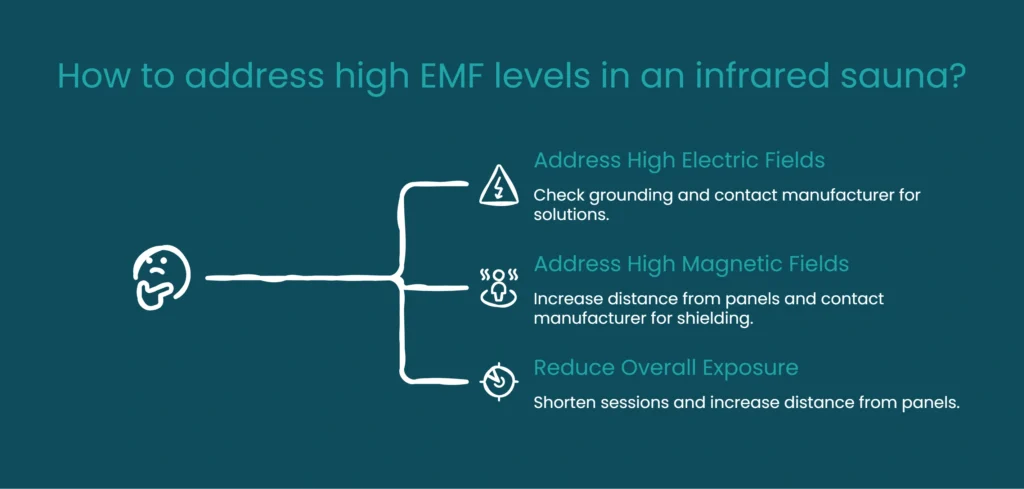
For elevated electric fields: check that the sauna is properly grounded to a grounded outlet, verify the outlet grounding itself with an outlet tester, and contact the manufacturer — elevated electric fields are often addressable through improved grounding.
For elevated magnetic fields: magnetic fields are harder to reduce without redesigning the heater wiring. Increasing your physical distance from the heating panels during sessions reduces exposure (inverse square relationship). Contact the manufacturer for any available shielding upgrades.
For both field types: shorter sessions reduce total exposure time, and increasing distance from panels during sessions reduces field strength.
Frequently Asked Questions
What meter should I buy to test my sauna’s EMF?
The Trifield TF2 is widely used by independent testers and building biologists for this purpose. It measures both magnetic and electric fields at power frequencies and provides reliable consumer-grade accuracy. Avoid single-axis meters and RF-only meters for this application.
Can a phone app measure sauna EMF accurately?
No. Smartphone magnetometers are designed for compass navigation, not electromagnetic field measurement. They lack the sensitivity and calibration for meaningful EMF assessment.
What is the difference between mG and µT for magnetic field readings?
They are different units for the same measurement. 1 mG (milligauss) = 0.1 µT (microtesla). Divide mG by 10 to get µT, or multiply µT by 10 to get mG.
Is there a government standard for safe EMF levels in saunas?
No government or health authority has established regulatory limits specific to sauna EMF exposure. ICNIRP (International Commission on Non-Ionizing Radiation Protection) guidelines exist for general public EMF exposure but apply to occupational and general environmental settings, not sauna-specific therapeutic use. [2] Building biology guidelines are the most commonly referenced framework for therapeutic environments.
Do low-EMF saunas cost significantly more than standard models?
Not necessarily. Low-EMF engineering is primarily a wiring and shielding design decision rather than a material cost increase. Some mid-range saunas achieve low-EMF specifications through better engineering, while some premium-priced saunas have not verified their EMF output through independent testing.
Medical Disclaimer: This article provides educational information about EMF measurement methodology and is not intended as medical advice. The health implications of EMF exposure at the levels generated by infrared saunas remain an area of ongoing research. Consult a healthcare provider with any specific health concerns related to electromagnetic field exposure.
For comprehensive guides on low-EMF infrared sauna design, verification methods, and evidence-based standards, visit Sauna Health Nut.
References
[1] Building Biology Institute. “Building Biology Evaluation Guidelines for Sleeping Areas.” SBM-2026 Standard. View guidelines
[2] International Commission on Non-Ionizing Radiation Protection (ICNIRP). “Guidelines for limiting exposure to electromagnetic fields.” Health Physics. 2026. View guidelines
You might also find these useful:
- Low-EMF infrared sauna explained
- Full spectrum vs far infrared wavelengths
- Infrared sauna safety and contraindications