
Should You Do Red Light Therapy Before, During, or Separate From Your Sauna Session?
Short answer: There isn’t a single validated answer here, since no controlled study has directly compared these three sequencing approaches against each other. The mechanism-based case for doing red light therapy before your sauna session is that clean, unobstructed skin gives light the best chance to penetrate before sweat and increased blood flow change how tissue absorbs and scatters it. The case for doing it separately, on non-sauna days or well before/after your session, is that combining two forms of stress on your body in immediate sequence could plausibly blunt the specific cellular response each modality is trying to trigger on its own. Both are reasonable positions built on plausible mechanisms, not settled research, which is exactly why practitioners genuinely disagree on this.
Last updated: 2026
At a glance:
- No controlled study has directly compared red light therapy timing relative to sauna sessions, so this remains a mechanism-based question, not a settled one
- The case for “before”: clean, dry skin without heat-induced vasodilation may allow more predictable light penetration to the target tissue
- The case for “during” or “immediately after”: increased blood flow from sauna heat could theoretically improve delivery of any downstream cellular effects, though this is speculative
- The case for “separate sessions”: avoiding stacking two different stressors (heat and light) on your body at once may let each modality’s individual mechanism operate without interference
- Sweat and moisture on skin can scatter and partially absorb light differently than dry skin, a real optical consideration regardless of which sequencing theory you find more compelling
- If you already do both, and the current order works for you, there’s no strong evidence compelling you to switch
Who this guide is for: People who use both a sauna and a red light therapy device and want to understand the actual mechanism-based arguments for sequencing them, rather than a firm answer research hasn’t actually established.
Why Doesn’t Research Already Answer This Question?
Photobiomodulation research and sauna research are two separate, well-established fields individually, each with its own body of controlled trials. The specific combination of the two, and particularly the question of optimal timing between them, sits in a genuine research gap. Most red light therapy studies test the light on its own, under controlled conditions without a preceding or following heat exposure. Most sauna research measures outcomes like blood pressure, HRV, or inflammation without a red light component involved. Because of this gap, any specific timing recommendation you encounter, including the ones below, is a mechanism-based argument extrapolated from what’s separately known about each modality, not a direct finding from a study that tested the sequencing question itself.
The Case for Red Light Therapy Before Your Sauna Session
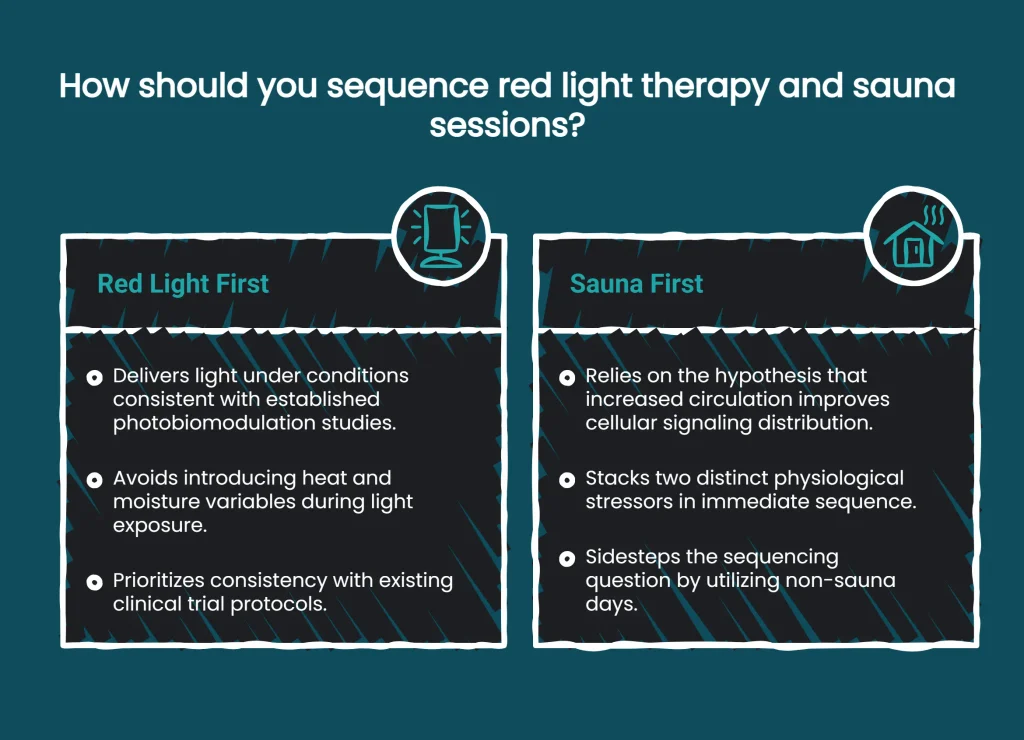
Photobiomodulation research generally studies light delivered to dry, room-temperature skin, and the therapeutic wavelengths involved (commonly 630-850 nanometers, the range where mitochondrial cytochrome c oxidase absorbs light most effectively)[1] penetrate tissue in a fairly well-characterized way under those conditions. Once you enter a hot sauna, your skin’s blood flow increases substantially (vasodilation) and you begin sweating, both of which change the optical properties of your skin in ways that aren’t well studied in combination with red light exposure. The straightforward argument for doing red light first is that it delivers the light under conditions closer to what the underlying research actually tested, before heat and moisture introduce variables that controlled photobiomodulation studies didn’t account for.
The Case for Red Light Therapy During or Immediately After Your Sauna Session
The counter-argument centers on blood flow rather than skin surface conditions. Some practitioners propose that the increased circulation from a sauna session could improve delivery of any downstream effects red light therapy triggers at a cellular level, on the theory that more blood flow to the treated area means faster distribution of any resulting cellular signaling. This is a plausible hypothesis, but it’s important to be clear that it remains a hypothesis, there isn’t controlled research demonstrating that sauna-induced vasodilation actually improves photobiomodulation outcomes specifically, as opposed to simply being a plausible-sounding mechanism.
The Case for Keeping Them Completely Separate
A third position, and the one some practitioners prefer specifically because of the uncertainty above, is to avoid stacking two different physiological stressors in immediate sequence at all. Heat exposure and light exposure each trigger their own distinct cellular and systemic responses, and combining them close together means you can’t easily attribute any specific outcome to one modality or the other, which matters if you’re trying to gauge whether either one is actually working for you individually. Doing red light therapy on non-sauna days, or with several hours of separation on the same day, sidesteps the whole sequencing question by simply not combining the two stressors at all.
What Does the Physical Skin Science Actually Tell Us?
Regardless of which sequencing theory you find most compelling, one thing is grounded in more basic physics rather than speculation: sweat and surface moisture do change how light interacts with skin, generally increasing scattering and altering absorption compared to clean, dry skin. This doesn’t tell us definitively which sequencing choice produces a better therapeutic outcome, since we don’t have direct outcome data either way, but it’s a real, physically grounded reason that light delivered to dry skin before a sauna session is operating under more predictable, better-characterized conditions than light delivered to sweaty, vasodilated skin mid-session.
Could Combining Them Actually Add Up to Too Much Light?
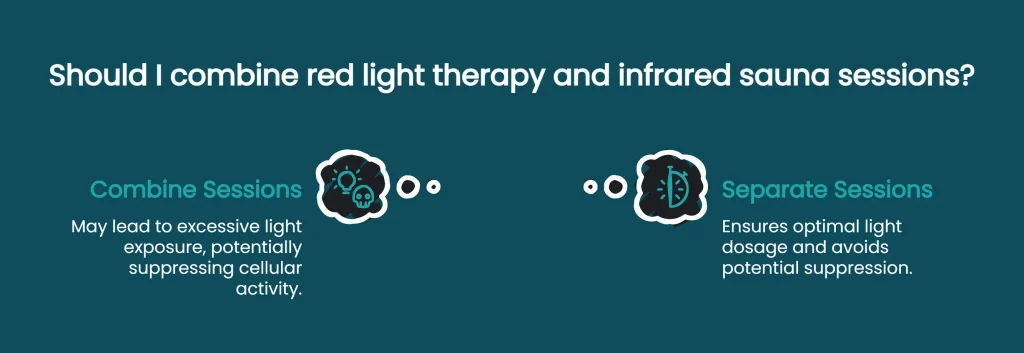
This is a consideration most articles on this topic don’t raise at all, and it comes from an established principle in photobiomodulation research rather than speculation: the field operates on a biphasic dose-response curve, often called the Arndt-Schultz law. In plain terms, a moderate light dose stimulates cellular activity, but pushing well past that moderate range can actually suppress the same cellular response rather than enhancing it further, more light is not simply “more benefit” past a certain point.[2] Research generally targets a fluence of roughly 3 to 10 J/cm² for basic cellular stimulation, with the effective range depending heavily on the specific tissue and application.[3]
Here’s why that matters for sequencing specifically: many “full-spectrum” infrared saunas already emit some near-infrared wavelength output as part of their heating panels, which sits in a similar general range to the wavelengths used in dedicated red light therapy panels. If you do a dedicated red light therapy session and then add a full-spectrum infrared sauna session on top of it, or a sauna with a built-in red light panel running the whole time, you may be stacking total light exposure higher than either modality delivers on its own, at least at the wavelengths where their outputs overlap. Whether that stacked exposure crosses from the stimulating range into the biphasic model’s suppressive range isn’t something research has directly tested for this specific combination, so treat this as a logical extension of established dose-response principles rather than a proven outcome. It’s a reasonable argument for keeping the two separate, or at least not assuming that doing both simultaneously must be additively better, rather than evidence that combining them is harmful.
Does Timing Near Bedtime Change Anything?
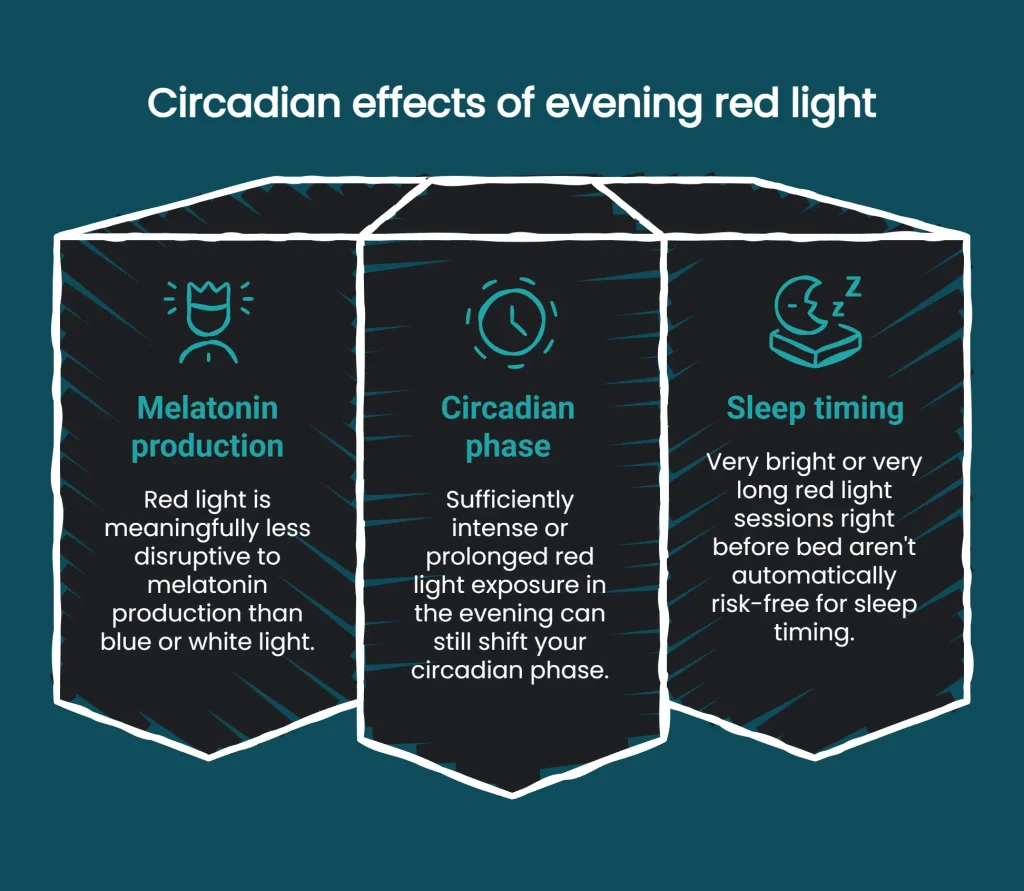
If you’re doing an evening sauna and red light session, there’s a genuinely useful, well-established piece of circadian research worth knowing, even though it’s rarely connected to this specific sequencing question. Red light is meaningfully less disruptive to melatonin production than blue or white light. A controlled study exposing healthy adults to red (631nm) versus blue (464nm) light for three hours in the evening found melatonin recovered to normal levels under red light within two hours, while blue light kept it suppressed for the full exposure period.[4] Harvard Health cites this same pattern as a reason red light, not blue or white, is the recommended choice for nighttime lighting.[5]
That’s a genuine point in favor of an evening red light session over, say, scrolling on a bright phone screen beforehand. The nuance worth knowing, though: this research is specifically about melatonin suppression, not every circadian effect. Separate research has found that sufficiently intense or prolonged red light exposure in the evening can still shift your circadian phase (delaying your body’s internal clock) even without suppressing melatonin the way blue light does.[6] In practice, this means red light is the safer choice for an evening routine relative to screens or bright white light, but very bright or very long red light sessions right before bed aren’t automatically risk-free for sleep timing either. If you’re already using the 60-90 minute pre-bed sauna window some readers report working well for sleep, keeping an evening red light session dim and reasonably short fits that same general logic, rather than treating “it’s red, so timing doesn’t matter” as a blanket rule.
So What Should You Actually Do?
Given the genuine absence of direct research, the most defensible position is: if you have a strong preference or existing routine, there’s no compelling evidence to force you to change it. If you’re deciding fresh, doing red light therapy before your sauna session has the stronger mechanism-based argument, since it operates under conditions closer to what the underlying photobiomodulation research actually tested. If convenience or your existing schedule makes doing it after or on a separate day easier, that’s a reasonable choice too, and you’re not giving up a proven benefit by choosing it, since no study has established that one timing choice outperforms another.
Frequently Asked Questions
Is there a proven best time to do red light therapy relative to sauna use? No. No controlled study has directly compared timing sequences, so any specific recommendation, including the ones in this article, is based on plausible mechanisms rather than direct research findings.
Does sweat actually block red light therapy’s effectiveness? Sweat and moisture change how light scatters and is absorbed by skin compared to dry skin, a real optical consideration, though there isn’t direct research quantifying how much this affects therapeutic outcomes specifically.
Can I do red light therapy inside the sauna at the same time? Some sauna brands build red light panels into the cabin for exactly this use case. The sequencing question in this article applies whether you’re combining them simultaneously or doing them as separate sessions.
Is it better to keep red light therapy and sauna use on completely separate days? It’s a reasonable, defensible choice, particularly if you want to isolate and evaluate each modality’s individual effect on you rather than combining two different stressors at once.
Should my choice change based on what I’m using red light therapy for? Possibly, since different applications (skin-focused versus deeper tissue-focused, for example) may be more or less sensitive to the skin-condition considerations discussed above, though dedicated research on this specific interaction doesn’t currently exist to give a firm answer either way.
Can doing red light therapy and a full-spectrum infrared sauna together add up to too much light exposure? It’s a reasonable consideration based on established dose-response research (the Arndt-Schultz law), which shows that light stimulation follows a curve where too much can suppress the same response a moderate dose stimulates. Whether this specific combination crosses that line hasn’t been directly studied, so treat it as a reason not to assume more combined light is automatically better, not as evidence the combination is harmful.
Is it safe to do red light therapy right before bed if I already did a sauna session that evening? Red light is meaningfully less disruptive to melatonin than blue or white light, making it a reasonable evening choice compared to screens. Very bright or prolonged red light exposure can still shift circadian timing in some research, though, so a shorter, dimmer session fits better with an evening routine than an unusually long or intense one.
Medical Disclaimer: This article discusses general sequencing considerations and is not medical advice. Combining heat and light therapy modalities is not appropriate for everyone. Consult your physician before beginning regular use of either modality if you are pregnant, have a photosensitivity condition, take medications that increase light or heat sensitivity, or have a cardiovascular condition.
References:
- “Brain Photobiomodulation Therapy: A Narrative Review.” PMC. View on PubMed/PMC
- “Review of Light Parameters and Photobiomodulation Efficacy: Dive into Complexity.” PMC. View on PubMed/PMC
- “Photobiomodulation: Cellular, Molecular, and Clinical Aspects.” ScienceDirect. View source
- “Comparative Effects of Red and Blue LED Light on Melatonin Levels During Three-Hour Exposure in Healthy Adults.” Life (MDPI). View on PubMed/PMC
- Harvard Health Publishing. “Blue Light Has a Dark Side.” View source
- “Systematic Review of Light Exposure Impact on Human Circadian Rhythm.” Chronobiology International. View source
You might also find these useful:
- Infrared saunas with built-in red light therapy
- How to use a sauna safely
- Cold plunge and sauna: how to combine them safely