Sauna for Beginners: What to Expect Your First Time

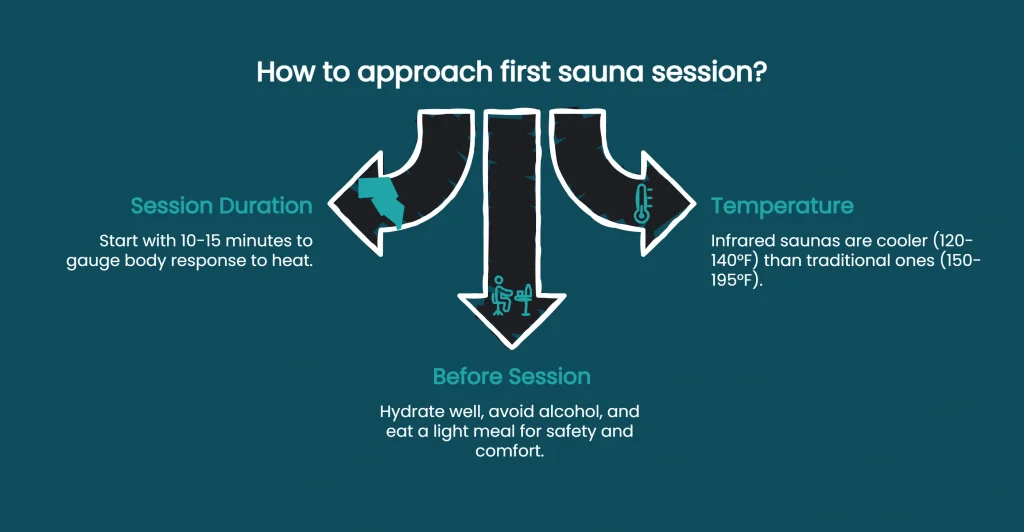
Short answer: Start shorter and cooler than you think you need to. A first session of 10-15 minutes at a moderate temperature (around 130-140°F for infrared, or the lower bench of a traditional sauna) is enough to introduce your body to heat exposure without overdoing it, and you can build up duration and intensity over several sessions as you learn how your body responds. Hydrate before you go in, skip alcohol beforehand, and get up slowly if you start to feel lightheaded rather than pushing through it. Most of what makes a first sauna experience unpleasant is avoidable: going too hot, too long, too dehydrated, on the first try.
Last updated: 2026
At a glance:
- First session: 10-15 minutes at a moderate temperature is a reasonable starting point, not the maximum you should ever do
- Hydrate well before your session; you don’t need to drink excessive water during it, but starting dehydrated makes heat exposure feel worse than it needs to
- Skip alcohol before a sauna session. Its diuretic effect worsens the dehydration risk from sweating, and it impairs your judgment of how well you’re actually tolerating the heat, both well-established effects, even though alcohol’s direct impact on your body’s temperature-regulation system specifically is less settled in the research than commonly claimed
- If you feel dizzy, nauseated, or your heart is racing uncomfortably, exit calmly rather than waiting for the feeling to pass
- Build up duration and temperature gradually over multiple sessions rather than trying to match an experienced user’s routine on your first visit
- A cool shower or a few minutes resting at room temperature after your session helps your body transition back to normal more comfortably than going straight from hot to cold air conditioning
Who this guide is for: Anyone about to use a sauna, infrared or traditional, for the first time and unsure what to actually expect or how to avoid a rough first experience.
How Long Should Your First Session Actually Be?
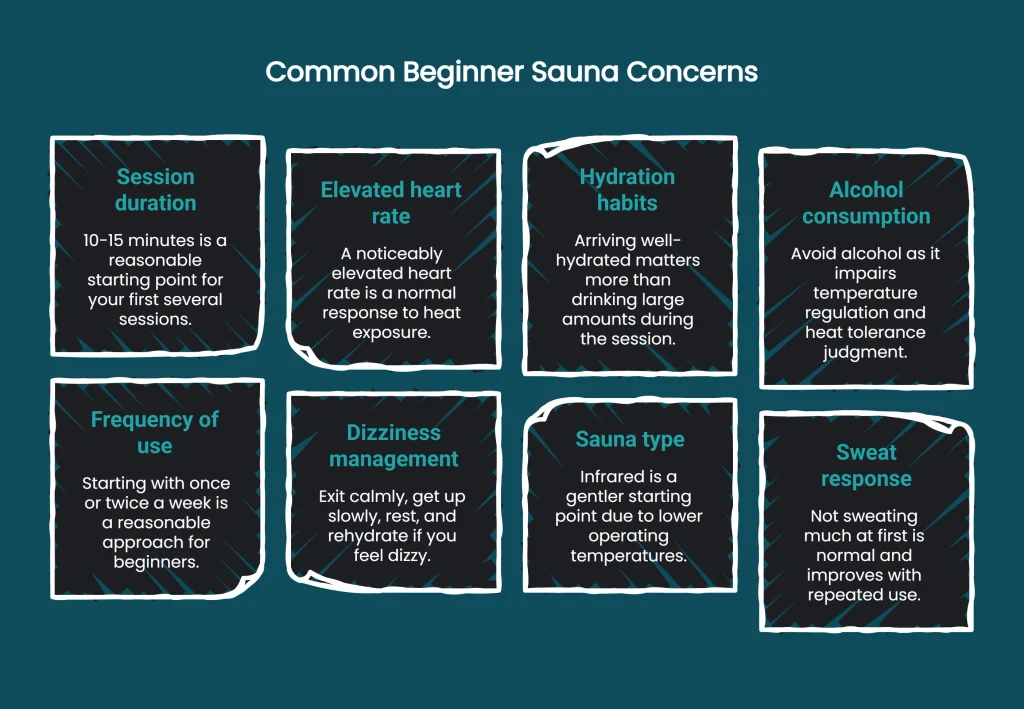
Ten to fifteen minutes is a reasonable, conservative starting point regardless of sauna type. This isn’t a hard ceiling you can never exceed, it’s a starting point specifically because you don’t yet know how your body responds to sustained heat exposure, and the only way to find out safely is to start shorter than you assume you’ll need and see how you feel both during and in the hours afterward. Experienced sauna users commonly stay in for 20-30 minutes or more, but that tolerance is typically built up gradually over weeks or months of regular use, not something to replicate on your very first visit.
What Temperature Should You Expect?
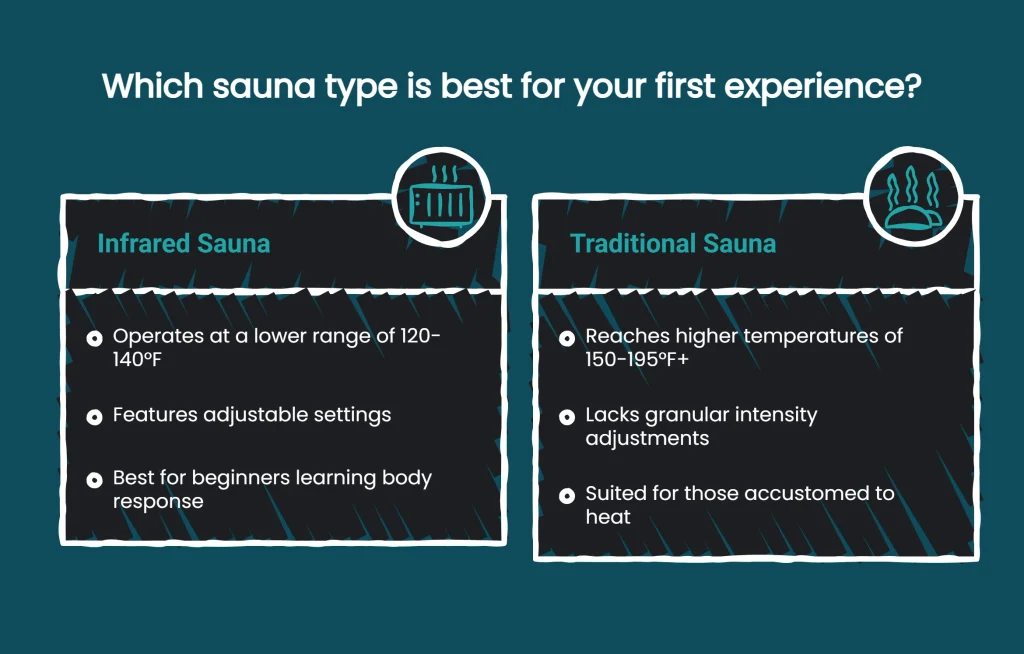
Infrared saunas typically run cooler than most people expect, commonly in the 120-140°F range depending on brand, noticeably lower than a traditional Finnish sauna’s typical 150-195°F range. If you’re trying an infrared sauna first, don’t be surprised that it feels less intensely hot than sauna scenes in movies or from a traditional sauna, that’s expected, infrared heats your body directly rather than heating the surrounding air to the same degree. If you’re trying a traditional sauna, the lower bench runs meaningfully cooler than the upper bench, a reasonable place to start if you have the option, rather than immediately sitting on the highest, hottest tier.
What Should You Do Before Your First Session?
Hydrate well in the hours leading up to your session, not immediately beforehand with a large volume of water, but generally arriving well-hydrated rather than dehydrated. Skip alcohol before a sauna session entirely for your first few visits. Alcohol has a diuretic effect that worsens the dehydration you’re already experiencing from sweating, and it dulls your ability to accurately judge how you’re actually tolerating the heat, both well-established effects.[1] The popular claim that alcohol directly impairs your body’s core temperature-regulation system is repeated often but is actually less settled in the research than commonly stated, a 2026 systematic review found the evidence for a direct thermoregulatory effect from moderate alcohol intake in the heat is mixed rather than conclusive.[2] Either way, the combination increases real risk without you necessarily noticing it happening in the moment, through the dehydration and judgment pathways alone. Eating a light meal beforehand rather than going in on a completely empty stomach or right after a heavy meal is also a reasonable practical habit, though this comes down more to personal comfort than a specific safety rule.
What Does a Sauna Session Actually Feel Like?
Expect your heart rate to climb noticeably within the first few minutes, a normal physiological response to heat exposure that mimics some of what happens during moderate exercise. You’ll likely start sweating within 5-10 minutes depending on the sauna type and your own body. A comfortable session should feel warm and relaxing, building toward a point where you’re ready to step out, not an experience of pushing through significant discomfort to prove you can handle it. If a session feels unpleasant rather than simply warm, that’s useful information about your current tolerance, not a signal to push harder.
What Are the Warning Signs You Should Exit Immediately?
Dizziness, lightheadedness, nausea, an uncomfortably racing heartbeat, or a headache developing during a session are all reasonable signals to calmly exit rather than waiting to see if the feeling passes on its own. Get up slowly rather than standing quickly, since a rapid position change after heat exposure can itself cause a brief drop in blood pressure and lightheadedness independent of anything related to the sauna itself. If symptoms don’t resolve within a few minutes of cooling down and rehydrating, or if you experience chest pain or severe symptoms, seek medical attention rather than assuming it will pass.
How Should You Cool Down Afterward?
A gradual transition works better than an abrupt one for most first-time users. A few minutes resting at room temperature, followed by a cool (not ice-cold) shower, gives your body a more comfortable path back to baseline than stepping directly from a hot sauna into strongly air-conditioned air or jumping straight into very cold water, which some experienced users do intentionally as contrast therapy but which is a more advanced practice worth working up to rather than trying on your first visit.
How Often Should You Sauna as a Beginner?
Once or twice a week is a reasonable starting frequency, giving you enough repeated exposure to notice how your tolerance builds over several sessions without committing to a daily habit before you know how your body responds. Many of the cardiovascular and wellness benefits associated with sauna use in research come from consistent, longer-term use measured in months, not from any single session, so there’s no need to rush toward maximum frequency immediately.
Should You Start With Infrared or Traditional as a Beginner?
If you have a choice between the two for your first experience, infrared is generally the gentler entry point. Lower operating temperatures (120-140°F versus 150-195°F+) mean less overall heat stress while you’re still learning how your body responds, and the ramp-up in intensity between sessions is easier to control incrementally on an infrared unit’s adjustable settings. Traditional sauna has a steeper but still very manageable learning curve, the lower bench and shorter session lengths covered above apply just as well there, and plenty of people take to a traditional sauna as their first experience without issue, particularly if they’re already used to other forms of heat exposure like hot yoga or a hot climate. Neither choice is wrong; if you already have access to one specific type through a gym or a friend’s home, that’s a perfectly good reason to start there rather than waiting to find the other.
What Does a Realistic First Month Look Like?
A reasonable progression for a new sauna user, whether infrared or traditional, might look something like this: sessions one through three at 10-15 minutes, focused entirely on noticing how you feel rather than pushing any specific number. Sessions four through eight, once you have a baseline, gradually extending toward 20 minutes if the shorter sessions felt comfortable, still at a moderate temperature setting. By the end of a first month of once-or-twice-weekly use, many beginners find they’ve naturally settled into a 20-30 minute session at a temperature that felt too intense in week one, without consciously forcing that progression, your tolerance genuinely does build with repeated exposure. This is a general pattern, not a fixed schedule, some people progress faster, some slower, and neither is a sign you’re doing anything wrong.
What Does a Realistic First Month Look Like?
A reasonable progression for a new sauna user, whether infrared or traditional, might look something like this: sessions one through three at 10-15 minutes, focused entirely on noticing how you feel rather than pushing any specific number. Sessions four through eight, once you have a baseline, gradually extending toward 20 minutes if the shorter sessions felt comfortable, still at a moderate temperature setting. By the end of a first month of once-or-twice-weekly use, many beginners find they’ve naturally settled into a 20-30 minute session at a temperature that felt too intense in week one, without consciously forcing that progression, your tolerance genuinely does build with repeated exposure. This is a general pattern, not a fixed schedule, some people progress faster, some slower, and neither is a sign you’re doing anything wrong.
Common Beginner Concerns That Aren’t Actually Problems
A few things that worry new sauna users but usually aren’t cause for concern: not sweating much in your first session or two is normal, sweat response genuinely improves with repeated heat exposure as your body acclimatizes, a well-documented physiological adaptation that includes earlier sweating onset and greater sweat production over roughly one to two weeks of consistent exposure, not a sign the sauna isn’t working from the start.[3] Feeling only mildly warm rather than dramatically hot, especially in a cooler infrared session, doesn’t mean you’re not getting anything out of it, the research behind most sauna health claims involves exactly this kind of moderate, sustained heat exposure rather than an intense, uncomfortable one. Not wanting to increase your time or temperature quickly is also fine, there’s no schedule you’re required to hit, and plenty of regular users stay at a comfortable, moderate setting indefinitely rather than working toward the longest or hottest sessions they can tolerate.
How long should a beginner stay in a sauna? 10-15 minutes is a reasonable starting point for your first several sessions, building up duration gradually as you learn your own tolerance.
Is it normal to feel your heart racing in a sauna? Yes, a noticeably elevated heart rate is a normal response to heat exposure. An uncomfortably racing heartbeat combined with dizziness or nausea is different and a reasonable signal to exit.
Should I drink water during my sauna session? Arriving well-hydrated matters more than drinking large amounts during the session itself. Rehydrate normally afterward based on thirst.
Can I drink alcohol before using a sauna? It’s best to avoid it, especially as a beginner. Alcohol’s diuretic effect worsens dehydration from sweating, and it impairs your ability to accurately judge how you’re tolerating the heat, both well-established effects, even though alcohol’s direct impact on temperature regulation specifically is more contested in the research than commonly claimed.
Is it safe to sauna every day as a beginner? Starting with once or twice a week is a more reasonable approach while you learn your own tolerance, rather than beginning with daily use before you know how your body responds.
What should I do if I feel dizzy during a session? Exit calmly and get up slowly rather than standing quickly. Rest, rehydrate, and let symptoms resolve. Seek medical attention if symptoms don’t improve or if you experience chest pain.
Should a beginner start with infrared or traditional sauna? Infrared is generally the gentler starting point given its lower operating temperature, though either type works fine as a first experience, especially if that’s the one you actually have access to.
Is it a problem if I don’t sweat much during my first few sauna sessions? No. Sweat response genuinely improves with repeated heat exposure as your body acclimatizes, a well-documented adaptation that typically develops over one to two weeks. Not sweating heavily at first isn’t a sign anything is wrong.
Medical Disclaimer: This guide covers general beginner practices and is not medical advice. Sauna use is not appropriate for everyone, including some pregnant individuals and people with certain cardiovascular conditions or other health issues. Consult your physician before beginning sauna use, especially if you have any underlying health conditions. See our full guide on safe sauna use guidelines for more detailed safety information.
References:
- “Alcohol and Heat in Summer: Increased Risks.” Clínic Barcelona. View source
- “The Effect of Alcohol Consumption on Human Physiological and Perceptual Responses to Heat Stress: A Systematic Scoping Review.” Environmental Health. View on PubMed/PMC
- Centers for Disease Control and Prevention, NIOSH. “Acclimatization.” View on CDC.gov