
Infrared Sauna for Rheumatoid Arthritis: What the Research Actually Shows

Short answer: Infrared sauna therapy shows preliminary evidence for reducing pain perception and improving quality of life in rheumatoid arthritis (RA) patients during clinically stable periods. The primary mechanisms are deep tissue vasodilation, muscle relaxation, and temporary reduction in pain signaling. The evidence base is small — the most cited study involved supervised sessions in a controlled clinical setting — and infrared saunas should never be used during active inflammatory flares. Medical clearance from a rheumatologist is essential before beginning any sauna protocol.
Last updated: 2026
At a glance
- The most relevant clinical study found infrared sauna sessions were well-tolerated in stable RA patients with short-term reductions in pain and stiffness [1]
- Infrared saunas must not be used during active RA flares — heat applied to acutely inflamed joints can worsen inflammation and pain
- Far-infrared (FIR) wavelengths are the primary mechanism: deep tissue warming, vasodilation, and temporary muscle relaxation
- The detoxification claims common in RA sauna marketing are not supported by evidence — liver and kidneys are the body’s primary detox organs
- Rheumatologist clearance is non-negotiable before beginning sauna use, particularly for patients on immunosuppressant or biologic medications
Who this guide is for
This article is for people living with rheumatoid arthritis who are evaluating infrared sauna therapy as a complementary approach to symptom management. It covers the current evidence for RA specifically, the mechanisms that may explain observed effects, critical contraindications, and how to use sauna therapy safely alongside prescribed medical care. This is not medical advice — consult your rheumatologist before making any changes to your treatment approach.
How Infrared Heat Interacts with RA Symptoms
Rheumatoid arthritis is an autoimmune condition characterized by immune-mediated joint inflammation, synovial tissue damage, and systemic inflammatory burden. Understanding why infrared heat might affect RA symptoms requires looking at the specific mechanisms that overlap with RA pathophysiology.
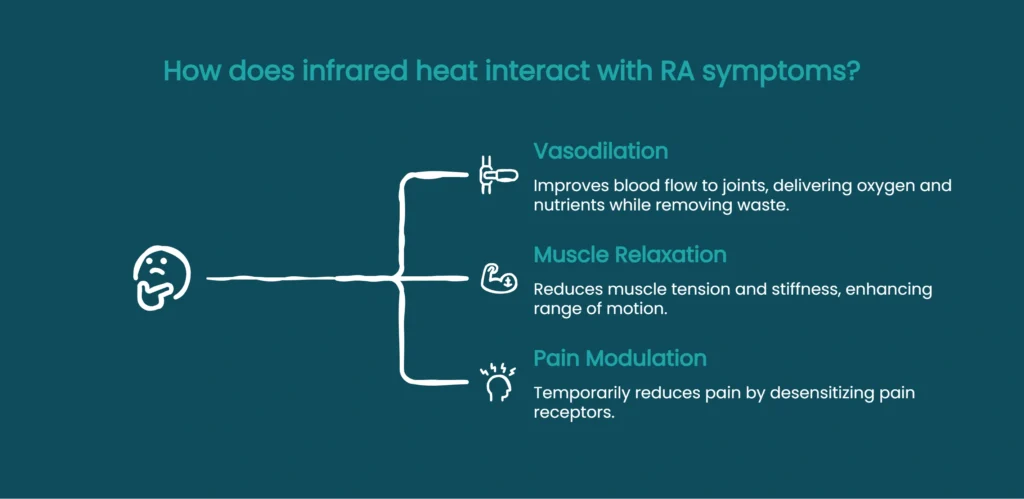
Vasodilation and Circulation to Affected Joints
Far-infrared wavelengths (3–14 microns) penetrate tissue up to approximately 1.5 inches, warming deep soft tissue and triggering local vasodilation. In RA, affected joints frequently experience impaired microcirculation due to synovial inflammation and tissue changes. Improved blood flow through heat-induced vasodilation delivers oxygen and nutrients while helping clear metabolic waste products and inflammatory mediators that accumulate in affected tissue. This mechanism is plausible and consistent with how heat therapy has been used in rheumatology for decades — the question specific to infrared is whether the deeper tissue penetration produces meaningfully different outcomes than surface heat.
Muscle Relaxation and Reduced Guarding
RA patients commonly develop secondary muscle tension and guarding around affected joints as a pain-protective response. This tension can compound joint stiffness and reduce range of motion beyond what the primary joint pathology alone would cause. Deep tissue warming from far-infrared radiation directly reduces muscle tension by affecting the mechanical properties of collagen and connective tissue, which become more pliable at elevated temperatures. This mechanism is relevant for the morning stiffness and restricted movement many RA patients experience.
Temporary Modulation of Pain Signaling
Heat activates TRPV1 receptors in sensory neurons, which can temporarily desensitize pain signaling pathways and reduce perceived pain intensity. This mechanism — well established in heat therapy research generally — may contribute to the short-term pain relief reported by RA patients after sauna sessions. It is a temporary effect that does not modify the underlying disease process.
What the Clinical Evidence Actually Shows
The Most Relevant Study
The most specific infrared sauna evidence for RA comes from a pilot study by Oosterveld et al. published in Clinical Rheumatology. The study examined infrared sauna sessions in patients with rheumatoid arthritis and ankylosing spondylitis during clinically stable periods. Short-term infrared sauna sessions were found to be well-tolerated in both patient groups, with participants reporting reductions in pain and stiffness during the treatment period and no significant worsening of disease activity. [1]
Several important caveats apply to this study: it was a small pilot trial, sessions were medically supervised, participants were in stable disease periods (not active flares), and the improvements observed were in patient-reported outcomes rather than objective disease activity markers like CRP or ESR.
What the Evidence Does Not Show
The clinical evidence for infrared sauna in RA does not support several claims commonly found in wellness content about this topic:
Infrared sauna has not been shown to reduce inflammatory cytokines in RA patients in controlled studies. The claim that it “lowers pro-inflammatory cytokines and increases anti-inflammatory markers” appears in numerous wellness sources but is not supported by RA-specific clinical evidence.
Infrared sauna has not been shown to slow or modify RA disease progression. It is not a disease-modifying intervention and should not be framed as one.
The “detoxification through sweat” mechanism frequently cited in RA sauna content is not supported by evidence. The body’s primary detoxification organs are the liver and kidneys. Sweat contains trace amounts of various compounds but is not a meaningful pathway for eliminating the inflammatory mediators relevant to RA pathophysiology.
Critical Contraindications for RA Patients
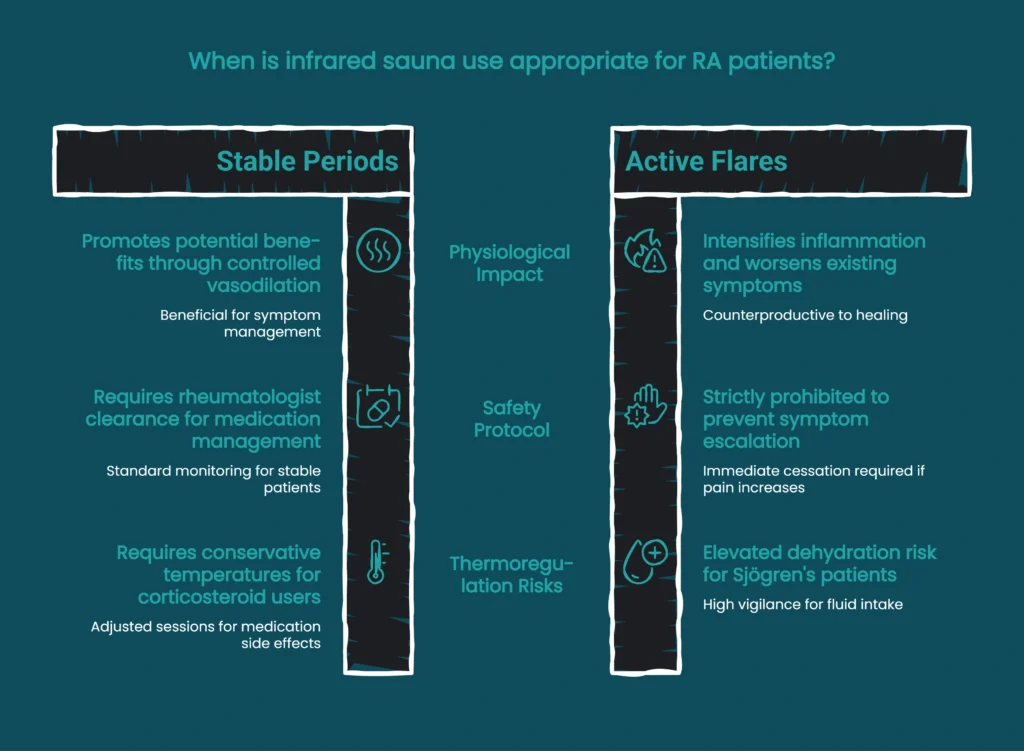
Never Use During Active Flares
This is the most important safety point for RA patients. Heat applied to acutely inflamed joints — during a flare characterized by warmth, swelling, redness, and increased pain — can intensify inflammation and worsen symptoms. The vasodilation that makes infrared sauna potentially beneficial during stable periods becomes counterproductive when joints are already in an acute inflammatory state.
Infrared sauna use should be limited strictly to stable periods between flares, and should be stopped immediately if joint symptoms worsen during or after a session.
Immunosuppressant and Biologic Medications
Most RA patients are managed with disease-modifying antirheumatic drugs (DMARDs), biologics, or JAK inhibitors. These medications affect immune function and can influence how the body responds to thermal stress. Some may also affect thermoregulation or cardiovascular response to heat. Explicit clearance from your rheumatologist is required before beginning sauna use on any of these medications — not just a general medical consultation.
Corticosteroid Use
Patients on corticosteroids should exercise additional caution. Corticosteroids can mask symptoms of overheating and affect the body’s normal thermoregulatory responses. Sessions should be shorter and temperatures more conservative if sauna use is cleared by a physician during corticosteroid treatment.
Additional Contraindications Relevant to RA Patients
RA patients have elevated cardiovascular risk compared to the general population due to systemic inflammation. This means the standard cardiovascular contraindications for sauna use apply with additional weight: uncontrolled hypertension, recent cardiac events, and significant arrhythmias require explicit cardiologist clearance in addition to rheumatologist clearance.
Patients with Sjögren’s syndrome as a comorbidity — common in RA — face higher dehydration risk in any heat environment and must be especially vigilant about fluid intake before, during, and after sessions.
Safe Usage Framework for RA Patients
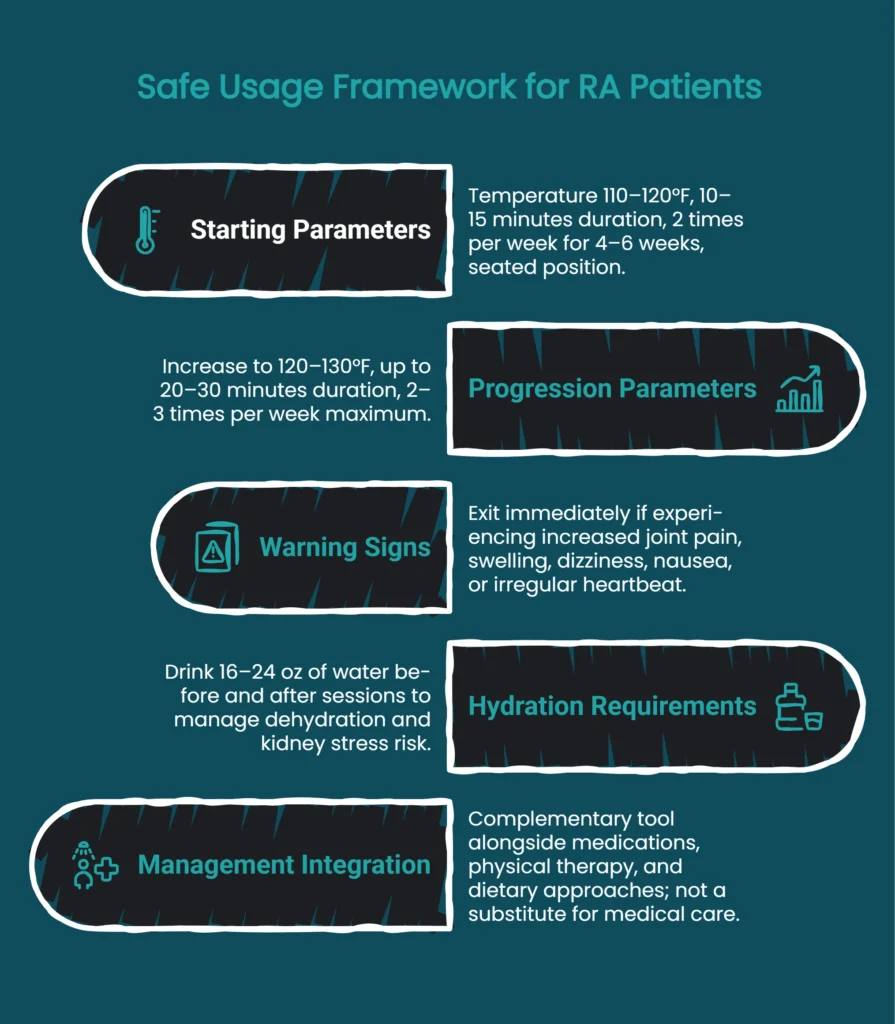
The following parameters assume medical clearance has been obtained from a rheumatologist and that the patient is in a clinically stable period with no active joint flares.
Starting Parameters
Temperature: 110–120°F initially — lower than general wellness protocols to minimize thermal load on potentially vulnerable joints. Duration: 10–15 minutes per session maximum initially. Frequency: 2 times per week during the first 4–6 weeks. Position: seated with attention to minimizing direct heat exposure to the most severely affected joints.
Progression (only with stable symptoms and physician awareness)
Temperature: Increase to 120–130°F over 4–6 weeks if well-tolerated. Duration: Increase to 20 minutes as tolerance develops — do not exceed 30 minutes. Frequency: Maintain 2–3 times per week maximum.
Warning Signs During Sessions — Exit Immediately If:
Increased joint pain, warmth, or swelling during or after the session. Dizziness, nausea, or disorientation. Rapid or irregular heartbeat. Any sensation that joints feel worse rather than better following heat exposure.
Hydration Requirements
RA patients on certain medications (particularly methotrexate, diuretics, or NSAIDs) face elevated dehydration and kidney stress risk during heat exposure. Drink 16–24 oz of water in the hour before sessions and 16–24 oz after. Do not enter a sauna if you are already thirsty, have consumed alcohol, or are experiencing symptoms of a flare.
How Infrared Sauna Fits Within RA Management
Infrared sauna therapy is appropriately positioned as a complementary symptom management tool — not a treatment for RA and not a substitute for any prescribed medical care.
It fits alongside: prescribed DMARDs, biologics, and other medications; physical therapy and occupational therapy; anti-inflammatory dietary approaches; sleep optimization; and regular movement within pain tolerance. It does not replace: prescribed disease-modifying medications, rheumatologist-supervised disease monitoring, laboratory monitoring of disease activity markers, or physical therapy targeting specific functional deficits.
The honest expectation is that regular infrared sauna use during stable periods may reduce the burden of secondary muscle tension and stiffness, provide temporary pain relief through heat-based analgesia, and support relaxation and stress reduction that may indirectly benefit inflammatory burden. These are meaningful quality-of-life benefits for a condition that significantly affects daily function — they simply need to be framed accurately rather than as disease modification.
Frequently Asked Questions
Is infrared sauna safe for rheumatoid arthritis?
For patients in clinically stable periods who have received explicit clearance from their rheumatologist, infrared sauna use appears to be well-tolerated based on available small studies. It is not appropriate during active flares, without medical clearance, or for patients with significant cardiovascular comorbidities that have not been evaluated. Safety depends heavily on timing, temperature, duration, and individual health status.
Can infrared sauna reduce RA inflammation?
There is no robust clinical evidence that infrared sauna reduces RA-specific inflammatory markers such as CRP, ESR, or inflammatory cytokines in controlled studies. The primary documented benefits in available research are patient-reported reductions in pain and stiffness during stable periods, consistent with the temporary pain-modulation mechanisms of heat therapy rather than actual anti-inflammatory action at the disease level.
What temperature should RA patients use for infrared sauna?
Lower temperatures than general wellness protocols — starting at 110–120°F rather than the 130–150°F used by healthy adults without inflammatory conditions. The goal is therapeutic warmth without excessive thermal load on joints and tissues that are already affected by inflammation.
How soon after a flare can RA patients return to sauna use?
There is no established clinical guideline for this specific question. A conservative approach is to wait until the flare has fully resolved — normal joint temperature, no increased swelling, pain returned to your personal baseline — and then restart at the lowest parameters (shorter sessions, lower temperature) with your rheumatologist’s awareness. Do not resume sauna use during or immediately after a flare.
Can infrared sauna replace medications for rheumatoid arthritis?
No. Rheumatoid arthritis is a progressive autoimmune condition that requires disease-modifying medical treatment to prevent joint damage and systemic complications. Infrared sauna addresses symptom perception temporarily — it does not modify the underlying disease process. Reducing or discontinuing prescribed RA medications based on perceived sauna benefits risks allowing disease progression that may not be immediately symptomatic but causes long-term joint damage.
Medical Disclaimer: This article provides educational information about infrared sauna research in relation to rheumatoid arthritis and does not constitute medical advice. Rheumatoid arthritis requires individualized medical management by a qualified rheumatologist. Always consult your rheumatologist and any other relevant specialists before adding infrared sauna use to your treatment approach, particularly if you take immunosuppressant, biologic, or cardiovascular medications.
For comprehensive guides on infrared sauna safety, mechanisms, and evidence-based applications, visit Sauna Health Nut.
References
[1] Oosterveld FG, et al. “Infrared sauna in patients with rheumatoid arthritis and ankylosing spondylitis.” Clinical Rheumatology. 2009. View on PubMed
[2] Hannuksela ML, Ellahham S. “Benefits and risks of sauna bathing.” The American Journal of Medicine. 2001. View on PubMed
[3] Beever R. “Far-infrared saunas for treatment of cardiovascular risk factors: summary of published evidence.” Canadian Family Physician. 2009. View on PMC
You might also find these useful: