
Sauna for Muscle Recovery: Infrared and Traditional Methods Compared

Short answer: Both infrared and traditional saunas support muscle recovery through heat-induced vasodilation, DOMS reduction, and parasympathetic activation — but through different mechanisms at different temperatures. Infrared saunas penetrate tissue directly at lower ambient temperatures (110–150°F); traditional Finnish saunas create a more intense systemic heat response at 170–195°F. Both show preliminary evidence for post-exercise recovery benefits. Timing, hydration, and individual training load determine which type fits your routine better.
Last updated: 2026
At a glance
- Both sauna types reduce DOMS through heat-induced vasodilation and improved circulation to worked muscle tissue
- Traditional saunas produce a more intense systemic heat response; infrared saunas deliver deeper tissue warming at lower ambient temperatures
- Post-exercise timing (30–60 minutes after training) applies to both types — pre-exercise use is not recommended for either
- Heat shock protein production occurs in both sauna types and may support cellular repair relevant to athletic adaptation
- Neither sauna type replaces sleep, nutrition, or structured recovery — both are complementary tools
Who this guide is for
This article is for recreational and competitive athletes, gym-goers, and active individuals evaluating sauna use as part of their recovery protocol. It covers how both infrared and traditional saunas support recovery, the available evidence, practical timing guidance, and how each type fits alongside other recovery strategies. It is not intended as a substitute for individualized sports medicine guidance.
Why Saunas Support Muscle Recovery: The Core Mechanisms
Athletic adaptation happens during recovery, not during training. Training creates the stimulus — tissue breakdown, metabolic stress, neuromuscular fatigue — and recovery is when the adaptive response occurs: muscle protein synthesis, glycogen replenishment, connective tissue remodeling, and neuromuscular recalibration. Any intervention that accelerates or improves recovery quality can either improve adaptation outcomes or allow higher training volume by reducing the time needed between sessions.
Both infrared and traditional saunas share the same primary recovery mechanisms, though the intensity and depth of each mechanism differs between types.
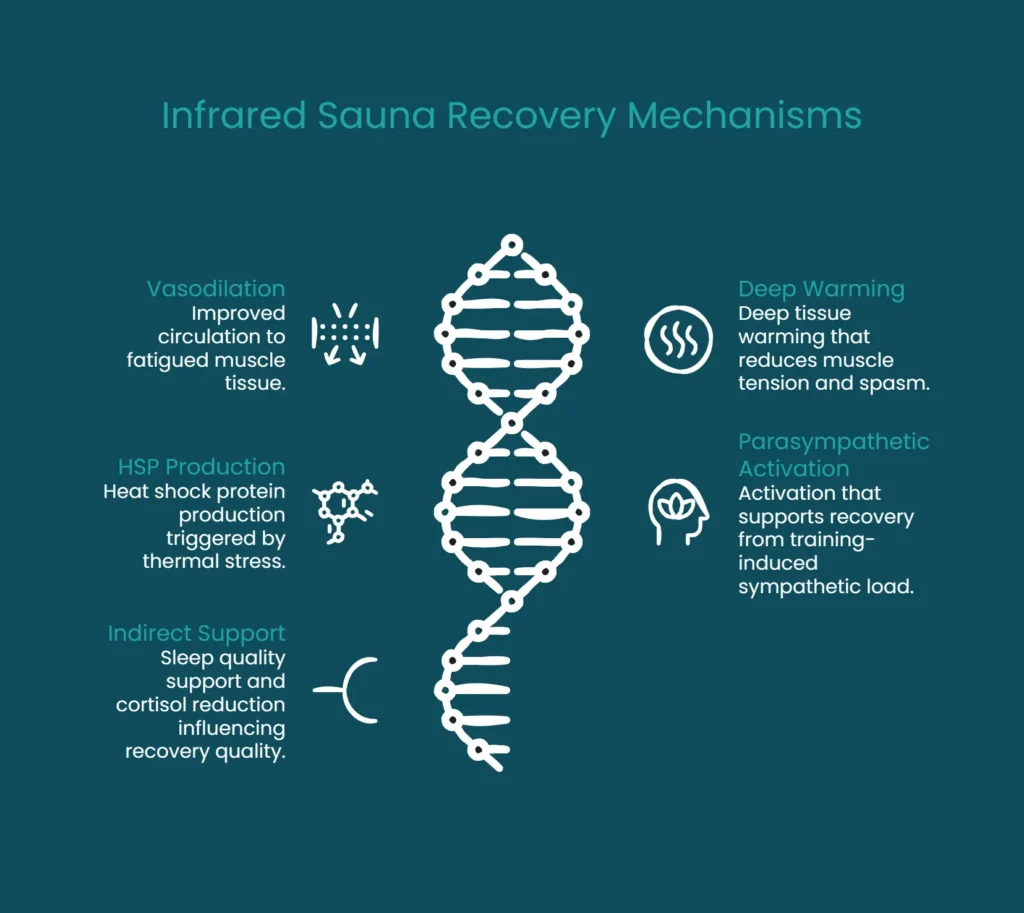
Vasodilation and circulation: Heat causes blood vessels to dilate, increasing blood flow to fatigued muscle tissue. This delivers oxygen and nutrients while clearing metabolic waste products including lactate and inflammatory mediators that accumulate after intense exercise.
Muscle relaxation: Deep warming reduces muscle tension and spasm by affecting the mechanical properties of collagen and connective tissue, which become more pliable at elevated temperatures.
Heat shock protein (HSP) production: Both sauna types trigger HSP production as a cellular stress response. HSPs help refold and repair damaged proteins within cells — directly relevant given that intense exercise damages cellular proteins in muscle tissue.
Parasympathetic activation: Heat exposure promotes the relaxation response, helping the nervous system shift from the sympathetic (fight-or-flight) state induced by training toward the parasympathetic (rest-and-digest) state that supports recovery.
Secondary mechanisms: Both types also support sleep quality and cortisol reduction indirectly, both of which influence recovery quality.
Traditional Sauna for Muscle Recovery
Traditional Finnish saunas operate at 170–195°F (77–91°C) using convection heat — superheated air that warms the body from the outside in. This creates a powerful systemic heat response that places significant cardiovascular and thermoregulatory demand on the body.
What the Research Shows
The strongest and most established sauna recovery research involves traditional high-heat saunas. Finnish population studies have documented the broad health associations of regular traditional sauna use across decades, providing the most robust evidence base for any sauna type.
For muscle recovery specifically, the intense systemic heat response of traditional saunas produces rapid and significant vasodilation throughout the body, accelerated heart rate elevation (comparable to moderate cardiovascular exercise), and strong heat shock protein production triggered by the high thermal load. A 2026 systematic review identified 40 clinical studies involving 3,855 participants examining traditional sauna health outcomes including cardiovascular function and physical recovery markers. [4]
The high ambient temperature also creates a powerful hormetic stress — beneficial stress that stimulates the body to adapt and become more resilient — which may contribute to longer-term recovery capacity improvements with regular use.
Traditional Sauna Recovery Protocol
Temperature: 170–185°F (77–85°C) — lower end is sufficient for recovery benefits. Duration: 10–20 minutes per session (shorter than infrared due to higher heat intensity). Frequency: 2–4 times per week post-training. Cooling: alternating with cold shower or cold plunge between rounds is common in Finnish tradition and may enhance recovery through the contrast effect on circulation. Hydration: critical — the high heat produces rapid, heavy sweating. Drink 16–24 oz before and after each session.
Infrared Sauna for Muscle Recovery
Infrared saunas use radiant heat emitters to deliver infrared wavelengths directly to tissue, warming the body from within rather than heating the surrounding air. Operating temperatures are significantly lower (110–150°F / 43–66°C), but the direct tissue penetration allows meaningful core temperature elevation at more comfortable ambient conditions.
What the Research Shows
A study examining far-infrared sauna use following muscle-damaging exercise found that participants who used infrared sauna immediately post-exercise reported lower DOMS ratings at 24 and 48 hours compared to a passive recovery control group. [1] The researchers proposed that improved blood flow and temperature-mediated reduction in inflammatory mediator accumulation were the operative mechanisms.
A small controlled trial in strength-trained athletes found that post-exercise infrared sauna sessions (20 minutes at 130°F) were associated with faster resolution of perceived muscle soreness compared to passive rest, though differences in objective muscle function measures were less consistent. [2] Evidence rating: preliminary positive evidence — consistent direction across small studies; no large RCTs. Subjective soreness improvements are more consistently reported than objective recovery markers.
A retrospective pilot study examining biomarkers after a six-month multi-modal wellness intervention including sauna use found reductions in high-sensitivity C-reactive protein (hsCRP), a systemic inflammation marker relevant to recovery. [3]
Infrared Sauna Recovery Protocol
Temperature: 120–140°F (49–60°C). Duration: 20–30 minutes. Frequency: 3–5 times per week aligning with training days. Timing: 30–60 minutes post-session after initial rehydration. Hydration: 16–24 oz water before entering, additional 16 oz after.
Infrared vs Traditional Sauna for Recovery: Key Differences
| Factor | Traditional Sauna | Infrared Sauna |
|---|---|---|
| Operating temperature | 170–195°F (77–91°C) | 110–150°F (43–66°C) |
| Heat mechanism | Convection (hot air) | Radiant (direct tissue) |
| Session duration | 10–20 minutes | 20–30 minutes |
| Heat intensity | High systemic | Moderate, targeted |
| Vasodilation effect | Strong, full-body | Strong, tissue-level |
| HSP production | High (greater thermal stress) | Moderate |
| Evidence base | Larger, longer-term studies | Smaller, shorter-term studies |
| Comfort level | Intense — may be limiting | More tolerable for most |
| Best suited for | Athletes tolerant of high heat, seeking hormetic stress | Athletes preferring longer sessions at lower temperatures |
| Cold contrast protocol | Common and well-supported | Less traditional but compatible |
Should You Use a Sauna Before or After a Workout?
After — for both sauna types.
Using either sauna type immediately before training creates two problems regardless of which type you choose. First, sauna sessions produce fluid loss through sweating — beginning training even mildly dehydrated impairs thermoregulation, increases cardiovascular strain, and reduces performance. Second, starting exercise with an already-elevated core temperature reduces the body’s heat dissipation reserve, limiting exercise intensity and duration before heat becomes a constraint.
The practical rule for both types: train first, rehydrate, then sauna.
The only exception worth noting: some research on “passive heat acclimation” suggests brief, low-intensity heat exposure before endurance events in hot conditions can pre-condition the thermoregulatory system. This is a specific performance protocol distinct from routine recovery use and should not be confused with pre-workout sauna for general training.
Optimal post-workout timing:
- Traditional sauna: 20–40 minutes after training (allows acute cardiovascular stress to normalize before adding high-heat load)
- Infrared sauna: 30–60 minutes after training (more forgiving timing due to lower ambient temperature)
How Saunas Compare to Other Recovery Modalities
| Recovery Modality | Primary Mechanism | Best Evidence For | Where Sauna Fits |
|---|---|---|---|
| Sleep | CNS restoration, hormonal regulation, protein synthesis | Everything — primary recovery driver | Non-negotiable; sauna supports but does not replace |
| Nutrition/protein | Substrate provision for protein synthesis | Muscle repair and glycogen replenishment | Non-negotiable; sauna does not substitute |
| Cold water immersion | Vasoconstriction, inflammation reduction | Acute soreness reduction | Contrasting mechanism to heat — use strategically |
| Active recovery | Circulation, metabolic waste clearance | DOMS, next-session readiness | Sauna produces similar circulation benefit |
| Sauna (both types) | Vasodilation, HSP production, relaxation | DOMS, subjective recovery, sleep quality | Complementary — not primary |
| Compression | Reduced swelling, circulation support | Acute post-exercise edema | Compatible alongside sauna use |
| Massage | Circulation, fascial mobility, parasympathetic activation | DOMS, tissue quality | Similar outcomes; sauna less targeted |
The Cold vs Heat Debate for Recovery
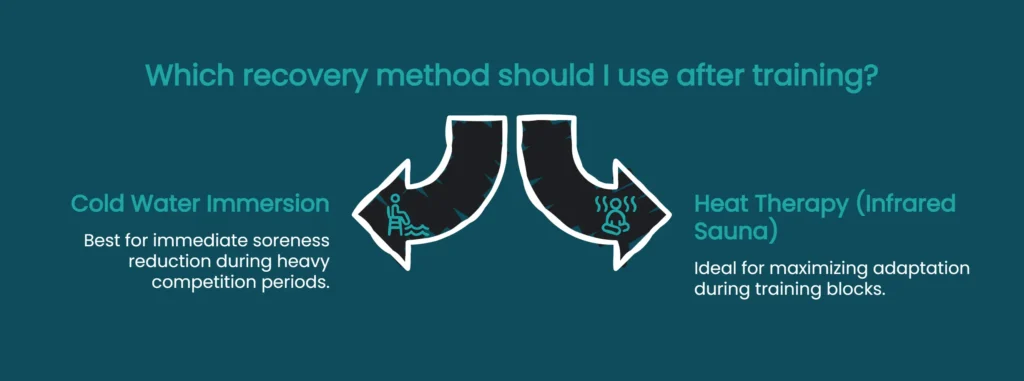
Cold water immersion and heat therapy represent physiologically opposing approaches. Cold produces vasoconstriction, inflammation suppression, and immediate soreness reduction — but may blunt training adaptation if used immediately after strength training sessions. Heat produces vasodilation, circulation enhancement, and HSP production — and may better preserve adaptation signaling while still supporting recovery.
Current evidence does not definitively establish one as superior. For athletes in heavy competition periods where reducing soreness quickly is the priority, cold may be appropriate. For training blocks where maximizing adaptation is the goal, sauna may be a better-fit modality. Some practitioners use contrast protocols (alternating heat and cold) — this is most common with traditional saunas and cold plunge combinations.
Practical Recovery Protocols by Training Type
Strength and Hypertrophy Training
Infrared: 30–60 minutes post-session. Temperature 130–140°F. Duration 20–25 minutes. Frequency 3–4 times per week.
Traditional: 20–40 minutes post-session. Temperature 170–185°F. Duration 10–15 minutes per round (1–2 rounds). Frequency 2–3 times per week.
Hydration for both: 16–24 oz water immediately post-training before entering sauna, additional 16 oz after.
Endurance Training
Infrared: 1–2 hours post-session to allow core temperature to normalize. Temperature 120–135°F. Duration 15–20 minutes. Frequency 2–3 times per week.
Traditional: Same 1–2 hour wait. Temperature 160–175°F. Duration 8–12 minutes. Endurance athletes with high sweat output must be especially vigilant about rehydration before any sauna session.
High-Intensity Interval Training (HIIT)
Infrared: 45–60 minutes post-session. Temperature 125–135°F. Duration 15–20 minutes.
Traditional: 45–60 minutes post-session. Temperature 160–175°F. Duration 8–10 minutes. HIIT produces significant metabolic acidosis and core temperature elevation — ensure adequate recovery before adding sauna thermal load of either type.
Frequently Asked Questions
Should I use a sauna before or after working out?
After, not before — for both sauna types. Pre-workout sauna use increases dehydration risk and reduces heat dissipation capacity during training regardless of whether you use infrared or traditional. Post-workout use after initial rehydration provides recovery benefits without compromising training quality.
Is infrared or traditional sauna better for muscle recovery?
Neither is definitively superior. Traditional saunas produce stronger systemic heat stress and have a larger evidence base overall. Infrared saunas offer deeper tissue warming at more comfortable temperatures and allow longer sessions. The best choice depends on your heat tolerance, available equipment, and whether you prefer shorter intense sessions (traditional) or longer moderate sessions (infrared).
How long should I wait after training to use a sauna?
30–60 minutes for infrared; 20–40 minutes for traditional. This allows initial rehydration and lets acute cardiovascular stress normalize before adding sauna thermal load. For endurance sessions with high sweat output, waiting 1–2 hours is more appropriate for both types.
Can sauna replace ice baths for recovery?
It is a different tool, not a direct replacement. Cold immersion and heat therapy have contrasting mechanisms and may serve different purposes — cold for acute soreness reduction in competition periods, heat for vasodilation and adaptation-supportive recovery in training blocks. Neither definitively outperforms the other across all contexts.
How many times per week should athletes use a sauna for recovery?
2–5 times per week depending on sauna type and training schedule. Infrared: 3–5 sessions per week is supported by available protocols. Traditional: 2–4 sessions per week is more typical given the higher intensity per session. Both can align with training days or be split across training and rest days.
Medical Disclaimer: This article provides educational information about sauna use in athletic recovery contexts and is not intended as medical or sports medicine advice. Individual responses to heat therapy vary based on fitness level, training load, hydration status, and health conditions. Consult a sports medicine physician or healthcare provider for personalized recovery guidance, particularly if you have cardiovascular conditions or train at elite levels.
For comprehensive guides on sauna mechanisms, safety guidelines, and evidence-based applications, visit Sauna Health Nut.
References
[1] Skorski S, et al. “The Effects of Post-Exercise Sauna Bathing on the Symptoms of Exercise-Induced Muscle Damage.” Journal of Strength and Conditioning Research. 2026. View on PubMed
[2] Stanley J, et al. “Effect of sauna-based heat acclimation on plasma volume and heart rate variability.” European Journal of Applied Physiology. 2026. View on PubMed
[3] Stanford Lifestyle Medicine. “The Healthspan Project: A Retrospective Pilot of Biomarkers and Biometric Outcomes after a 6-Month Multi-Modal Wellness Intervention.” View study
[4] Hussain J, Cohen M. “Clinical Effects of Regular Dry Sauna Bathing: A Systematic Review.” Evidence-Based Complementary and Alternative Medicine. 2026. View on PMC
You might also find these useful:
Are Infrared Saunas Safe? Risks, Contraindications, and Medical Guidelines
Infrared vs Traditional Saunas: Key Differences Explained
Infrared Sauna Temperature, Time, and Frequency Guidelines