Best Infrared Saunas of 2026: Clearlight vs Sunlighten vs More

Shopping for an infrared sauna gets confusing fast. Almost every brand claims “low EMF,” “premium wood,” and a “lifetime warranty.” But those words don’t always mean the same thing from company to company.
This guide compares four established brands: Clearlight, Sunlighten, JNH Lifestyles, and Health Mate. We look at three price tiers and focus on the details that separate a good purchase from a regretted one.
That means checking whether EMF numbers come from an independent lab or just the manufacturer. It also means looking at what the cabin is really made of, and how well the warranty holds up over time.
We also spent real time in two Clearlight models, the Premier and the Sanctuary, and we’ll tell you what that was like. The other three brands are covered through verified research, dealer documentation, and published specs rather than hands-on testing.
Updated for 2026.
Quick Picks by Price Tier
- Under $3,000: JNH Lifestyles Joyous or Vivo. Best for a first sauna on a tight budget. The tradeoff: thinner EMF documentation and shorter warranty windows on some parts.
- $3,000 to $6,000: JNH Ensi or a Health Mate far-infrared model. This tier is where third-party EMF testing starts showing up more consistently. Clearlight’s entry Premier models sometimes land here too, during sales.
- $6,000 and up: Clearlight Sanctuary or Sunlighten mPulse/Amplify. These are full-spectrum, tech-heavy cabins for buyers who want the most independently documented low-EMF performance. They’re built for people who don’t mind going through a dealer quote process.
Every price above is a starting point, not a guarantee. Clearlight and Sunlighten sell their higher-end lines through dealer networks. Quotes shift monthly, so confirm current numbers directly before you commit.
How We Evaluated These Saunas
We judged each brand on six criteria that matter most to a skeptical buyer. Those criteria are: EMF claims backed by a named third-party lab, heater type and build quality, and wood species used in the cabin. We also compared warranty length and coverage, current price versus published list price, and reported customer service experience.
We did not include Sun Home Saunas here, even though it shows up often in other roundups and has grown quickly. Much of its “award” coverage traces back to press-release distribution rather than independent editorial testing. So we kept this comparison focused on four brands with longer track records and clearer documentation.
Clearlight Sauna Review: Premier and Sanctuary
Clearlight sells two main lines. The Premier Series uses far infrared only, built around True Wave II heaters. These blend carbon panels for wide, even heat with ceramic elements for higher-intensity output. The Sanctuary line adds full-spectrum output on top of that same heater philosophy.
Sitting in the Premier, the heat feels steady and evenly distributed rather than concentrated in hot spots. That matches what the hybrid heater design is supposed to do. The Sanctuary runs hotter and adds red light and near-infrared options. Some buyers notice this more than others, depending on why they’re using the sauna.
Clearlight doesn’t publish prices on its own site. Buyers request a quote through a dealer network instead. Retailer listings we found ranged from roughly $5,300 to $7,000 for Premier models, and $6,800 to $9,800 for Sanctuary models, with outdoor versions running higher. Confirm exact current pricing directly, since these numbers shift with seasonal promotions.
Clearlight is one of the few brands where EMF figures are commonly cited as tested through an independent lab (Vitatech Electromagnetics). That’s different from brands that just describe their output as “low” without naming a lab. Cabinetry uses basswood, mahogany, or cedar depending on the line. The company advertises a lifetime warranty, though you should confirm exactly which components that covers before buying.
If you want the full breakdown of our time with both models, our full Clearlight sauna review covers the Sanctuary/Premier decision, the outdoor models, and where Clearlight’s own marketing oversells a couple of claims. Otherwise, current Clearlight Premier and Sanctuary pricing is worth checking before you compare it against the other three brands here.

Sunlighten Sauna Review: mPulse and Amplify
Sunlighten’s mPulse line uses what the company calls PulseIQ. It’s a system meant to deliver red light along with near, mid, and far infrared independently, rather than all at once. The Amplify line pairs that same infrared approach with a hotter cabin. It reaches up to 170°F, with thicker insulation and double-pane glass doors.
Both mPulse and Amplify are sold through a quote process, not a listed price. Third-party estimates we found varied widely, from around $4,200 to well over $13,000, depending on size and features. Sunlighten’s Signature line is the exception. It uses far infrared only, with SoloCarbon heaters, and has published pricing starting around $5,099. The portable Solo starts around $2,099.
Sunlighten’s own published warranty for residential cabin saunas breaks down by part. Cabinetry and heaters get 7 years, controls get 3 years, and glass doors and audio get 1 year. That’s shorter than Clearlight’s advertised lifetime coverage, though it’s also more specific about what’s included, and it’s worth reading the fine print: Sunlighten’s warranty page states coverage is parts only, with the customer responsible for freight and labor not included.
Sunlighten describes its EMF output as low, but that description is based on in-house testing. The product pages we reviewed didn’t point to a specific named third-party lab report, the way Clearlight’s documentation does. Treat “low EMF” here as a manufacturer claim until you see independent verification.
Checking Sunlighten’s current mPulse and Amplify offers is the next step if the full-spectrum feature set matters more to you than third-party EMF documentation.

JNH Lifestyles Review: Vivo, Joyous, Ensi, and Tosi
JNH Lifestyles runs several tiers under one brand. Vivo is the entry option, Joyous is the most popular far-infrared line, Ensi is built around low EMF output, and Tosi is the newer full-spectrum option. JNH generally sits at the lowest price point among the four brands, with published list pricing rather than a dealer-quote model.
Wood construction across JNH’s lines uses Canadian hemlock or Canadian red cedar. It’s sourced from FSC-certified forests and left untreated and unstained. That’s a solid material choice worth checking for, since some budget competitors use MDF or engineered composite panels instead.
EMF documentation varies sharply between JNH’s lines. The Joyous line advertises under 8 mG, with no publicly available third-party lab report attached to that number. The Ensi line is different. Its heaters have reportedly been tested by both Intertek and Vitatech, with an average reading around 0.32 mG. That’s the kind of documented figure this comparison looks for.
One recurring, user-reported design note on Joyous models involves a small gap at the top of the glass door. It can leak heat in cooler rooms, reducing how hot the cabin gets and how long it holds temperature. This shows up across multiple user reports, but isn’t independently confirmed as a defect. Treat it as a design characteristic to ask about, not a guaranteed problem.
JNH’s warranty terms vary by model, generally landing somewhere between 1 and 5 years depending on the line and component. For the full model-by-model breakdown, including specific dimensions and a closer look at the Arki flagship, see our full JNH Lifestyles review.
Viewing JNH Lifestyles’ current sauna lineup is the fastest way to see where your specific budget lands across Vivo through Tosi.

Health Mate Sauna Review: A Lineup Worth Confirming Directly
Health Mate has built infrared saunas continuously since 1979, making it the longest-running brand in this comparison. Its saunas use a patented Tecoloy heater compound.
Here’s where we have to flag a real gap rather than paper over it: sources disagree sharply on Health Mate’s current lineup structure and pricing. Some describe an Enrich line (far infrared, lower price) with published figures in the $5,300-$5,900 range, and separate Restore-branded models like Elevated Health and Therapy Lounge topping out around $8,500. Other sources describe an Enrich Solo starting near $2,995 and a Restore line running Solo through 4-person up to roughly $6,995. We couldn’t reconcile these into one confident table, which suggests Health Mate has restructured or renamed its lineup at some point and different sources are reflecting different snapshots in time. Confirm the current model names and pricing directly with Health Mate before treating any published figure, including ours, as current.
What we can say with more confidence: the Restore line uses Western Red Cedar cabinetry, while the Enrich line is priced lower using a different wood, though sources we reviewed disagreed on whether that wood is hemlock or eucalyptus, so confirm that directly too.
Health Mate advertises EMF readings under 1 milligauss at typical session positions, and references third-party testing through Korean labs. We weren’t able to locate a directly linked current lab report confirming that figure. Verify it on Health Mate’s own site before treating it as settled.
Warranty terms for Health Mate were reported inconsistently across our sources. Some describe lifetime coverage; others describe a component-specific term closer to 10 years on the cabin. We also found a single, unconfirmed report describing no dedicated service network and E1 control panel errors on some established models. That’s worth asking about directly, since it comes from just one source.
Comparing current Health Mate models and requesting a quote is the only reliable way to get Health Mate’s actual current lineup and pricing, given how much the published sources disagree.

Side-by-Side Comparison
| Brand | Typical Price Range | EMF Verification | Heater Type | Wood | Warranty |
|---|---|---|---|---|---|
| Clearlight | ~$5,300-$9,800+ | Third-party (Vitatech), commonly cited | True Wave II hybrid carbon/ceramic | Basswood, mahogany, cedar | Lifetime (confirm coverage details) |
| Sunlighten | ~$2,100-$13,000+ (varies by line) | Manufacturer-described “low,” no specific third-party report cited | PulseIQ / SoloCarbon | Not detailed on product pages | 7 yrs cabinet/heater, 3 yrs controls, 1 yr glass/audio |
| JNH Lifestyles | Lowest in category (verify current list price) | Ensi line: Intertek/Vitatech tested (~0.32 mG); Joyous: unverified | Standard carbon-panel heaters | Canadian hemlock, Canadian red cedar | Varies 1-5 years by model |
| Health Mate | Lineup and pricing structure disputed across sources, confirm directly | Claimed under 1 mG, Korean labs referenced (unlinked report) | Tecoloy | Western Red Cedar (Restore); disputed on Enrich | Reported inconsistently, verify directly |
EMF Explained: Verified vs. Claimed
EMF stands for electromagnetic field. It’s the main safety question people ask about infrared saunas, since the heater sits close to your body for 20 to 40 minutes at a time. Not all “low EMF” claims are equal. The difference between a manufacturer’s own testing and an independent lab’s report matters.
A commonly used precautionary benchmark from Building Biology guidelines puts the “no concern” threshold for sleeping areas at roughly 0.2 mG for magnetic fields and under 1 V/m for electric fields, with readings up to about 1 mG or 5 V/m falling into a “slight concern” range that warrants a closer look rather than immediate alarm.[1] These thresholds were developed mainly for sleeping areas, not sauna benches specifically, and they’re a precautionary guideline rather than an official regulatory limit. Treat them as a helpful reference point for comparison, not a pass/fail safety test.
Among the four brands here, Clearlight most consistently gets cited alongside named third-party lab testing (Vitatech). JNH’s Ensi line has a specific, documented reading from Intertek and Vitatech testing. Sunlighten and Health Mate both describe their output as low. But the documentation trail for those specific claims was thinner in the sources we reviewed. If EMF is your main concern, ask each brand for the actual lab report, not just the marketing page, and see our guide to testing your own sauna’s EMF for how to verify it yourself once your unit arrives.
Full Spectrum vs. Far Infrared: What Most Buyers Actually Need
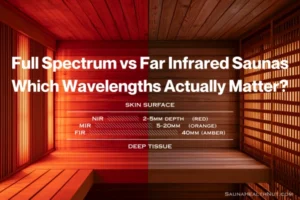
Far infrared is the original, most-studied wavelength used in infrared saunas. It has the stronger evidence base behind the core benefits people buy these saunas for, like relaxation and post-exercise recovery. Full spectrum adds near and mid infrared, plus sometimes red light. Some buyers value that for skin-focused or added light-therapy reasons.
Most people shopping in this category don’t need full spectrum to get the core experience they’re after. It’s a real feature, not a marketing gimmick, but it adds cost without a guaranteed extra benefit for every user. Our full spectrum vs. far infrared comparison breaks down the actual wavelength differences if you want to dig into whether the upgrade is worth it for you.
Who Should Buy Which
Buyers who want the most documented EMF testing should look at Clearlight or Sunlighten’s mPulse and Amplify lines. Just know you’ll be going through a dealer-quote model rather than a listed price.
Buyers who want a lower entry cost with solid wood construction should consider JNH’s Ensi line, and should feel comfortable asking directly for lab reports.
Buyers who care most about a long brand track record over cutting-edge tech features should look at Health Mate, while confirming the current lineup and pricing directly given the discrepancies noted above.
If budget is the deciding factor above everything else, JNH’s Joyous or Vivo lines get you into a sauna under $3,000. The tradeoff is thinner EMF documentation on the cheapest models.
FAQs
Is a full-spectrum infrared sauna worth paying more for than far infrared?
For most buyers, no. Far infrared has the stronger evidence base for the core benefits people want. Full spectrum mainly adds cost for features some users value more than others.
How much does a good infrared sauna actually cost in 2026?
Expect roughly $2,000 to $3,000 for a solid entry-level cabin. Mid-range models with better documentation run $3,000 to $6,000. Full-spectrum, tech-heavy cabins start around $6,000 or more. Always confirm current pricing directly with the brand or dealer.
What EMF level is considered “safe” in an infrared sauna?
There’s no official regulatory limit built specifically for sauna use. A commonly cited precautionary benchmark from Building Biology guidelines puts the “no concern” threshold for sleeping areas at roughly 0.2 mG for magnetic fields and under 1 V/m for electric fields, with a “slight concern” range extending to about 1 mG and 5 V/m.
Which infrared sauna brand has the best warranty?
Clearlight and some Health Mate models advertise lifetime warranties, though exact coverage varies and should be confirmed directly. Sunlighten publishes a more detailed, tiered warranty: 7 years on cabinetry and heaters, with shorter terms on controls and glass, parts only, with freight and labor excluded.
Clearlight vs. Sunlighten, which is better?
Neither is definitively better for every buyer. Clearlight publishes more consistent third-party EMF documentation across its lines. Sunlighten’s PulseIQ technology and Signature line’s published pricing appeal to buyers who want more control over wavelength settings.
Are budget brands like JNH Lifestyles reliable long-term?
JNH’s Ensi line has solid, documented EMF testing and quality wood sourcing, making it a reasonable budget-to-mid option. Its warranty terms are shorter than premium brands, so factor that into long-term reliability expectations.
Do infrared saunas need special (240V) electrical work?
Most standard residential infrared saunas run on a regular 120V outlet. Larger multi-person cabins and some full-spectrum models may require a dedicated circuit. Check the specific model’s electrical requirements before installation.
Bottom Line
No single brand here is the definitive “best” infrared sauna. Clearlight offers the strongest combination of documented EMF testing and a broad lineup. That’s based on our own time with the Premier and Sanctuary models. Sunlighten brings genuine wavelength technology and the most specific published warranty terms of the four, but leans more on manufacturer-described EMF claims. JNH Lifestyles opens the category to the smallest budgets, and its Ensi line stands out for its lab-documented EMF figure. Health Mate has the longest track record of the four, but its current lineup and pricing need direct confirmation before you treat any published figure, including ours, as settled.
Whichever brand you lean toward, verify current pricing first. Ask for the actual EMF lab report, not just a marketing summary, and confirm exact warranty coverage before you buy.
Medical Disclaimer: This guide compares general product features based on published specifications, independent testing sources, and hands-on time with select models, and is not a substitute for professional medical advice. Heat therapy, including infrared sauna use, is not appropriate for everyone. Consult your physician before beginning regular sauna use if you are pregnant, have cardiovascular conditions, or are on certain medications. See our full guide on infrared sauna safety and contraindications before purchasing any home sauna.
References:
- “Building Biology FAQ: EMF, Air Quality & Healthy Home Questions.” Healthy Building Education and Certification Institute. View source
- Sunlighten. “Warranty, U.S.A. & Canada.” View source