Clearlight Sauna Review: Is the Premium Price Worth It?
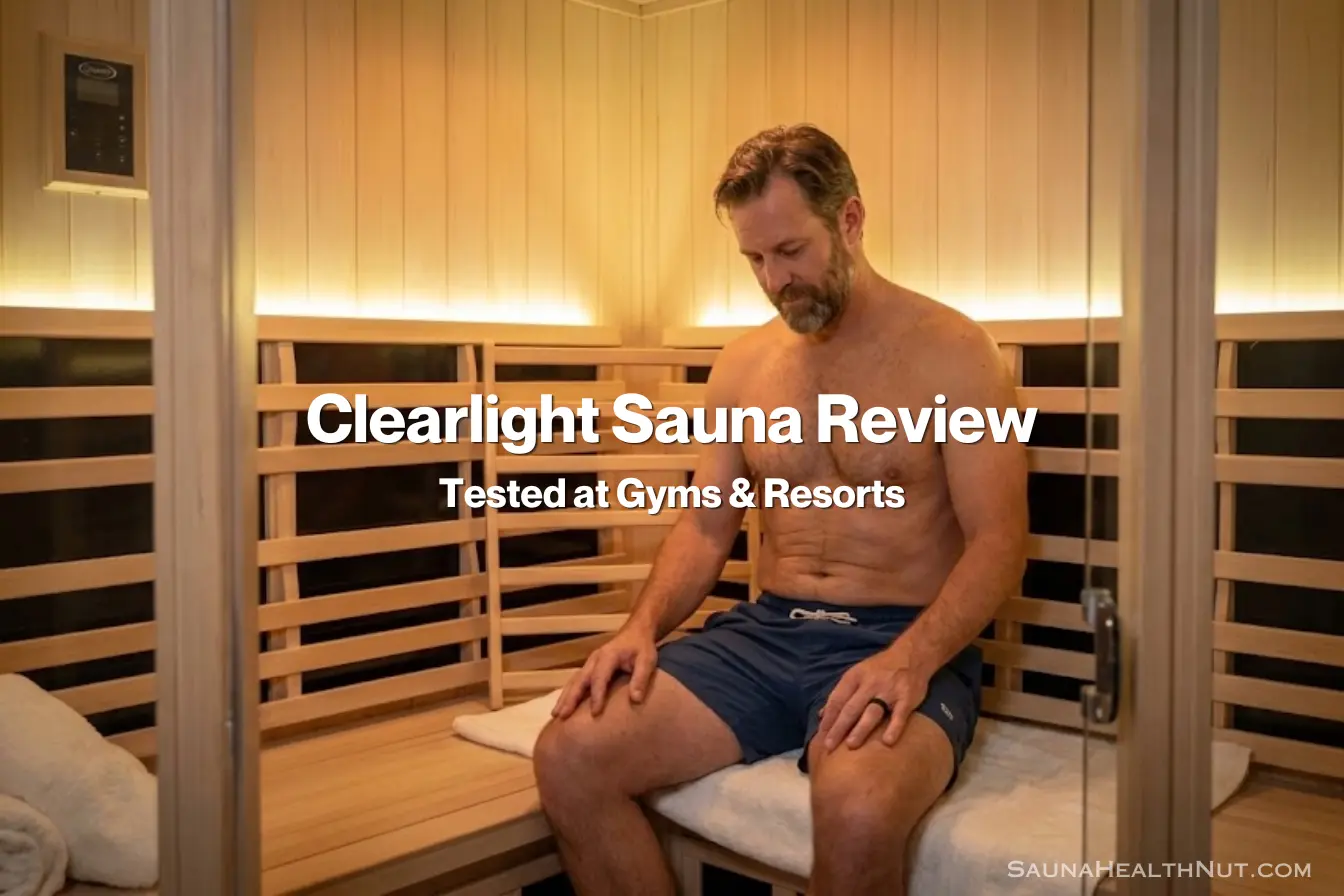
A Clearlight quote can land anywhere from around $3,400 for an entry Premier up past $10,000 for a larger Sanctuary with add-ons, and the company doesn’t post a fixed price on its own site anymore. That gap between budget infrared boxes and a premium brand like Clearlight raises a fair question: are you paying for real engineering, or just a name?
I’ve spent real time in both of Clearlight’s indoor lines, the Premier and the Sanctuary, at gyms I visit regularly and at resorts during travel, in sizes from 1-person up to 3-person. This review breaks down what actually justifies the price, what doesn’t hold up against Clearlight’s own published specs, and who should look elsewhere.
Verdict: For most buyers who want a home sauna they’ll keep for a decade or more, yes, the price generally holds up. The True Wave® heater engineering, wood quality, and lifetime warranty on parts are noticeably better than the budget imports I’ve compared them to directly. The catch is real too: Clearlight now runs a quote-only pricing model with commonly reported lead times of 6 to 14 weeks, and a couple of the brand’s own marketing claims (sweat-based detox, cardio benefits “nearly the same” as exercise) overstate what the evidence actually supports.
Last updated: 2026
At a glance:
- Two distinct indoor lines: Premier (far-infrared only, 1-3 person) and Sanctuary (full-spectrum near/mid/far infrared, 1-5 person plus two outdoor-rated models)
- Wood options are Mahogany or Basswood, not cedar, despite what some other reviews claim
- Clearlight’s own buyer’s guide cites a $5,000-$9,000 range; third-party dealer listings put entry Premier pricing lower, around $3,400-$6,500, with larger Sanctuary configurations exceeding $10,000 with add-ons
- EMF is claimed at under 1 milligauss “tested directly on the heater,” per Clearlight’s own wording, not at bench-sitting distance, a real difference in what the claim actually means
- Lifetime warranty covers parts and shipping; labor is not included beyond the initial warranty period, so later repairs are on you or a local technician
- Founded by Dr. Raleigh Duncan in 1997, with roughly 70,000 saunas sold according to Clearlight’s own figures
Who this review is for: Buyers actively comparing home infrared sauna brands in the premium tier who want a straight answer on what actually separates Clearlight’s models, backed by both real usage and Clearlight’s own published specs, not a rewritten spec sheet.
Reader Disclosure: This post contains affiliate links. If you purchase through them, we may earn a small commission at no extra cost to you. We only link to products
we've evaluated against our editorial standards.
What’s the Actual Difference Between Sanctuary and Premier?
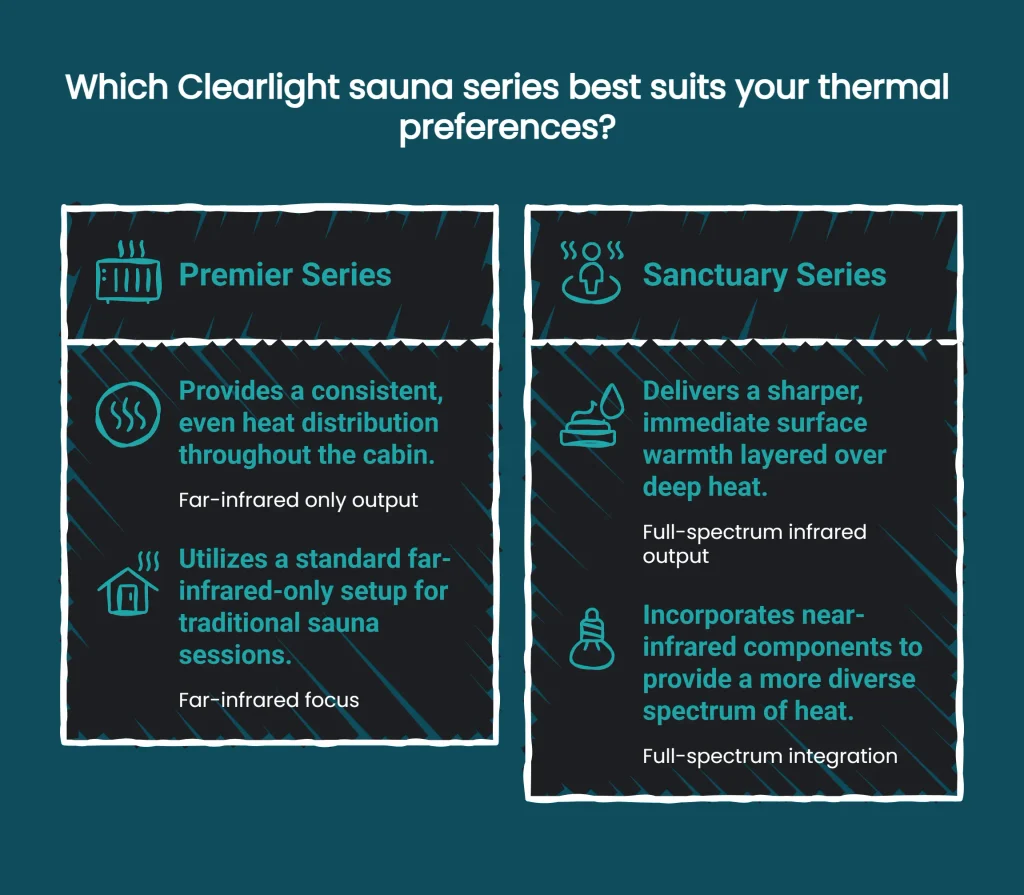
Premier is a far-infrared-only cabin, available in three sizes only: 1-person (IS-1), 2-person (IS-2), and 3-person (IS-3), all indoor. It uses Clearlight’s True Wave® heaters, carbon fiber panels paired with ceramic elements for wide, even heat coverage. Chromotherapy on Premier runs a 6-color LED system (Clearlight’s own pages list this as either 15 or 36 LEDs depending on which page you check, an inconsistency on Clearlight’s own site I can’t fully resolve), plus a built-in Nakamichi Bluetooth speaker system.
View Current Premier Models and Pricing →
Sanctuary adds near- and mid-infrared emitters, specifically two 500-watt front-wall heaters, on top of the same far-infrared coverage on the back, sides, floor, and calf area. It has a distinct glass-front design, a more advanced chromotherapy system, Wi-Fi/Bluetooth app control, and a heat-proof charging station. This is also where Clearlight puts every larger and specialty configuration: sizes run 1-person up to 5-person, a 4-person corner unit (Sanctuary C), a 4-person unit with removable benches for exercise or hot yoga (Sanctuary Retreat), and two outdoor-rated models (Outdoor 2 and Outdoor 5). Premier doesn’t offer any of those.
View Current Sanctuary Models and Pricing →
The near-infrared boost in Sanctuary is real and noticeable in use, but it’s not the same thing as a dedicated clinical photobiomodulation device, more on that below. For a deeper breakdown of what full spectrum heat can and can’t do compared to far infrared alone, our full spectrum vs. far infrared comparison covers that distinction.
My Experience With Both Series, In Gyms and Resorts
I’ve used Premier and Sanctuary models ranging from 1-person to 3-person, both at gyms I frequent regularly and at resorts I’ve traveled to. My usual protocol in the Premier runs 20 to 25 minutes at 130 to 140°F on the display, and the heat distribution has been noticeably more even than the lower-cost infrared saunas I’ve tried elsewhere. (Worth noting: Clearlight’s own guidance is that the cabin will typically stabilize around 115-125°F regardless of what you set the thermostat to, since running it at max is what keeps the heaters outputting continuously, not what actually raises the air temperature further.)
The Sanctuary’s full-spectrum heaters produce a genuinely different feel than Premier’s far-infrared-only setup. The near-infrared component is perceptible almost right away, a sharper surface warmth layered on top of the deeper far-infrared heat. Build quality in both series has felt solid, and the units I’ve used at resorts and gyms, which see heavy repeat use from many different people, have held up well, which says something about panel and bench durability under conditions well beyond typical home use.
I wear an Oura Ring during sessions to track heart rate and HRV response. I won’t claim specific numbers here since this isn’t a controlled test, but the pattern across sessions has felt consistent with what you’d expect from passive heat exposure: elevated heart rate during the session, followed by a normal recovery pattern afterward. EMF has consistently felt like a non-issue given Clearlight’s low claimed output, though I’d still recommend independent verification for your specific delivered unit rather than taking any brand’s number at face value; our guide to testing your own sauna’s EMF covers how to do that.
What Model Sizes and Configurations Does Clearlight Offer?
The full residential lineup, since generic “1-person” or “3-person” searches don’t tell you which specific unit you’d be buying:
| Model | Line | Capacity | Approx. dimensions (W x D x H) |
|---|---|---|---|
| Premier 1 (IS-1) | Premier, far infrared | 1 person | 40″ x 44″ x 76″ |
| Premier 2 (IS-2) | Premier, far infrared | 2 people | Confirm current spec sheet with dealer |
| Premier 3 (IS-3) | Premier, far infrared | 3 people | 61″ x 44″ x 76″ |
| Sanctuary 1 | Sanctuary, full spectrum | 1 person | 43″ x 48″ x 77″ |
| Sanctuary 2 | Sanctuary, full spectrum | 2 people | 52″ x 48″ x 77″ |
| Sanctuary 3 | Sanctuary, full spectrum | 3 people | 71″ x 48″ x 77″ |
| Sanctuary 5 | Sanctuary, full spectrum | 5 people | Confirm current spec sheet with dealer |
| Sanctuary C | Sanctuary, full spectrum | 4 people, corner design | Confirm current spec sheet with dealer |
| Sanctuary Retreat | Sanctuary, full spectrum | 4 people, removable benches for exercise use | Confirm current spec sheet with dealer |
| Sanctuary Outdoor 2 | Sanctuary, full spectrum, outdoor-rated | 2 people | Confirm current spec sheet with dealer |
| Sanctuary Outdoor 5 | Sanctuary, full spectrum, outdoor-rated | 5 people | Confirm current spec sheet with dealer |
A practical clearance rule across the lineup: leave roughly 2 inches around the cabin in an enclosed space, plus at least 12 inches above the roofline.
Can You Put a Clearlight Sauna Outside?
Only two models: the Sanctuary Outdoor 2 and Sanctuary Outdoor 5, both requiring Clearlight’s optional weatherproof cover. Neither Premier nor the other Sanctuary models are rated for outdoor use. One real limitation: because infrared saunas heat your body directly rather than the surrounding air (Clearlight states only about 20% of heater output goes toward warming cabin air), performance drops in cold weather, and outdoor placement generally isn’t recommended where ambient temperatures fall below roughly 40°F.
Build Quality, Wood Options, and Assembly
Clearlight uses tongue-and-groove panel construction across both lines. Assembly is designed for two people to complete in roughly 1-3 hours with no tools beyond a screwdriver for the door handle, and that matches what I’ve seen firsthand: panels line up cleanly and the frame feels tight once assembled.
Wood is offered in Mahogany or Basswood, that’s it. Mahogany is harder, naturally antifungal and antibacterial, and ranges from light honey to deep reddish tones. Basswood is lighter in color and lower in natural scent, a better pick if you’re sensitive to wood smell during longer sessions. If you’ve seen a review mention Cedar as a Clearlight option, that’s inaccurate; Cedar isn’t in Clearlight’s current wood lineup at all.
EMF and ELF: What’s Actually Verified
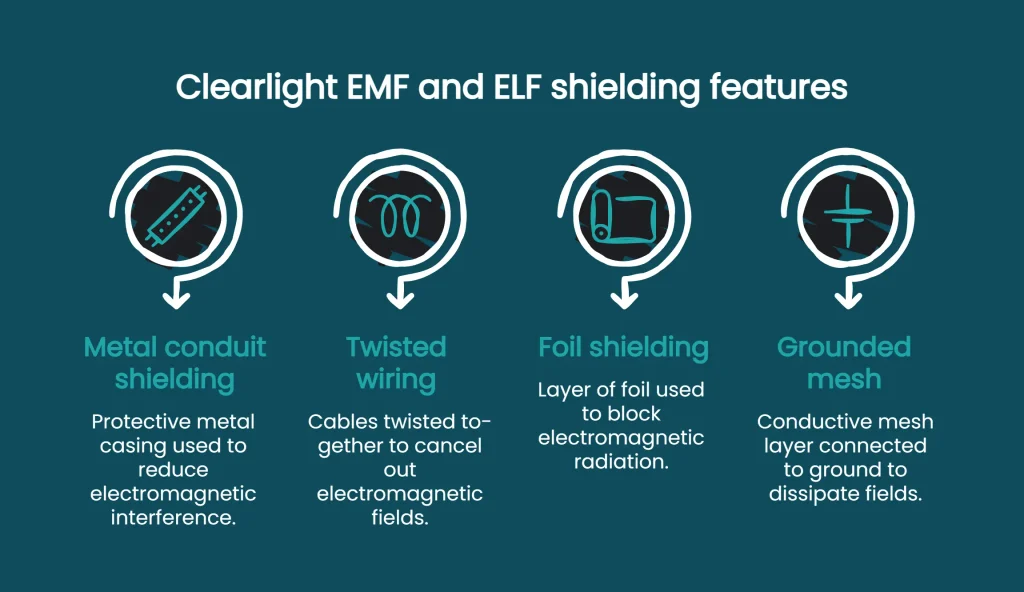
Clearlight advertises an average EMF level under 1 milligauss (mG), and its own buyer’s guide is specific that this figure is measured directly on the heater itself, not at typical bench-sitting distance, which is a meaningfully different (and weaker) claim than “under 1 mG in the seat,” even though some secondary sources round it up to sound stronger than that. Clearlight’s official materials also state that both Premier and Sanctuary share the same True Wave® low-EMF heater design and the same ELF-canceling wiring (metal conduit shielding, twisted wiring, foil shielding, grounded mesh), so I wouldn’t assume one line reads meaningfully lower than the other without testing your specific delivered unit.
Clearlight isn’t the only brand publishing low-EMF figures either; Sunlighten shares its own third-party EMF data for its lines, so a low-EMF claim alone isn’t a unique differentiator in this price tier. If EMF exposure is a top priority for you, get your specific unit independently tested rather than relying only on manufacturer specs, our EMF measurement guide walks through how.
What Does the Clinical Research Clearlight Cites Actually Show?
Clearlight points buyers to several outside studies on its research page: a Loras College study on exercise recovery, a Binghamton University (SUNY) study on weight loss, an RMIT University study comparing sauna use to exercise, and a UCSF study combining infrared heat with cognitive behavioral therapy for depression. Worth being direct about how to read these: they’re studies Clearlight cites and, in at least some cases, appears to have been directly involved in (the Binghamton weight-loss study specifically used a Clearlight Premier IS-3), which makes them manufacturer-affiliated research rather than fully independent, peer-reviewed literature I could verify on PubMed. Treat them as preliminary signals connected to the brand, not settled proof.
Two specific framings from this research page go further than the underlying evidence should be stretched:
“The sauna offered nearly the same cardiovascular benefits as moderate-intensity exercise… just sitting in an infrared sauna mimics exercise.” This is how Clearlight’s own page summarizes the RMIT comparison. Passive heat exposure and aerobic exercise both raise heart rate, but they aren’t physiologically equivalent. Exercise involves muscular workload, oxygen consumption, and training adaptations that passive heating doesn’t replicate, regardless of how similar the heart-rate curve looks on a monitor.
“Daily sweating can help detoxify your body of accumulated toxic heavy metals.” Sweat is a real but minor excretion pathway. The liver and kidneys handle the large majority of that work continuously, sauna or not. This claim, found elsewhere on Clearlight’s site, overstates sweat’s actual role.
Neither correction is a knock on the hardware. The heater engineering and build-quality claims are separate from these two overstated wellness framings, and shouldn’t be confused with each other when you’re weighing the purchase.
What Does a Clearlight Sauna Cost, and What Do You Get for It?
Clearlight’s own buyer’s guide cites a general range of $5,000 to $9,000. Third-party dealer listings and independent reviews put entry-level Premier pricing somewhat lower in practice, commonly $3,400-$6,500 depending on size, with larger Sanctuary configurations exceeding $10,000 once you add features like halotherapy or a red light therapy tower. Treat any of these as a starting point to confirm at quote time, not a fixed price, since Clearlight’s own site no longer publishes per-model pricing and instead routes every buyer through a quote request.
Financing is available directly through Clearlight, commonly structured as 18-month terms with $999 down, and military, teachers, first responders, and medical professionals can get a 10% discount through ID.me verification.
On warranty: the Limited Lifetime Warranty covers parts and shipping for as long as you own the sauna, but labor is only covered for the initial warranty period, not for the sauna’s lifetime, meaning later repairs mean installing the part yourself or paying a local technician. Lead times are commonly reported by buyers and other reviewers in the 6-14 week range, since these aren’t stocked, ship-same-week items; budget your timeline accordingly if you’re working around a specific move-in date or season.
Browse All Clearlight Models and Get Pricing →
Clearlight vs. Jacuzzi: Are They the Same Sauna?
Not exactly, and less so than the shared name suggests. Clearlight and Jacuzzi Inc. announced an exclusive licensing partnership in 2026, but as of 2026 the two run entirely separate storefronts and, more importantly, different heater technology: Jacuzzi’s JS-series (JS-1i, JS-2i, JS-3i) uses its own Mica/Carbon far infrared heaters, described as a “Jacuzzi Exclusive,” not Clearlight’s True Wave® design. Jacuzzi’s JS-series also carries a verified 5-year comprehensive warranty (confirmed directly on every current JS model page as of mid-2026), a real difference from Clearlight’s own residential Limited Lifetime Warranty on parts. Jacuzzi’s saunas do come standard with an overhead red light therapy bar and Vibrational Resonance Therapy built in, which Clearlight sells as separate add-ons instead. If the lifetime warranty term is specifically why you’re drawn to this family of saunas, the Jacuzzi badge isn’t the one that carries it.
How Does Clearlight Compare to Sunlighten, Jacuzzi, and Other Alternatives?
| Brand | Pricing model | Approx. price range | Warranty |
|---|---|---|---|
| Clearlight | Quote-only | $3,400-$10,000+ | Limited lifetime (parts/shipping; labor only during initial period) |
| Sunlighten | Quote-only | Roughly $4,500-$10,000 | Varies by line |
| Jacuzzi JS-series | Dealer network, no published per-model price | Not publicly listed | 5-year comprehensive (verified) |
| Peak Saunas | Published online pricing | Roughly $8,000-$11,000 on comparable full-spectrum models | 7-year limited lifetime (structure, wood, heating elements); 7-year red light panel warranty |
Sunlighten is Clearlight’s closest full-spectrum rival, with per-wavelength programmable heaters and its own published EMF data; some buyers prefer Sunlighten’s separated heater design for targeting specific wavelengths, others find Clearlight’s combined True Wave approach simpler.
Peak Saunas is the transparent-pricing alternative in this tier, publishing live model pricing online without a sales call, and includes a full-body red light panel standard on some models (published irradiance data at multiple distances) rather than as a paid add-on. It has a shorter track record than Clearlight’s nearly three decades, but pricing opacity is a real dealbreaker for some buyers, and Peak removes that friction entirely.
What Do Verified Complaint Patterns Actually Show?
Clearlight (operating as Sauna Works on BBB records) has been BBB accredited since 2006 with an A+ rating, though that rating measures how a business responds to complaints, not customer satisfaction directly; the BBB’s own customer review average sits at 2/5 stars, based on a small sample of only 4 reviews. Trustpilot tells a different story at scale: 4.4/5 (“Excellent”) across roughly 1,483 reviews as of mid-2026. That gap is worth understanding rather than picking one number: a handful of BBB reviews skews toward people who had a bad enough experience to file a formal complaint, while Trustpilot’s much larger sample gives a more representative average.
The complaint themes that do repeat consistently across BBB, Trustpilot, and app store reviews are worth taking seriously: app and Wi-Fi connectivity issues (Clearlight has rebuilt its Sauna Connect app across at least two generations to address this), freight delivery damage or delay on the heavy crates these saunas ship in, and the labor-excluded warranty meaning post-warranty-period repairs fall on the owner. None of these make Clearlight a bad sauna, and I haven’t experienced any of them personally in gym or resort settings, but they’re real enough, and consistent enough across independent platforms, to factor into your decision if any of them would be a dealbreaker for you.
Who Should Buy Clearlight, and Who Should Skip It
Clearlight makes sense if you plan to use a home sauna for years, want heater engineering with a genuinely low EMF design, and value a strong parts warranty over a lower sticker price or transparent online pricing. It’s also a reasonable pick if you’ve already tried a Premier or Sanctuary unit at a gym or resort, the way I have, and liked the experience.
Skip it if you need an exact price before you’ll even consider a brand, you’re working with a tight budget under $3,000, you can’t tolerate a multi-week wait for delivery, or app connectivity reliability is a hard requirement for you given the documented pattern above.
Consider Alternatives If
- You want genuine red light therapy included standard, not as an add-on: Jacuzzi’s JS-series and some Peak Saunas models include it standard; Clearlight sells its Red Light Therapy Tower separately.
- Pricing transparency matters more to you than brand history: Peak Saunas publishes live pricing online with no sales call required.
- You need a 4+ person or outdoor sauna and want Premier’s lower price point: Premier doesn’t offer those configurations at all; you’d need Sanctuary or a different brand.
- App reliability is a hard requirement: this is the most consistently repeated complaint across independent review platforms for Clearlight specifically.
Frequently Asked Questions
Is the Clearlight premium price actually worth it compared to cheaper infrared saunas? For long-term buyers, generally yes, based on my own use of both lines and Clearlight’s published specs. The True Wave® heater design, wood quality, and parts warranty are noticeably better than budget imports. The trade-offs are a quote-only pricing process and commonly reported 6-14 week lead times.
What’s the real difference between Clearlight Premier and Sanctuary? Premier is far-infrared only, capped at 3-person sizes. Sanctuary adds near- and mid-infrared through dedicated front-wall heaters and is the only line offering 4-5 person or outdoor-rated models.
Is Clearlight’s EMF claim as strong as it sounds? The under-1-mG figure is measured directly on the heater, not at bench-sitting distance, which is a real distinction some secondary sources gloss over. Both Premier and Sanctuary use the same claimed low-EMF technology, so I wouldn’t assume one line tests measurably lower without independently verifying your own unit.
Can I put a Clearlight sauna outside? Only the Sanctuary Outdoor 2 and Outdoor 5, with the optional weatherproof cover, and generally not recommended in climates that regularly drop below about 40°F.
Is Clearlight the same company as Jacuzzi? No. They’re connected by a 2026 licensing partnership, but Jacuzzi’s JS-series uses its own Mica/Carbon heater technology, not Clearlight’s True Wave® design, and carries a separately verified 5-year warranty rather than Clearlight’s lifetime parts warranty.
Does Clearlight’s sauna really give a workout-equivalent cardio benefit or major detox effect? Not to the degree Clearlight’s own marketing suggests in places. Sweat is a minor detox pathway next to the liver and kidneys, and passive heat exposure isn’t physiologically equivalent to aerobic exercise even though both raise heart rate.
What does the warranty actually cover? Parts and shipping for as long as you own a residential Sanctuary or Premier unit. Labor is only covered during the initial warranty period, not for the sauna’s lifetime, so later repairs are on you or a local technician.
How does Clearlight compare to Sunlighten? Both are premium, quote-only priced brands with published low-EMF claims. Sunlighten offers per-wavelength programmable heaters; Clearlight uses a combined True Wave® approach some buyers find simpler.
Medical Disclaimer: This review discusses general product features based on published specifications and personal use, and is not a substitute for professional medical advice. Heat therapy, including infrared sauna use, is not appropriate for everyone. People who are pregnant, have cardiovascular conditions, or are on certain medications should consult a physician before beginning regular sauna use. See our full guide on infrared sauna safety and contraindications before purchasing any home sauna.
Shop All Current Clearlight Models →
Have questions about which Clearlight model fits your space and budget? Browse our full sauna review library →