
Full Spectrum vs Far Infrared Saunas: Wavelength Differences and Effects
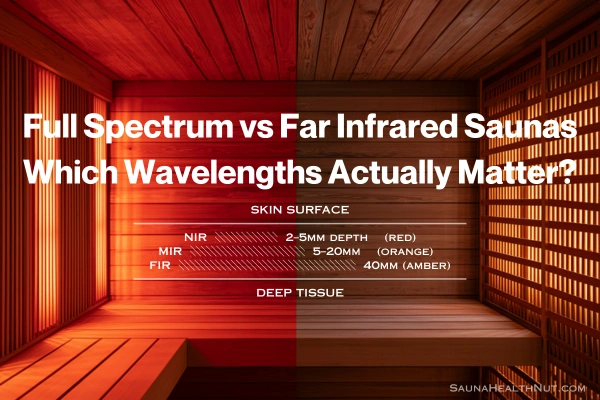
Short answer: The core difference between full spectrum and far infrared saunas is wavelength coverage. Far infrared (FIR) saunas emit wavelengths in the 3–14 micron range, producing deep tissue heat and strong thermoregulatory responses. Full spectrum saunas add near-infrared (NIR, 0.8–1.4 microns) and mid-infrared (MIR, 1.4–3 microns) wavelengths, each with distinct penetration depths and studied cellular effects. Whether the additional wavelengths justify the cost difference depends entirely on your specific health goals.
Last updated: 2026
At a glance
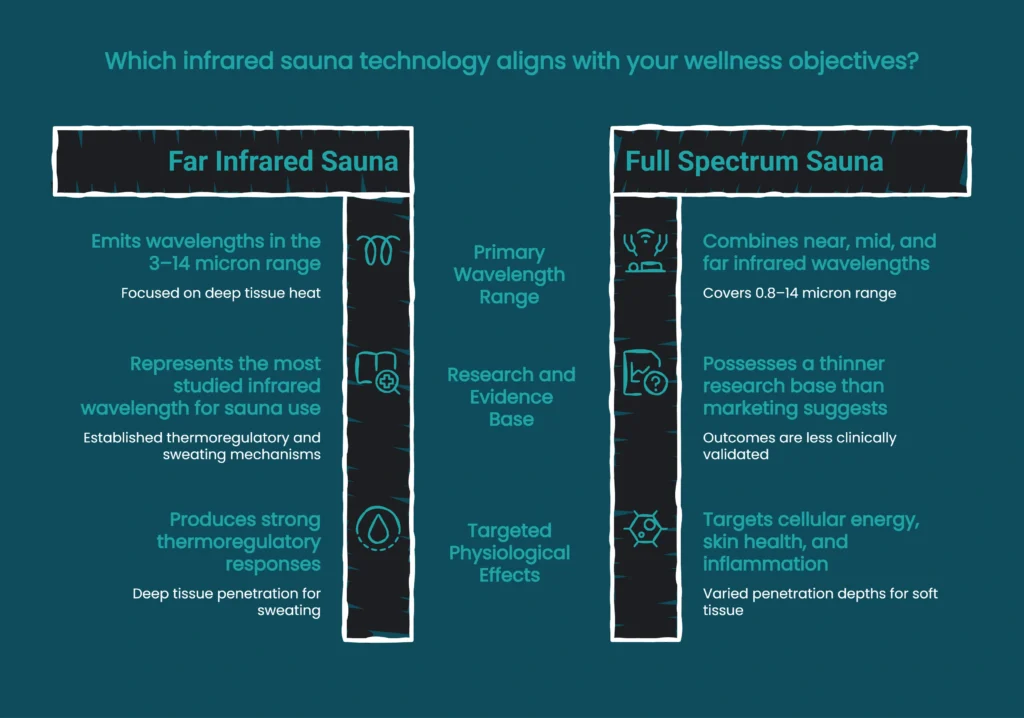
- Far infrared (FIR) is the most studied infrared wavelength for sauna use: deep heat, sweating, and thermoregulatory responses
- Near-infrared (NIR) penetrates shallower tissue layers and has been studied in relation to cellular energy production and skin health
- Mid-infrared (MIR) penetrates soft tissue and has been studied in relation to circulation and inflammation
- Full spectrum saunas deliver all three; FIR-only saunas deliver the most established sauna mechanism
- The research base for full spectrum sauna-specific outcomes is thinner than marketing suggests
Who this guide is for
This article is for consumers and wellness practitioners evaluating infrared sauna types based on wavelength delivery. It covers the physics, penetration depths, and current evidence for each wavelength type — not product recommendations. For a broader overview of how infrared saunas work at the tissue level, see our technical guide to infrared heat delivery and tissue interaction.
Understanding the Infrared Spectrum: A Starting Point
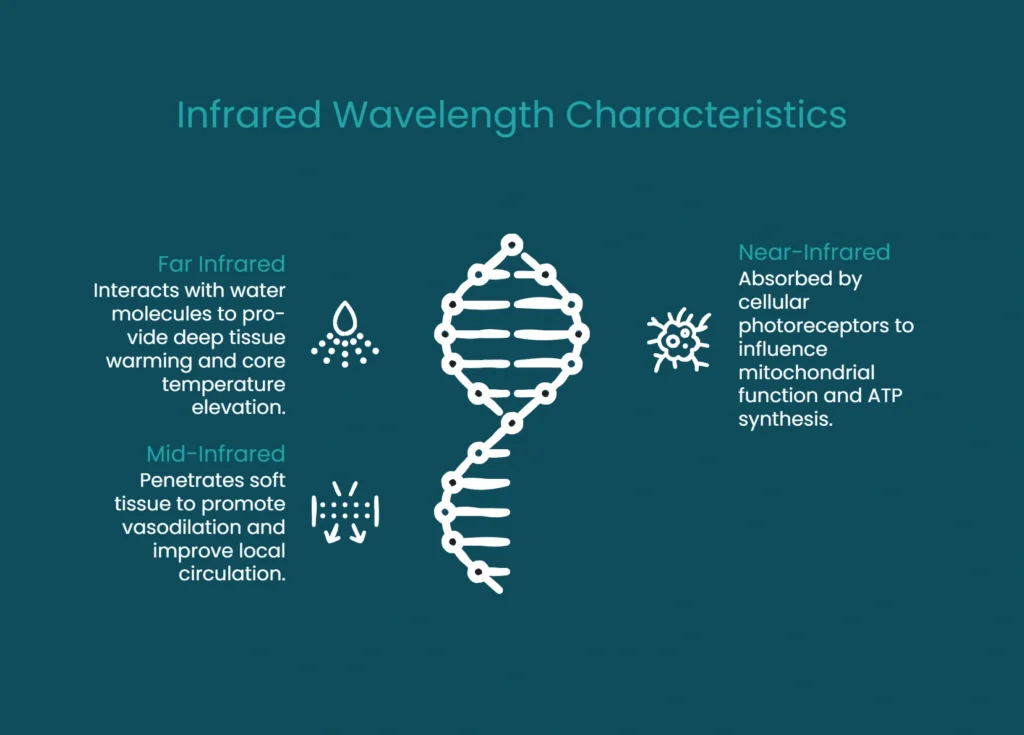
Infrared radiation occupies the portion of the electromagnetic spectrum between visible red light (approximately 700 nm) and microwave radiation. It is invisible to the human eye but perceived as heat when absorbed by tissue. The infrared spectrum is typically divided into three sub-bands, each with distinct physical properties and biological interactions:
| Wavelength Type | Range | Penetration Depth | Primary Studied Mechanism |
|---|---|---|---|
| Near-Infrared (NIR) | 0.8–1.4 microns (800–1,400 nm) | 2–5 mm (skin and subcutaneous tissue) | Photobiomodulation, cellular energy (ATP) |
| Mid-Infrared (MIR) | 1.4–3 microns (1,400–3,000 nm) | 5–20 mm (soft tissue, muscle surface) | Vasodilation, circulation, inflammation |
| Far-Infrared (FIR) | 3–14 microns (3,000–14,000 nm) | Up to 40 mm (1.5 inches, deep tissue) | Core temperature elevation, sweating, HSP production |
These penetration depths are approximate and vary based on tissue type, water content, and wavelength intensity. The body is not a uniform material — bone, fat, muscle, and skin each absorb infrared wavelengths differently.
Far Infrared Saunas: The Established Standard
Far infrared saunas emit wavelengths that interact primarily with water molecules in body tissue. Because human tissue contains approximately 60% water, and water strongly absorbs far infrared radiation, FIR is highly efficient at transferring thermal energy into the body. The result is direct deep tissue warming that elevates core body temperature without requiring extremely high ambient air temperature — the mechanism responsible for the characteristic infrared sauna experience: sustained, penetrating warmth at lower room temperatures (110–150°F) compared to traditional saunas (175–195°F).
Well-documented FIR responses include core temperature elevation of 1–3°F during a 20–30 minute session, profuse sweating as the thermoregulatory system responds, heart rate elevation of 30–50% above resting baseline, and heat shock protein (HSP) production — a cellular stress response mechanism studied in relation to protein repair and cellular resilience. Studied associations with moderate evidence include muscle relaxation, temporary reduction in musculoskeletal discomfort, blood pressure changes through heat-induced vasodilation, and improvements in subjective sleep quality in small studies.
Far infrared is the most extensively studied infrared wavelength for sauna applications. A 2009 review identified nine studies with high-quality evidence (Level I or II) examining far infrared sauna effects on cardiovascular risk factors. [1] The majority of clinical sauna studies — whether examining cardiovascular markers, pain, fatigue, or general wellness — use FIR-dominant saunas as their primary intervention. When you read research on infrared sauna benefits, you are almost always reading research on far infrared specifically.
Near-Infrared: The Added Layer in Full Spectrum Saunas
Near-infrared wavelengths (800–1,400 nm) are absorbed primarily in the outer 2–5 mm of tissue — the epidermis, dermis, and superficial subcutaneous layer. Unlike FIR, which heats tissue primarily through water absorption, NIR interacts with specific cellular photoreceptors. The most studied mechanism involves cytochrome c oxidase, an enzyme in mitochondria that absorbs NIR wavelengths. When absorbed, this enzyme triggers a cascade of intracellular effects — including altered electron transport, nitric oxide release, and changes in reactive oxygen species — that collectively influence cellular energy production (ATP synthesis). [2]
This mechanism is the basis for photobiomodulation (PBM) therapy, a separate but related field of light-based medicine. NIR has been studied for skin health (collagen synthesis support, wound healing), cellular energy (mitochondrial function and ATP production), and pain and inflammation through controlled trials on musculoskeletal pain using targeted NIR devices.
The critical distinction: most photobiomodulation research uses targeted, high-intensity NIR devices that deliver specific wavelengths at calibrated irradiance levels (measured in mW/cm²). Infrared sauna NIR emitters are different in both intensity and delivery method — they warm a room rather than delivering precise doses to specific tissue sites. The clinical evidence for NIR effects generally cannot be directly transferred to infrared sauna settings. The mechanisms are plausibly the same, but the dose, delivery, and evidence base differ. Full spectrum sauna manufacturers often reference photobiomodulation research without acknowledging this gap.
Mid-Infrared: The Middle Range
Mid-infrared wavelengths (1,400–3,000 nm) penetrate deeper than NIR (5–20 mm) but less deeply than FIR, and are primarily absorbed by soft tissue — muscle surface layers, connective tissue, and blood vessel walls. The primary physiological effect studied in relation to MIR is vasodilation — the expansion of blood vessels. When MIR is absorbed by tissue surrounding blood vessels, local warming causes vasodilation, improving circulation to the area. This has been studied in relation to post-exercise muscle recovery, joint discomfort support, and localized inflammation reduction through improved tissue perfusion.
Isolated MIR research in sauna contexts is limited. Most full spectrum sauna research measures the combined effect of all three wavelengths rather than isolating MIR’s contribution. The stronger evidence base for MIR effects comes from targeted infrared therapy devices such as infrared lamps and heating pads.
Full Spectrum Saunas: What “Full Spectrum” Actually Means
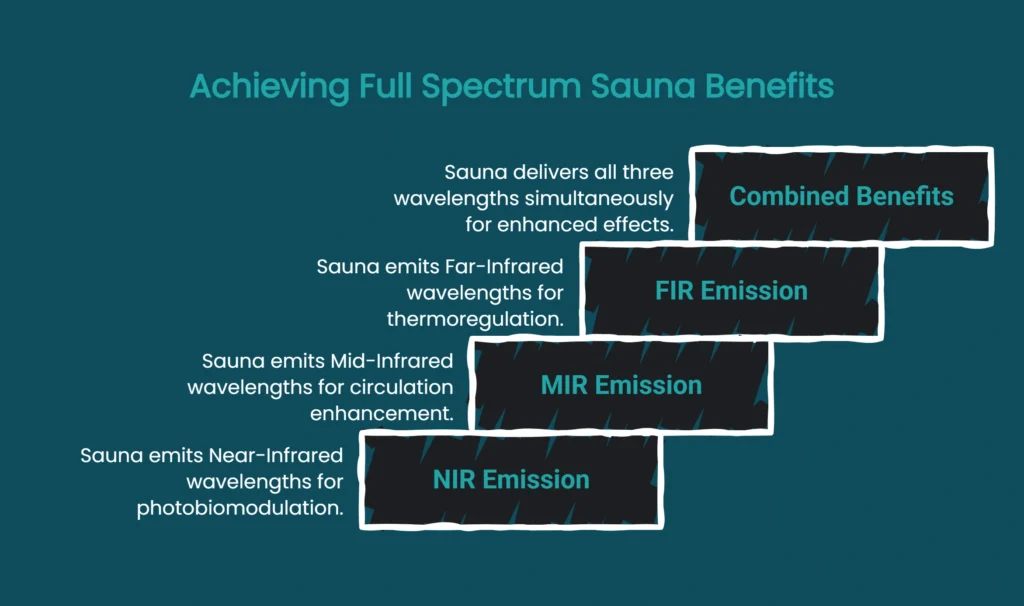
“Full spectrum” in sauna marketing refers to a sauna that emits NIR, MIR, and FIR wavelengths simultaneously or through separate emitter panels. In practice there is significant variability in how full spectrum saunas deliver these wavelengths. Some use separate panel types for each wavelength; others use broad-spectrum emitters that cover multiple ranges simultaneously. The relative intensity and distribution of each wavelength type differs by manufacturer and model.
“Full spectrum” is a marketing term, not a regulated specification. A sauna labeled full spectrum may prioritize FIR heavily with minimal NIR output, or may balance all three. Without third-party spectral analysis, wavelength distribution claims cannot be verified.
If a full spectrum sauna genuinely delivers meaningful NIR and MIR alongside FIR, it adds potential photobiomodulation effects from NIR, potential circulation enhancement from MIR, and the same core thermoregulatory benefits from FIR as a FIR-only sauna. What it does not add: a substantially different deep heating experience (FIR handles this regardless), clinically equivalent photobiomodulation effects to targeted NIR therapy devices, or guaranteed combined-wavelength benefits — the interaction effects of all three wavelengths delivered simultaneously in a sauna setting have not been well-studied.
Goal-Based Wavelength Matching
| Goal | Best Fit | Rationale |
|---|---|---|
| Deep tissue warmth, sweating, cardiovascular stimulus, general wellness | Far infrared (FIR) | Strongest research base; primary mechanism of sauna therapy |
| Skin health, cellular energy, surface tissue effects | Full spectrum with verified NIR output | NIR mechanism plausible; dose less controllable than clinical devices |
| Muscle recovery, joint comfort | Full spectrum (MIR) or FIR with extended duration | MIR adds soft tissue vasodilation; FIR at longer duration achieves similar results |
| Chronic pain management | Far infrared | Most chronic pain sauna studies use FIR protocols specifically |
Key Distinctions at a Glance
| Factor | FIR Only | Full Spectrum |
|---|---|---|
| Wavelength coverage | Far infrared (3–14 microns) | NIR + MIR + FIR |
| Deep tissue heating | Primary mechanism | Same FIR component |
| Photobiomodulation potential | Not delivered | Via NIR (dose varies) |
| Vasodilation at soft tissue | Via temperature elevation | Enhanced via MIR |
| Research base | Stronger (most sauna studies use FIR) | Thinner (combined wavelength studies limited) |
| Typical cost | Lower | Higher |
| Wavelength verification | Simpler to verify | Requires spectral analysis |
Frequently Asked Questions
Is full spectrum infrared better than far infrared?
“Better” depends on your goals. FIR has a more established research base for classic sauna outcomes — deep heat, cardiovascular response, sweating, relaxation. Full spectrum adds wavelength coverage that theoretically broadens the mechanism range, but the combined-wavelength evidence specific to sauna settings is limited. For most users seeking general wellness benefits, FIR alone is well-supported.
Do near-infrared wavelengths actually do anything in a sauna?
NIR’s interaction with cytochrome c oxidase and mitochondria is a documented cellular mechanism. Whether sauna-delivered NIR achieves therapeutic dose levels equivalent to clinical photobiomodulation devices is uncertain and poorly studied. The mechanism is real; the dose question in a sauna context remains open.
Can I get photobiomodulation effects from a full spectrum sauna?
Potentially, at lower intensity than targeted NIR therapy devices. Sauna NIR emitters are not calibrated to specific irradiance levels the way clinical PBM devices are. Users interested in specific photobiomodulation effects may get more reliable outcomes from dedicated red light therapy panels alongside a FIR sauna.
Why do most sauna studies use far infrared specifically?
FIR is the primary infrared wavelength absorbed by tissue water, making it the most direct mechanism for the deep tissue heating central to sauna therapy. Most researchers designing clinical protocols choose FIR because its thermal effects are the most predictable and well-characterized.
How do I verify what wavelengths my sauna actually delivers?
Request third-party spectral analysis documentation from the manufacturer. Reputable full spectrum sauna brands provide independent testing showing wavelength output and relative intensity across NIR, MIR, and FIR ranges. Without this documentation, wavelength claims are unverifiable.
Medical Disclaimer: This article provides educational information about infrared sauna wavelength types and is not intended as medical advice. Consult a healthcare provider before beginning infrared sauna use, especially if you have pre-existing health conditions or take prescription medications.
For comprehensive guides on infrared sauna mechanisms, safety, and evidence-based applications, visit Sauna Health Nut.
References
[1] Beever R. “Far-infrared saunas for treatment of cardiovascular risk factors: summary of published evidence.” Canadian Family Physician. 2009. View on PMC
[2] Hamblin MR. “Mechanisms and applications of the anti-inflammatory effects of photobiomodulation.” AIMS Biophysics. 2026. View on PMC
You might also find these useful: