
How infrared saunas work: heat, light, and tissue interaction

Short answer: An infrared sauna works by using specific wavelengths of light to create heat directly within your body’s tissues. Unlike traditional saunas that heat the air around you, infrared light penetrates the skin to warm you from the inside out, triggering a deep sweat and unique cellular responses at lower, more comfortable temperatures.
Key Takeaways
- Infrared saunas use radiant heat (light), not convective heating (hot air) to warm the body
- Three mechanisms occur: photon absorption → tissue warming → physiological response
- Operates at 120-150°F versus 180-220°F for traditional saunas due to direct energy transfer
- Each wavelength type penetrates to different depths: NIR (2-3mm), MIR (10-15mm), FIR (40mm+)
How Infrared Saunas Differ from Traditional Heat Therapy
For decades, the word “sauna” has conjured a single image: a wood-paneled room, a bucket of water, and a pile of scorching rocks radiating intense, stifling heat. This is the world of the traditional Finnish sauna, a wellness tool built on the principle of convection heat. It heats the air to an extreme degree, and that superheated air, in turn, heats your body.
The therapeutic mechanism of an infrared sauna represents a fundamental shift. Rather than using brute-force environmental heat, it delivers energy through light at specific frequencies. When infrared photons are absorbed by water molecules and cellular structures in tissues, they create resonant warmth from the inside out. This internal energy transfer triggers biological responses that differ from simple ambient heating.
This article examines the physics of infrared light, the cellular mechanisms it activates, and how different wavelength types produce distinct tissue-level effects. For a comprehensive overview of infrared sauna types, wavelength characteristics, and physiological responses, see our complete guide to infrared sauna fundamentals and mechanisms.
The Physics of Radiant Heat: How Light Warms Tissue Directly
To understand how an infrared sauna works, we must first recognize that heat doesn’t need to travel through air to warm us. The key difference lies in the method of heat transfer.
A traditional dry sauna or steam room relies on convection and conduction. The heater warms the air (convection), and the hot air warms your skin (conduction). In an infrared sauna, the primary mechanism is radiation.
This is the same principle that allows you to feel the sun’s warmth on a chilly day. The air temperature may be low, but the sun’s infrared waves travel through space, pass through the cool air, and deposit their energy directly onto your skin. An infrared sauna harnesses this exact phenomenon. The infrared heaters emit photons—particles of light—that travel through the cabin and are absorbed directly by your body.
This process is often cited as more efficient, with estimates suggesting approximately 80% of the energy directly heating your body and only 20% heating the air. An infrared sauna heats the body directly using light, whereas a regular sauna uses heat to warm the air, which then warms the body.
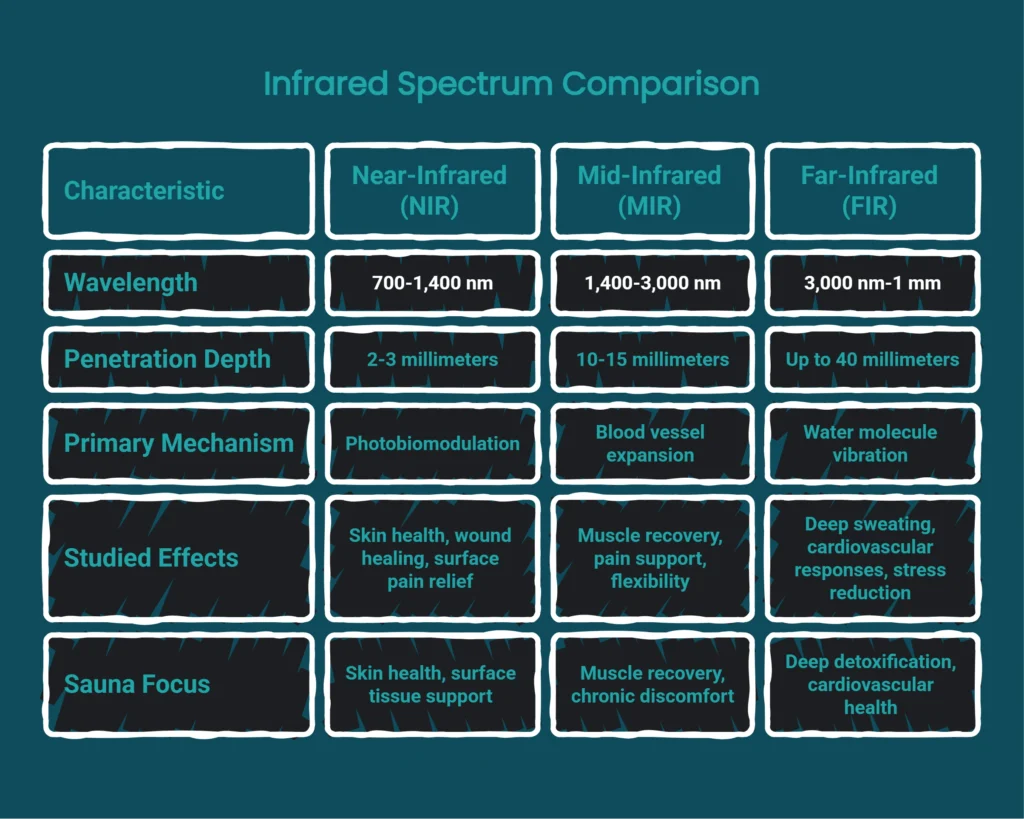
Infrared light exists on the electromagnetic spectrum, a continuum of energy waves ranging from gamma rays to radio waves. Infrared light sits just beyond the red light we can see. This spectrum is categorized into distinct bands based on wavelength: near-infrared (NIR, 700-1,400 nm), mid-infrared (MIR, 1,400-3,000 nm), and far-infrared (FIR, 3,000 nm-1 mm). Each interacts with the body differently. The ability of this thermal energy to bypass air and energize molecules directly is the foundational principle of infrared therapy.
What Happens First When Infrared Light Enters the Body
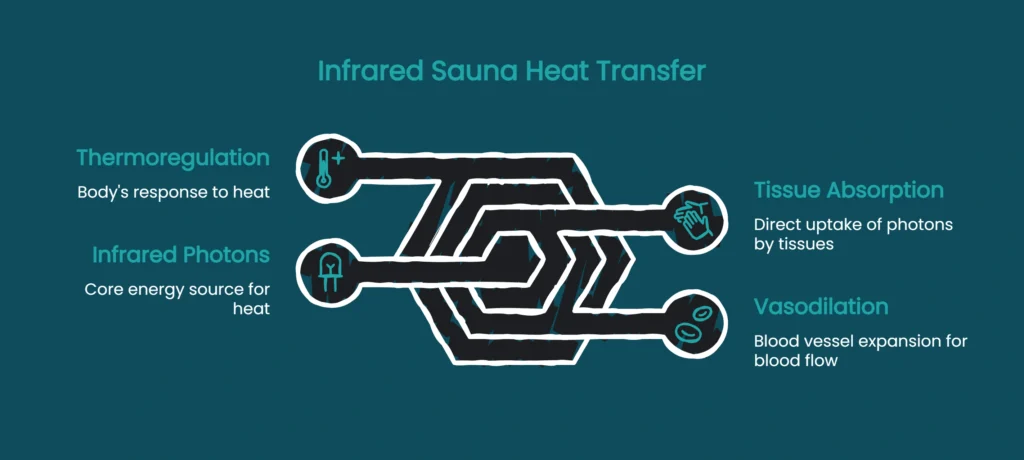
The body’s initial response to infrared exposure begins within seconds of light absorption. Infrared photons pass through the skin and are absorbed by water molecules and cellular chromophores (light-absorbing molecules), converting light energy into heat at the tissue level.
This immediate warming triggers vasodilation (blood vessel expansion), increases local blood flow, and initiates thermoregulatory signaling in the nervous system. Unlike air-based heat, these early responses occur without requiring the surrounding environment to reach extreme temperatures. The depth of penetration and specific cellular targets depend on the wavelength type, which determines the initial biological cascade.
The Cellular Chain Reaction: From Photons to Physiological Response
When infrared light penetrates tissues, a cascade of molecular and cellular events occurs. This is not passive warming; it’s an active biological process that engages the body’s innate mechanisms.
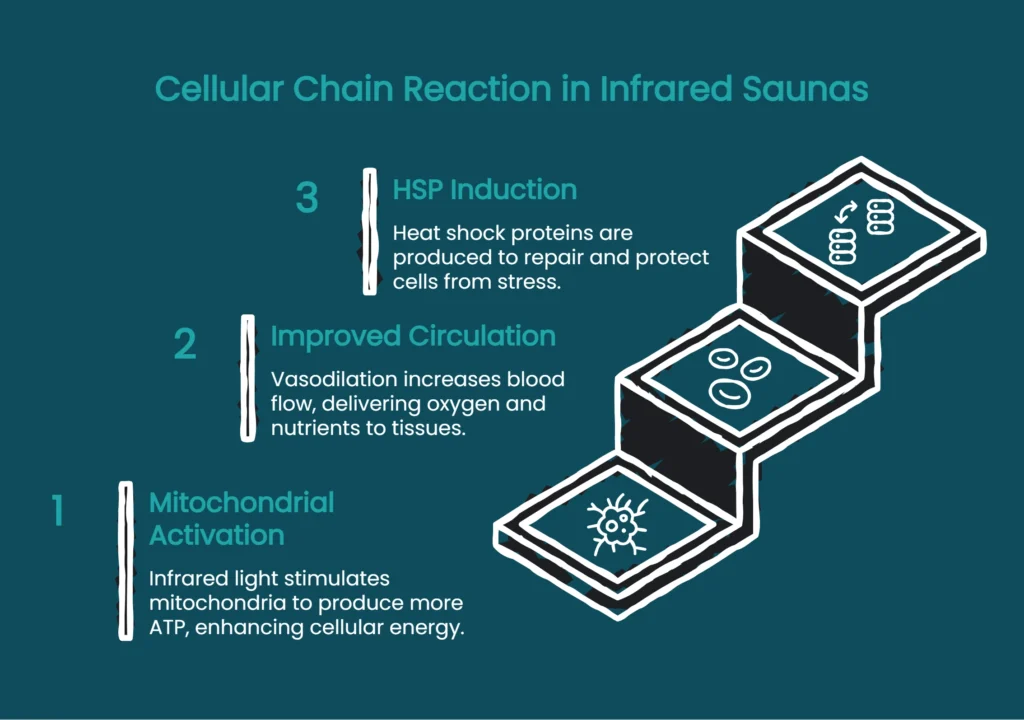
Mitochondrial Activation and Energy Production
Your cells contain mitochondria—tiny organelles responsible for producing adenosine triphosphate (ATP), the body’s primary energy currency. The primary absorption site for infrared light in cells is the mitochondria, specifically through cytochrome c oxidase, where light exposure has been studied in relation to enhanced cellular activity and ATP production.
When photons of near-infrared light interact with this enzyme, they may help facilitate the process of cellular respiration, potentially supporting more efficient energy production. This process, often referred to as photobiomodulation (PBM) or light therapy, is a mechanism studied in full-spectrum infrared saunas. By potentially stimulating mitochondria to produce more ATP, cells may have more energy available for repair and regeneration functions.
Improved Circulation Through Vasodilation
As infrared energy is absorbed and converted to heat within tissues, the body responds similarly to how it would during physical activity. Core body temperature begins to rise, and the circulatory system activates to manage this internal heat. Blood vessels expand in a process called vasodilation, which lowers vascular resistance and increases blood flow.
This enhanced circulation is studied for therapeutic applications. More oxygen and nutrient-rich blood can be delivered to tissues throughout the body, which has been associated with tissue healing support and muscle recovery. The process also helps transport metabolic waste products. Heat and light exposure have been studied in relation to nitric oxide release, a potent vasodilator that may contribute to cardiovascular support and circulation improvements.
The Role of Heat Shock Proteins (HSPs)
Progressive heating of the body’s core triggers an adaptive response: the production of Heat Shock Proteins (HSPs). These are specialized proteins that cells produce in response to stress, including thermal stress. HSPs act like molecular chaperones, helping to repair misfolded or damaged proteins within cells and protecting them from damage.
The induction of HSPs has been studied in relation to immune system support and cellular longevity. By creating controlled, mild thermal stress, an infrared sauna session may activate cellular defense mechanisms, supporting their resilience over time. This controlled hormetic stress (beneficial low-dose stress) is studied as a wellness tool.
Why Lower Temperatures Produce Deeper Physiological Effects
One of the most counter-intuitive aspects of infrared saunas is that they operate at significantly lower temperatures than traditional counterparts. A traditional Finnish sauna might run anywhere from 180°F to 220°F (82°C to 104°C). An infrared sauna, by contrast, typically operates in a range of 120°F to 150°F (49°C to 65°C).
How can a lower temperature produce substantial effects? The answer lies in radiant heat efficiency. Because infrared energy heats your body directly, it can induce vigorous sweating at lower ambient temperatures. You are warming from the inside out, raising core body temperature more effectively than by sitting in hot air. This means you can achieve deep sweating and elevated core temperature without enduring oppressively hot ambient conditions.
This “gentle heat, deep impact” approach makes infrared saunas accessible to a wider range of people, including those who may find traditional sauna heat intolerable. The lower cardiovascular strain also makes it suitable for individuals focused on heart health support. Some research has studied infrared saunas in relation to chronic health conditions, finding associations with benefits for high blood pressure, heart failure, and arthritis markers.
This also explains why certain traditional sauna guidelines don’t apply. The “rule of 200” suggests that the sum of ambient temperature (in Fahrenheit) and humidity percentage should not exceed 200 for traditional sauna safety. In an infrared sauna, where air temperature is secondary to radiant energy absorbed by your body, this rule is irrelevant. The focus is on the body’s internal response, not external environmental conditions.
Decoding the Spectrum: Differentiating Near, Mid, and Far Infrared
Not all infrared light is created equal. The term “infrared” covers a wide range of wavelengths, and the specific effects of an infrared sauna depend on which parts of the spectrum its heaters produce. A high-quality, full-spectrum sauna utilizes heaters that emit near, mid, and far infrared waves, each targeting the body in distinct ways.
Near-Infrared (NIR): 700-1,400 nm
With the shortest wavelength, near-infrared light has the shallowest penetration depth, primarily interacting with the skin’s surface layers (2-3 millimeters deep). Its primary mechanism is through photobiomodulation, potentially stimulating mitochondrial energy production.
Studied effects:
- Skin health: NIR has been studied in relation to collagen production and elastin, which may support skin tone and reduce visible signs of aging
- Wound healing: By potentially boosting cellular energy (ATP) and increasing circulation to skin’s surface, NIR has been associated with wound healing support
- Surface pain relief: May provide targeted support for surface-level discomfort and inflammation
A sauna with strong NIR output is often chosen by those focused on skin health and surface tissue support.
Mid-Infrared (MIR): 1,400-3,000 nm
Mid-infrared wavelengths penetrate deeper into the body’s soft tissues (10-15 millimeters), where they are studied for effects on blood vessel expansion and circulation enhancement.
Studied effects:
- Muscle recovery: Increased blood flow delivers more oxygen to fatigued muscles, which has been studied in relation to repair support and delayed onset muscle soreness (DOMS) reduction
- Pain support: MIR has been studied for inflammation associated with joint discomfort and injuries, potentially providing temporary relief from arthritis-related discomfort
- Flexibility: Gentle heat may help relax muscles and connective tissues
Athletes or individuals dealing with chronic discomfort often seek saunas offering dedicated mid-infrared programs.
Far-Infrared (FIR): 3,000 nm-1 mm
Far-infrared is the longest wavelength and penetrates most deeply into the body (up to 40 millimeters). This wavelength is most associated with classic infrared sauna effects: deep sweating and cardiovascular responses. FIR’s frequency closely matches the resonant frequency of water molecules in our bodies. When FIR waves are absorbed, they cause these water molecules to vibrate.
This vibration generates heat from the inside out, effectively raising core body temperature. This internal heating triggers profuse sweating. The liver and kidneys remain the body’s primary detoxification organs; sweat represents a minor elimination pathway composed primarily of water and electrolytes.
Studied effects:
- Deep sweating responses: By raising core body temperature efficiently, FIR promotes sweating that supports the body’s natural thermoregulatory processes
- Cardiovascular responses: The effort your body makes to cool itself—increasing heart rate and blood flow—has been studied as a form of passive cardiovascular stimulus. Regular FIR sauna use has been studied in relation to circulation support and blood pressure regulation
- Stress reduction: The deep, gentle warmth of FIR may support relaxation, which has been studied in relation to cortisol regulation and well-being
- Inflammation markers: In a six-month wellness study that included infrared sauna therapy, participants exhibited a significant decrease in the inflammatory biomarker hsCRP by an average of -1.75 mg/L.
Heaters designed for optimal FIR output, such as those made from carbon or certain ceramics, are valued for their high emissivity—their ability to efficiently radiate this deeply penetrating energy.
Infrared vs Traditional Sauna: Key Mechanism Differences
| Factor | Infrared Sauna | Traditional Sauna |
| Heat delivery method | Radiant heat (light absorption in tissues) | Convective heating (hot air warms body) |
| Operating temperature | 120-150°F (49-65°C) | 180-220°F (82-104°C) |
| Primary mechanisms | Photon absorption, photobiomodulation, thermoregulation | Thermoregulation via ambient heat |
| Wavelength specificity | Can target NIR (skin), MIR (muscle), FIR (deep tissue) | No wavelength targeting |
| Cardiovascular load | Lower strain due to moderate temps | Higher strain due to extreme temps |
| Session duration | 20-45 minutes typical | 10-20 minutes typical |
| Accessibility | More tolerable for heat-sensitive individuals | May be uncomfortable for some |
Frequently Asked Questions
How does the infrared sauna work scientifically?
An infrared sauna works by emitting photons of light within the infrared spectrum. These photons travel through air and penetrate the body’s tissues. This light energy is absorbed by molecules in the body, particularly water and chromophores like cytochrome c oxidase within mitochondria. This absorption causes molecules to vibrate and release energy as heat, warming the body from within. This internal heating triggers physiological responses including vasodilation, increased heart rate, heat shock protein release, and deep sweating.
Can infrared pass through body tissue?
Yes. This is the fundamental principle of infrared therapy effectiveness. The ability of infrared light to pass through tissue is called tissue penetration, though penetration depth depends on wavelength. Near-infrared (NIR) penetrates 2-3mm, affecting epidermis and dermis. Mid-infrared (MIR) penetrates 10-15mm into soft tissues like muscles. Far-infrared (FIR) penetrates deepest (up to 40mm), reaching subcutaneous layers and promoting core heating effects.
How does infrared affect living tissue?
Infrared light affects living tissue through thermal and non-thermal mechanisms. The thermal effect is heat produced when light energy is absorbed, leading to increased circulation, muscle relaxation, and sweating. The non-thermal effect, most prominent with near-infrared light, is photobiomodulation—where light energy may directly influence cellular processes without significant heating. This has been studied in relation to mitochondrial function support, ATP production, and collagen stimulation.
What is the rule of 200 in a sauna?
The “rule of 200” is a guideline for traditional Finnish saunas stating that the sum of ambient air temperature in Fahrenheit and relative humidity percentage should ideally not exceed 200 (e.g., 180°F with 20% humidity). This rule measures comfort and safety in extreme ambient heat environments. This rule is entirely irrelevant for infrared saunas because the primary heating mechanism is radiant light, not hot air. Air temperature is much lower, and humidity is not typically added, so the concept doesn’t apply.
Do infrared saunas provide the same benefits as traditional saunas?
Both types trigger thermoregulatory responses (elevated heart rate, sweating, heat shock protein production), but through different mechanisms. Traditional saunas have the most robust long-term evidence from Finnish population studies. Infrared saunas add photobiomodulation mechanisms and allow longer sessions at lower temperatures. They complement each other rather than replace one another.
How long does it take for an infrared sauna to work?
Physiological responses begin within seconds of infrared light absorption. Vasodilation occurs within 1-2 minutes, sweating typically begins within 5-10 minutes, and core temperature elevation continues throughout a 20-45 minute session. Cellular effects like heat shock protein production accumulate over the session duration.
Why Infrared Heat Produces Different Biological Responses Than Hot Air
Infrared saunas differ from traditional heat exposure not because they are “hotter,” but because they deliver energy through light rather than air. This distinction changes how heat is absorbed, how deeply tissues warm, and how cells respond to thermal stress.
When infrared photons are absorbed by tissue, they generate heat internally rather than relying on surface warming. This alters thermoregulation patterns, circulation responses, mitochondrial activity, and the production of protective cellular proteins. The result is a physiological response that can occur at lower ambient temperatures while still engaging many of the same adaptive pathways associated with heat exposure.
Understanding this mechanism clarifies why infrared sauna use feels different, operates differently, and produces distinct biological effects compared to conventional saunas. Rather than replacing traditional heat therapy, infrared saunas represent a complementary approach—one that emphasizes targeted energy delivery, wavelength-specific tissue interaction, and controlled physiological stress.
The sophisticated interplay between light wavelengths, tissue absorption, and cellular responses transforms what seems like simple “heat therapy” into a nuanced biological intervention. By delivering specific frequencies of electromagnetic energy to precise tissue depths, infrared technology allows for therapeutic effects that hot air alone cannot achieve.
For detailed guidance on choosing between infrared wavelength types, safety considerations, and evidence-based health applications, visit https://www.saunahealthnut.com.
Medical Disclaimer: This article provides educational information about infrared sauna safety and is not intended as medical advice. The content should not be used to diagnose, treat, cure, or prevent any medical condition. Individual responses to heat therapy vary based on health status, medications, and underlying conditions. Always consult with a qualified healthcare provider before beginning infrared sauna use, especially if you have cardiovascular disease, are pregnant, take prescription medications, or have any chronic health conditions. The information presented here is for educational purposes only and does not replace professional medical guidance.